The Spirit
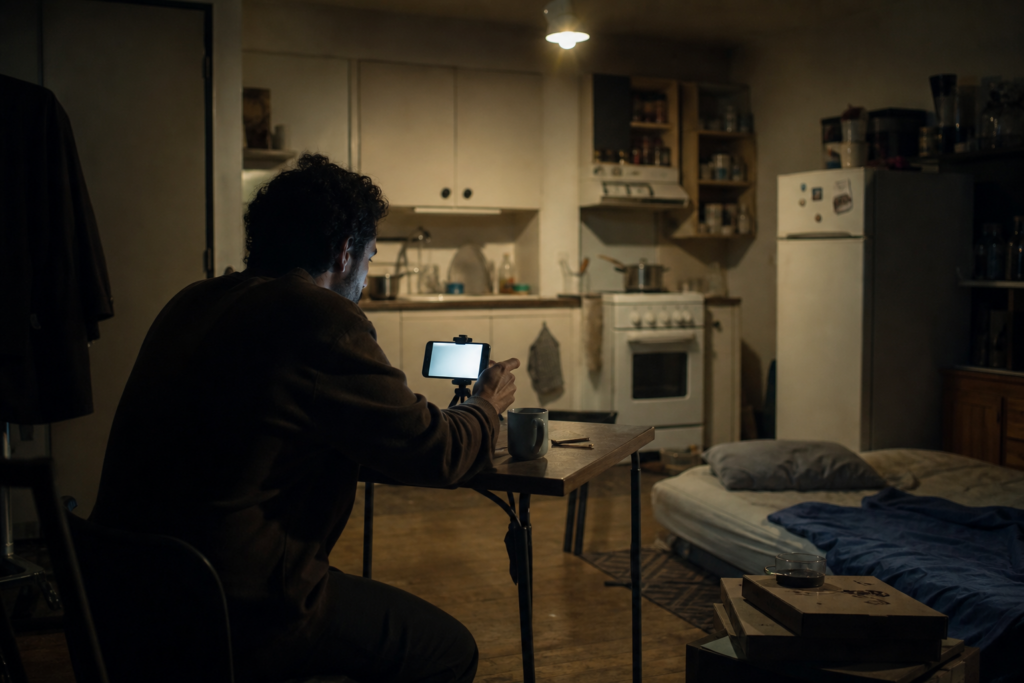
Nobody remembered the first video.
Not even him.
Years later, people would analyze it frame by frame.
Scholars would write books about the faded painting on the wall behind him.
Followers would insist the flickering kitchen light symbolized humanity awakening.
Conspiracy theorists would argue the upload date had been manipulated.
Someone would eventually claim to own the coffee mug visible in the bottom corner of the frame.
Nobody noticed it that Tuesday afternoon.
Least of all Elias.
He uploaded it because he couldn’t sleep.
The apartment was silent except for the refrigerator, which possessed a dying compressor and the determination of an old jazz musician refusing retirement.
His mattress lay directly on the floor.
A blue beach towel covered the stained fabric because fitted sheets had become one of those problems tomorrow kept inheriting.
Three pizza boxes stood against the wall.
Not because he was particularly untidy.
Because throwing them away required leaving the apartment.
Some days that was simply too ambitious.
His name was Elias Vale. He was thirty-two years old and worked in the basement of the municipal records office, converting the complaints of dead citizens into searchable text.
The dead citizens had not been dead when they complained. They had called about broken streetlights, wet ceilings, rats, parking fines, benefit decisions, fallen branches, and noises in adjoining walls. The city had recorded them for quality assurance and forgotten them for administrative convenience. A modernization grant had now made the forgotten voices valuable.
Elias wore headphones six hours a day and typed what they said.
There is water coming through the light fixture.
My husband cannot manage the stairs anymore.
I know this is not your department, but nobody will tell me whose department it is.
He removed names, corrected dates, assigned categories. URGENT. NON-URGENT. DUPLICATE. UNRESOLVED. The software suggested emotional labels as well. ANGER. CONFUSION. THREAT. The software was confident about anger and less competent with grief.
Elias had once wanted to restore paintings. At nineteen he had enrolled in conservation school and learned that cleaning a canvas was not the same as making it new. The point was to remove what time had placed upon the work without removing time itself. He liked the discipline of that. He liked that good restoration was almost invisible.
Then his father became ill.
Then tuition became rent.
Then temporary work acquired dental insurance and the authority of permanence.
The faded painting behind him in the first video was his only completed copy: a small harbor after Corot, painted badly at twenty-one and kept because his father had called the water convincing.
His father had been a bus mechanic. He trusted torque specifications, labeled every drawer in the garage, and regarded metaphor as a failure of maintenance. When cancer entered his liver, he spoke about it as though somebody had installed the wrong part.
“They’ll sort it,” he said.
They did not.
Elias’s younger sister Nora did most of the practical work. She spoke to doctors, learned medication schedules, argued with insurers, and placed absorbent pads beneath their father with such matter-of-fact tenderness that embarrassment had no room to grow. Elias brought books their father did not read and sat beside the bed thinking of things he would say later.
Later became one of the family’s more crowded rooms.
After the funeral, Nora returned to nursing school. Elias stopped painting. Neither decision was announced.
They remained close in the way siblings sometimes remain close after surviving the same weather in different shelters. Nora called every Sunday. Elias answered most Sundays. She asked whether he had eaten. He asked whether she was sleeping. Each lied according to specialty.
On the Tuesday of the first video, she had left him three messages.
The first concerned their mother’s leaking roof.
The second concerned the fact that Elias had not returned the first.
The third said only, “I know you’re awake.”
He was.
He had been awake for thirty-one hours, listening in his mind to a complaint he had transcribed that morning. An old woman had called the city because the apartment above hers had been empty for months, but every night she heard a chair move across the floor.
The operator told her empty apartments did not move furniture.
“I know,” the woman said. “That is why I am calling.”
The complaint was coded NON-URGENT.
Elias did not believe in ghosts. He believed in pipes, animals, memory, and neighbors who entered places they did not own. Still, the woman’s voice stayed with him. It contained fear, but also embarrassment at having fear. The embarrassment seemed worse.
He opened the laptop.
Clicked Record.
Looked at himself.
Immediately hated his face.
Deleted the recording.
Started again.
“Hello.”
Too cheerful.
Delete.
“This probably won’t interest anyone.”
Too pathetic.
Delete.
He sighed.
Started a fourth time.
“Sometimes I think…”
Long pause.
“…we’re all pretending to know what we’re doing.”
Silence.
“I don’t.”
Another silence.
“I just thought somebody else might need to hear that today.”
He reached forward.
Stopped the recording.
Uploaded it without watching it.
Then he made coffee.
It received fourteen views.
Four belonged to him.
Two belonged to his mother.
One was almost certainly an accident.
He never expected another.
⸻
The second video came six days later.
Nora had called during her break. Behind her voice came the alarms and rubber wheels of the emergency department.
“You look terrible,” she said.
“It’s audio.”
“I can hear your face.”
He told her the records office had eliminated twelve positions. His was not one of them. He felt guilty about the relief and resentful of the guilt.
“That seems normal,” Nora said.
“Which part?”
“All of it.”
After they hung up, Elias recorded a video about relief.
“Sometimes the good news is only that the bad thing happened to somebody else,” he said. “You don’t have to pretend that makes you noble. Maybe just notice the debt.”
He uploaded it, took the pizza boxes downstairs, and bought fitted sheets.
The video received eighty-seven views.
The third received forty-one.
The fourth received nine hundred because a woman in Leeds included it in a post about surviving redundancy. Elias watched the number rise during lunch while a dead man complained in his headphones about a sycamore blocking the afternoon light.
He recorded when he could not sleep, which was often. He spoke about ordinary moral failures: postponing a difficult call until it became cruelty, enjoying praise one had not earned, resenting the sick for requiring patience, mistaking exhaustion for insight. He never offered solutions. Solutions seemed indecent when the problem was another person.
The strange thing wasn’t that people watched.
The strange thing was why they stayed.
There were no dramatic speeches.
No music.
No expensive cameras.
No perfect lighting.
He simply spoke the way lonely people think.
As though the conversation had already begun long before anyone arrived.
Months passed.
Then one comment appeared.
I haven’t slept for weeks.
Tonight I did.
Thank you.
Elias stared at it.
He smiled.
Then frowned.
Because he hadn’t done anything.
The second comment arrived the following morning.
I didn’t drink today.
The third:
I finally called my sister.
The fourth:
You remind me that I’m still human.
He answered every one.
Usually with the same sentence.
“I’m glad you’re okay.
Please don’t give me credit.”
Nora found the channel when a paramedic showed her a video during a night shift.
“Isn’t this your brother?”
The video was called WHAT WE OWE THE PEOPLE WE AVOID. The thumbnail showed Elias reaching to stop the recording, mouth half open, eyes lowered. He looked like a saint attempting to fix a webcam.
Nora called him at four in the morning.
“You have thirty thousand followers.”
“Subscribers.”
“That correction is the most disturbing part.”
He said it had happened gradually.
“Thirty thousand is not gradual. Thirty thousand is a municipality.”
“Nobody is making them watch.”
“I know.”
She paused.
“You’re good at it.”
Elias waited for the joke.
It did not come.
“At what?”
“Leaving room.”
He thought about the calls in the basement. Operators filled silence because their performance was measured. Long pauses damaged completion times. People learned to compress fear into categories because someone at the other end was waiting to close the case.
“I don’t know what I’m doing,” he said.
“That may be the room.”
This was the first sentence anyone said about the videos that frightened him.
It was also the sentence he remembered most.
⸻
The rise, when it came, did not feel like rising.
It felt like additional correspondence.
At fifty thousand subscribers, people asked for reading lists.
At one hundred thousand, they sent manuscripts, medical histories, confessions, poems, photographs of scars, and audio messages recorded in parked cars.
At two hundred thousand, a stationery company offered him money to endorse a journal with PLEASE DON’T GIVE ME CREDIT embossed in gold on the cover.
He declined.
The company produced an unofficial version in silver.
At three hundred thousand, the records office asked him to deliver a lunchtime seminar on authentic communication. The deputy director introduced him beneath a screen displaying quarterly complaint-resolution metrics.
Elias spoke for twelve minutes about listening.
The staff listened politely.
The next week management replaced the phrase CUSTOMER CASE CLOSED with CITIZEN HEARD in the internal software. Nothing else changed.
His supervisor congratulated him.
“Language matters,” she said.
Elias agreed.
He did not say that language was sometimes what institutions changed when they wished to preserve everything underneath it.
A small agency called Sincere contacted him. The founder, Dana Kroll, met him in a café and ordered hot water with lemon, a drink that suggested both illness and discipline.
Dana had represented chefs, neuroscientists, an architect who lived without right angles, and a former finance minister whose podcast concerned humility. She wore no visible brand and possessed a watch whose price could have funded Elias’s conservation degree.
“I don’t want to make you famous,” she said.
“That’s fortunate.”
“You already are.”
She explained that fame was not an achievement but a liability class. People would quote him inaccurately, use his image, sell his words, impersonate him, invite him, denounce him, and eventually accuse him of failing to prevent events he had never imagined.
“You need structure.”
“I need them to stop sending photographs of their wounds.”
“That is structure.”
Dana helped hire two moderators and a lawyer. She removed his home address from three websites. She persuaded the platform to close forty-seven fraudulent accounts, including one that offered personal absolution for twelve dollars a month.
She also suggested a weekly release schedule.
“No.”
“People do better with consistency.”
“Television does better with consistency.”
“People invented television.”
He disliked her competence because he needed it.
Nora disliked her on principle, then revised the dislike after Dana arranged private security for their mother when strangers began leaving candles outside her house.
“She is useful,” Nora admitted.
“That sounded painful.”
“It was.”
Sincere leased Elias a small studio. He used it once. The soundproof walls made every pause feel manufactured. He returned to the apartment, where the refrigerator had finally died and been replaced by a quieter model that viewers accused of damaging the atmosphere.
He continued working at the records office until a reporter appeared in the basement asking colleagues whether Elias had shown signs of spiritual leadership before his emergence.
His supervisor asked him to resign for his own protection.
The city described the departure as mutual.
Elias described it as Thursday.
Without the office, time lost its categories. He walked in the mornings. He began painting again, then stopped when viewers identified a wet canvas behind him and offered interpretations before the paint had dried.
Nora came on Sundays with groceries and refused to discuss metrics.
She had married a geography teacher named Samir, though Elias still thought of the marriage as recent after four years. Their daughter, June, was six and believed her uncle worked inside the telephone.
June drew him with extremely long arms.
“Why are they like that?” Elias asked.
“Everybody keeps pulling you.”
The drawing disturbed him sufficiently that he placed it on the refrigerator.
⸻
The first Listening House began in a church basement in Leeds.
Its founder, Amara Bell, had written the comment about finally calling her sister. She was a social worker who had spent fifteen years moving people through systems designed to confirm eligibility for help before providing it. After her own breakdown, she began holding a Wednesday evening gathering with two rules: nobody had to speak, and nobody could give advice unless asked.
Seven people attended the first night.
One was recently widowed. One cared for a son with a brain injury. Two were students. One had left prison. One was not sure why he had come. The seventh made tea.
They sat in a circle and did very little.
It helped.
Within six months, the group had found temporary housing for three families, accompanied dozens of people to medical and benefits appointments, and created a night rota for a man whose wife was dying at home. They did not call these achievements. They called them things that needed doing.
Amara asked Elias to visit.
He refused twice and accepted the third time because Nora said refusing forever was another method of control.
The church basement smelled of dust, instant coffee, and damp coats. There was no stage. Elias sat in the circle. A man named Peter spoke about the silence after his wife’s death.
“People keep trying to remove it,” Peter said. “As if silence is the symptom.”
Elias listened.
Afterward, Amara showed him a cupboard of donated food and a spreadsheet of volunteers.
“Your videos did this,” she said.
“You did this.”
“Both can be true.”
He wanted to argue. The cupboard made argument feel vain.
That night he recorded a video called THE DIFFERENCE BETWEEN CREDIT AND RESPONSIBILITY.
“You may not deserve credit for the good somebody makes from your words,” he said. “That doesn’t mean you have no responsibility for what happens next.”
The sentence was careful.
It was also impossible.
Within a year there were eighty Listening Houses. Some occupied libraries, mosques, union halls, clinics, cafés after closing, and private living rooms. Several employed licensed counselors. Most did not. They distributed food, arranged childcare, paid electricity bills, visited prisons, sat beside hospital beds, and occasionally saved lives in ways no study could isolate.
Nora volunteered at one near the hospital.
She distrusted its name and trusted the people.
“They notice who disappears,” she told Elias. “Hospitals are not always good at that.”
He visited quietly. A retired accountant helped a delivery driver challenge an unlawful deduction. Two teenagers taught an elderly woman to use the video-calling app through which her grandchildren had been apologizing for their absence. A man three weeks sober washed cups for an hour because it was the first useful thing anyone had asked him to do.
Elias understood then why the comments had frightened him.
It was easier to believe he had done nothing.
Nothing required no answer.
⸻
The first article to call it a movement appeared in a business magazine.
THE HUMILITY ECONOMY, the headline said.
The accompanying illustration showed Elias with closed eyes, surrounded by arrows indicating REACH, TRUST, CONVERSION, and COMMUNITY RETENTION. Dana framed it as a joke and placed it in the Sincere office. Elias asked her to take it down. She moved it to the corridor.
Universities established centers for reciprocal listening. Corporations trained senior managers to begin difficult announcements by confessing uncertainty. A bank used a quotation from Elias in an advertisement about flexible mortgages.
We’re all pretending to know what we’re doing.
Below it, in smaller type:
Let’s pretend together.
Elias’s lawyer sent a letter.
The bank removed the advertisement and donated to six Listening Houses. Both actions appeared in its annual responsibility report.
The movement had no membership, which made estimates attractive. Journalists counted subscribers. Researchers counted people who watched more than seven minutes. Political consultants counted those who had shared a quotation within thirty days of voting. Depending on the definition, the movement contained between eleven million and nearly half the connected world.
By then the replies had multiplied beyond answering.
Followers quoted his old sentence everywhere.
PLEASE DON’T GIVE ME CREDIT.
Within a year it appeared on T-shirts.
The official foundation sold a version too.
That decision began with a boiler.
The Leeds Listening House lost heat in January. Amara refused money from a clothing company whose factories were under investigation. Dana said principles were easier to maintain in buildings with functioning pipes. Nora said children were using the basement after school and could not wear principles as coats.
They created a foundation with a board, an ethics charter, and merchandise certified by a labor organization whose certification process required its own investigation.
Elias signed the papers.
The shirts paid for the boiler, three counselors, a legal clinic, and a van used to bring food to elderly residents during a flood.
They also paid Sincere eight percent.
“You can’t make goodness clean by making it poor,” Dana told him.
“I didn’t say that.”
“No. You implied it with your face.”
Nora joined the foundation’s clinical advisory committee. She argued for referral standards, safeguarding policies, and a sentence printed at the entrance of every Listening House: THIS IS NOT EMERGENCY OR MEDICAL CARE.
Some organizers objected.
“A warning changes the space,” Amara said.
“So does a death,” Nora replied.
The sentence was adopted.
In photographs it was usually cropped out.
Elias traveled because refusing invitations had begun to harm people he claimed to respect. He opened a Listening House in Johannesburg, sat with bereaved parents in Osaka, visited a prison library in São Paulo, and spoke at a refugee center in Athens where a twelve-year-old boy asked whether grown men were allowed to cry if their fathers could not see them.
“They are allowed to cry even if everyone can see them,” Elias said.
The boy considered this.
“That sounds dangerous.”
“It can be.”
The exchange was viewed eighty million times.
For several months, boys around the world posted videos of themselves crying. Some were sincere. Some were advertisements for skin-care products. Most were both in proportions unavailable to science.
Genuine good kept ruining Elias’s suspicion.
A suicide-prevention service reported increased calls after one of his videos. A school district replaced automatic suspensions with mediated meetings. A group of widowers who had met in a comment thread began cooking for one another every Thursday. During a heat wave, followers created an address map of residents living alone; public-health officials later estimated that it had prevented dozens of deaths.
The movement did not merely admire compassion.
Sometimes it performed it.
This made criticism more difficult and more necessary.
When Elias said as much in a video, the foundation used the sentence in its fundraising campaign.
He stopped replying.
That became proof of wisdom.
He apologized for not understanding life.
People called it profound humility.
He admitted uncertainty.
Followers described it as certainty beyond language.
Every attempt to become smaller made him larger.
⸻
Nora remained the only person who could make him take out the recycling during a theological controversy.
She came to the apartment one Sunday carrying tomatoes, bread, and a printed transcript of his latest video.
“You said diagnosis can become a room people are locked inside.”
“It can.”
“You also said a name can be a door.”
“Four minutes later.”
“Nobody clips four minutes later.”
Elias cut the tomatoes. His knife was blunt. Nora took it from him, sharpened it against the underside of a ceramic bowl, and returned it.
“What do you want me to do?”
“Remember that some people listen as if you’re giving permission.”
“I say I’m not.”
“Permission doesn’t require the speaker’s consent.”
He looked at the transcript. The words seemed more assertive in print. Speech contained breath, hesitation, the face that had not decided. Text stood upright.
“Should I stop?” he asked.
Nora sliced the bread.
“Would that help?”
“I don’t know.”
“I know.”
He waited.
“It wouldn’t.”
They ate by the window. Across the street, a man photographed the building and pretended to photograph a tree.
Nora spoke about June, who was now nine and refusing to attend school because classmates asked whether her uncle could read thoughts. Samir wanted to move. Nora did not. Their mother enjoyed the candles outside her house until someone began stealing them.
“You could tell me to stop,” Elias said.
“You’d stop for a while. Then strangers would interpret your silence. I’m not interested in becoming the secret sister who controls The Spirit.”
“Don’t call me that.”
“I’m quoting the frightened parents at school.”
The name had begun as mockery on a late-night program. The host played a slow-motion clip of Elias drinking water and added celestial music.
“Behold,” he said, “The Spirit hydrates.”
Within a week admirers had adopted the insult. They said spirit did not mean ghost or prophet. It meant the invisible thing created between people when they paid attention. The explanation was reasonable, which made the name harder to oppose.
By the fifth year they called him The Spirit.
He hated the name.
“I’m not a spirit.”
They applauded.
“I am just a man.”
People cried.
“You already know everything I know.”
The applause lasted six minutes.
His words no longer belonged to him.
They belonged to whoever heard them.
Television wanted interviews.
He refused.
The refusal became front-page news.
Governments invited him.
He declined.
The decline was interpreted as moral purity.
Religious leaders criticized him.
Their congregations watched his videos in secret.
He never asked anyone to follow him.
Millions did anyway.
⸻
Politics arrived first as gratitude.
A mayor thanked the Listening Houses for sheltering people during a transit strike. A minister praised their contribution to national resilience. An opposition leader quoted Elias while proposing expanded mental-health funding. The funding passed. It was less than requested and more than expected.
Elias recorded a cautious message welcoming the law and warning that mutual aid should not become an excuse for public abandonment.
The government posted the first half.
The opposition posted the second.
Both thanked him.
During an election year, candidates began competing to embody uncertainty. One admitted he did not have all the answers, then delivered a forty-two-page program proving he had most of them. Another held listening rallies where audience questions were screened by a communications team. A nationalist party printed WE ARE STILL HUMAN above photographs of the border. A coalition supporting migrants used the same words below photographs of children behind fencing.
Elias objected to both uses.
Each side circulated the objection addressed to the other.
Dana hired a policy director. The foundation adopted rules against endorsements. Then it discovered that neutrality was interpreted as endorsement by whichever side benefited from delay.
“There is no outside,” Dana said during a board meeting.
“There has to be,” Elias said.
“Outside is a position with poor lighting.”
Amara wanted the foundation to denounce the government’s detention policy. A board member from the business community warned that half their institutional funding would disappear. Nora wanted the statement to describe medical consequences and name evidence. Younger organizers said evidence had become a ritual by which comfortable people postponed courage.
All of them had reasons.
Nobody was pretending to know what they were doing anymore.
That worried Elias most.
He issued a statement in his own name:
No person becomes less human because a government finds their humanity administratively inconvenient.
The sentence appeared on banners, court filings, church bulletins, and the side of a bus. Donations doubled. Three corporate sponsors withdrew. A private donor replaced them anonymously and was later revealed to own detention-service contracts through a subsidiary.
Dana offered to resign.
“Did you know?” Elias asked.
“No.”
“Would you have taken it if you did?”
She looked at him for a long time.
“Five years ago, no. Last winter, when the shelters were full?”
She removed her glasses.
“I don’t know.”
It was the first time Elias trusted her completely.
She stayed.
⸻
Julian Mercer was twenty-three when he came to the North Quay Listening House.
He had studied engineering for two years, left university after a psychotic episode, and spent eleven months moving between his mother’s flat, an inpatient ward, temporary work, and a supported-housing program he described as a place where every door knew it was a door.
He was funny, suspicious of kindness, and good at repairing electrical appliances. At North Quay he fixed a kettle nobody had unplugged despite the fact that it delivered small shocks.
Nora met him twice.
The first time he asked whether she was there to assess him.
“No.”
“That sounds like something an assessor says before assessing the quality of your reaction.”
“I’m Elias’s sister.”
Julian laughed.
“That sounds worse.”
He took medication inconsistently. It made his hands shake and his thoughts, he said, arrive wearing heavy shoes. He also knew it helped him sleep. He did not romanticize illness. He wanted treatment that felt less like surrender.
North Quay tried to help him find it.
Its coordinator, Safiya Dunn, was a former occupational therapist who had left public practice after fifteen years. She accompanied Julian to appointments. She argued successfully for a medication review. She helped his mother secure housing support. She and Julian fought often about risk and remained fond of each other.
Then a clipped section of Elias’s video about diagnosis began circulating.
A name can become a room people are locked inside.
Someone added music. Someone else added images of locked hospital doors. Julian posted it with the words I AM LEAVING THE ROOM.
Elias never saw the post.
Nora did, three days later, and called Safiya.
“He stopped taking everything,” Safiya said. “We’re working on it.”
“Does his psychiatrist know?”
“Julian asked us not to call.”
“He may be becoming unwell.”
“He is also an adult who has been ignored every time he describes what treatment does to him.”
Both statements were true.
Truth did not make them compatible.
That Friday Julian arrived at North Quay after midnight. The House was officially closed, but Safiya and two volunteers were preparing food parcels. Julian had not slept in four days. He believed a local radio tower was translating private grief into weather reports. He was frightened and lucid about being frightened.
He asked them not to call emergency services.
The last time police had taken him to hospital, he had been restrained face down. Safiya had seen the bruises.
They sat with him.
They made tea.
They listened.
For a while, it worked.
At three in the morning Julian became calmer. At four he asked to stand outside in the rain. A volunteer went with him. At four twelve he ran.
North Quay stood between warehouses and an elevated roadway beside the river. Julian climbed a maintenance stairway to the roadway. Safiya followed far enough to keep him in sight and not far enough to make him flee. She called emergency services then.
He crossed the barrier before they arrived.
Whether he meant to jump was disputed.
His mother said he was trying to escape the people following him.
The coroner said intention could not be determined.
The newspapers said a follower of The Spirit had died after rejecting medical treatment.
The sentence was not false.
It was not the truth either.
⸻
Elias learned about Julian from Nora.
She came to his apartment before dawn. He knew something had happened because she used her key.
“Was he alone?” Elias asked.
“No.”
“Did he see the video?”
“Yes.”
“Did he stop because of it?”
“I don’t know.”
“You think he did.”
“I think he used it to say something he already needed to say.”
Elias sat on the mattress, which by then rested on a proper frame. Public mythology preferred the floor and continued to describe it that way.
“I said a name can be a door.”
“Later.”
“I said treatment can save people.”
“Later.”
“How much later?”
“Four minutes.”
He laughed once. It sounded like a cough.
“Four minutes.”
Nora sat beside him.
“This is not all yours.”
“How much is?”
“I don’t know.”
“That’s becoming a very expensive sentence.”
She looked at him sharply, then nodded.
“Yes.”
Julian’s mother asked the foundation not to use his death in any statement. The foundation respected the request for six hours, until reporters published his name.
Elias recorded a video and deleted it.
He recorded another and sent it to Nora.
“You are making yourself the center,” she said.
He deleted that one too.
The final statement was written by lawyers, clinicians, organizers, Dana, and Elias. It affirmed the value of medical care, acknowledged the failures that made people fear it, promised an independent review, and expressed grief without claiming a grief the family had not given them.
Nobody liked it.
That was considered evidence of balance.
North Quay closed during the investigation. Two people who relied on its food parcels lost electricity. Safiya received death threats and messages thanking her for resisting psychiatric violence. Julian’s mother received requests for interviews, donations, and proof that she was really his mother.
The independent review found failures in training, escalation, overnight staffing, clinical coordination, and documentation. It also found that Safiya and the volunteers had acted with care in circumstances shaped by a legitimate fear of coercion. Emergency services acknowledged that their previous treatment of Julian had contributed to his refusal.
Every faction quoted the paragraph that absolved it.
Elias attended the inquest and sat behind Julian’s mother. She did not look at him until the final day.
Outside the court she said, “He liked you.”
Elias could not answer.
“That isn’t an accusation,” she said. “I don’t know what it is.”
“Neither do I.”
She studied his face as though checking it against the videos.
“He would have liked that answer.”
Then she left.
For months Elias heard accusation in her words.
Later he heard mercy.
He distrusted both interpretations.
⸻
After Julian, Elias spoke less.
The platform filled the absence with older versions of him.
Clips from the first year circulated beside clips from the fifth, allowing him to contradict himself several times before breakfast. Accounts specialized in Restorative Elias, Radical Elias, Clinical Elias, Anti-Clinical Elias, Elias Before Dana, and Elias After Corruption. A channel called The Unedited Spirit edited twelve-hour compilations.
He asked the platform to stop recommending old videos as current guidance.
The platform offered a label explaining that the content represented an evolving body of thought.
“It’s a person,” Elias said during the call.
“We understand,” the representative replied. “The label performs better with ‘body of thought.’”
Dana began finding unauthorized books in airport shops. The Spirit Method. Eleven Silences. Stop Knowing. One consisted entirely of sentences Elias had never said, translated from English into another language and then back into a more marketable English.
He sued one publisher and lost because the cover described the work as “inspired by” him. He won against another and was accused of suppressing spiritual inquiry.
The foundation changed too. It had twelve regional offices, four hundred employees, safeguarding officers, auditors, brand standards, a crisis team, and a staff wellbeing problem. It funded excellent work. It also held meetings about whether the phrase “hold space” implied ownership.
Amara left the board.
“Too many forms?” Elias asked.
“Forms are useful,” she said. “They tell you what the institution is afraid of.”
“What are we afraid of?”
“Becoming what we had to become.”
She returned to the basement in Leeds, where the boiler worked and nobody knew which donor had paid for it.
Nora also resigned from the advisory committee. The work had improved. Referral policies were stronger. Training included lessons from Julian’s death. But every disagreement now passed through communications before it reached care.
“You won,” Elias told her.
“No,” she said. “Something got better. That’s not the same.”
Their relationship survived because Nora refused the two roles available to her: keeper of the ordinary man and witness to the hidden prophet. She was simply his sister. Sometimes she defended him. Sometimes she did not answer his calls. When their mother died, Nora chose the hymns and Elias chose the coffin. The funeral was private until a mourner streamed twelve seconds of it.
The clip showed Elias placing his hand on the coffin.
Followers called it a blessing.
He had been checking whether the lid was properly closed.
That explanation was judged spiritually significant.
For the first time, Nora understood why he sometimes laughed at the worst moment. Laughter was the last small room interpretation had not fully occupied.
“You can still leave,” she told him that evening.
They sat in their mother’s kitchen among labeled boxes. KEEP. DONATE. ELIAS. NORA. Their father’s handwriting remained on jars of screws in the garage.
“Leave what?”
“Exactly.”
He opened the drawer where their mother had kept old batteries, string, birthday candles, foreign coins, and keys to locks nobody remembered.
“Do you think it would have happened without me?” he asked.
Nora did not ask what it meant.
“Not like this.”
“That isn’t an answer.”
“It’s the only one I have.”
He found the key to his father’s garage cabinet. Inside were bus manuals, rusted tools, and a newspaper clipping about Elias’s first million subscribers. His father had died years before the channel existed.
Their mother must have placed it there.
Elias sat on the concrete floor.
“He would have hated all of this,” he said.
Nora crouched beside him.
“He would have watched every video.”
That was worse.
It was also probably true.
⸻
The movement survived the scandal over Julian, the foundation split, two elections, a financial investigation that found incompetence but not theft, and the brief popularity of an opposing movement based on decisive answers.
Listening Houses separated from the central foundation. Some professionalized. Some returned to volunteer circles. Some closed. Others became clinics, kitchens, legal cooperatives, youth clubs, or ordinary places where the kettle was always on. They argued over ownership of the name until Amara placed it in a public trust.
Political wings formed and denied being wings. Religious communities incorporated Elias’s pauses into worship. Atheist groups did the same without worship. Therapists criticized the movement while referring isolated patients to its meetings. Governments funded it and monitored it. Corporations sponsored it and feared their employees might listen too carefully.
Elias’s importance diminished without reducing his fame.
This distinction was almost peaceful.
New speakers emerged. Some were wiser. Some were better on camera. Some understood policy, trauma, theology, labor, and history in ways Elias never had. A few became his friends. Others built careers explaining his failure.
He watched a young organizer named Laleh tell an audience, “Elias gave us uncertainty, but uncertainty is not a politics.”
The crowd applauded.
He agreed with her.
The following week she was criticized for betraying him.
He defended her.
She was then criticized for requiring his defense.
They met once in a railway station and apologized to each other for events neither had caused.
“You know they don’t need you anymore,” Laleh said.
“I know.”
“Does that hurt?”
“Yes.”
She smiled.
“Good.”
“Why?”
“I was afraid you’d make it beautiful.”
He thought about this for years.
He moved from the famous apartment after the owner tripled the rent and offered to waive the increase if Elias appeared in promotional photographs. The new apartment faced a railway line. He liked the trains because they went somewhere without asking him what the journey meant.
He painted again.
Not harbors. Household objects. A folded towel. A cracked plate. Nora’s hands holding a knife against the underside of a bowl. He did not show the paintings. Concealment felt childish and necessary.
June, now fourteen, visited one afternoon and found them stacked in a cupboard.
“They’re good,” she said.
“Thank you.”
“Are you going to post them?”
“No.”
“Then how will people know they’re good?”
“They won’t.”
She considered the possibility with the solemnity of someone examining an extinct custom.
“Can I have this one?”
It was the blue towel that had covered his mattress in the first video.
“Why?”
“I like the blue.”
He gave it to her.
For several months the painting hung in her bedroom and meant nothing beyond itself.
Elias considered this one of his greatest achievements.
⸻
One afternoon he visited a gathering in another country.
No security.
No cameras.
Just a hat and sunglasses.
Thousands had assembled in a valley outside a city whose language he could not speak. The event had begun as an anniversary of the first Listening House and become a festival of choirs, clinics, legal workshops, food tents, political arguments, children’s games, grief circles, and vendors selling unauthorized mugs.
Dana had told him not to go.
Nora had said, “Bring a coat.”
He went alone.
Nobody stopped him at the entrance. Volunteers were busy directing buses and locating a missing child who was eventually found asleep beneath a table of pamphlets. Elias passed a medical tent staffed by local nurses, a translation booth, and a group debating whether participation in elections legitimized systems designed to resist listening.
The debate was patient and ferocious.
Not to see him.
To celebrate him.
Or what had survived him.
A young woman stood on stage.
She quoted one of his earliest videos.
“When he said…”
“We’re pretending to know what we’re doing…”
“…he wasn’t talking about himself.”
“He was talking about civilization.”
The crowd nodded.
An elderly man disagreed.
“No.”
“He meant governments.”
Another interrupted.
“He meant religion.”
“No.”
“He meant consciousness.”
The discussion grew louder.
Soon hundreds of people argued passionately over the meaning of a sentence Elias had spoken while looking for coffee filters.
He listened quietly.
Nobody asked him.
Nobody recognized him.
Eventually someone sitting beside him turned and asked:
“What do you think he meant?”
The stranger was a middle-aged man holding two paper cups of soup. He offered one to Elias before waiting for the answer.
Elias took it.
He thought of the basement records office. The woman who heard a chair move in an empty apartment. The boy in Athens. The shirts that paid for a boiler. Julian running into rain. His mother placing a newspaper clipping among his father’s tools. The blue towel hanging in June’s room without symbolism.
He could have explained all of it.
Explanation was the oldest temptation left to him.
Elias smiled.
“I don’t know.”
The stranger laughed.
“That’s exactly what he would say.”
When the meeting ended, the crowd began singing.
The words were familiar.
Too familiar.
He had spoken them years before while trying to comfort himself.
Now thousands sang them together.
The singing was not beautiful at first. People entered at different times. Several groups used different melodies. A drummer attempted to help and made the confusion louder.
Then the errors found one another.
The song became something no person could have composed.
He walked away unnoticed.
Not because they failed to recognize him.
Because they no longer needed him.
They had something much larger.
They had each other.
As the sun disappeared beyond the hills, Elias finally understood the oldest trick humanity had ever played upon itself.
People did not gather around truth.
People gathered around stories that allowed strangers to imagine they belonged to the same family.
Sometimes those stories built hospitals.
Sometimes they built prisons.
Most often…
They built civilizations.
He smiled.
For the first time in years, the smile belonged only to him.
⸻
The next morning he uploaded one final video.
It lasted eleven seconds.
There was no faded painting behind him. No flickering light. The frame showed a white wall and part of an open window. Somewhere outside, a truck reversed with a regular electronic warning.
Elias looked older than he did in the archived thumbnails and younger than the portraits painted by followers. He looked, Nora thought when she watched it later, like her brother after a difficult shift.
“I hope,” he said softly,
“that one day you’ll stop listening to me…
…and start listening to each other.”
The account disappeared that afternoon.
Millions searched.
Millions argued.
Millions invented reasons.
Some believed the government had silenced him. Some believed he had entered a monastery, died, transcended, relapsed, escaped, or begun speaking through selected children. A technology investor claimed Elias had transferred his consciousness into the archive. The investor later launched a subscription service.
Dana issued no statement.
Amara made tea in the Leeds basement.
Nora went to work.
That evening she received a message from Elias containing a photograph of a train window and no explanation. She replied with a photograph of the hospital vending machine, which had kept her money.
He sent a laughing face.
It was the last public mystery and a private conversation of no importance.
Nobody believed he had simply left.
Some stories become too important to permit an ending.
And perhaps…
that was the story he had been trying to tell all along.