Before the President
Before Americans created one of the most powerful political offices in the world, they tried to govern without it.
Podcast requires regeneration.
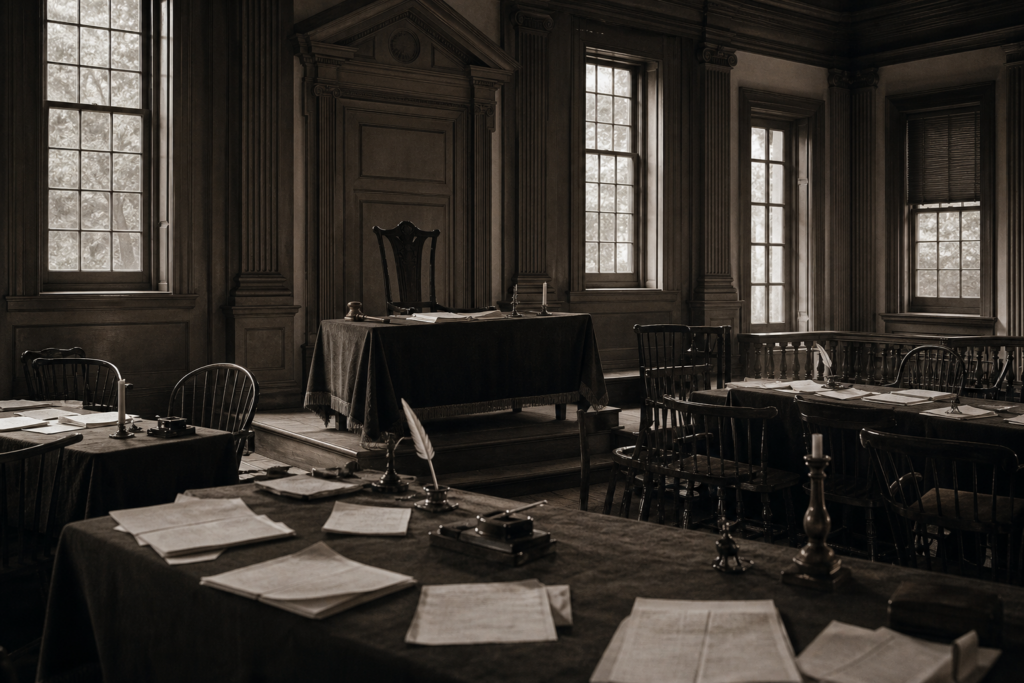
There was a president before George Washington.
There were, in fact, several.
They signed documents. They received correspondence. They presided over the government of the United States. One of them, John Hanson of Maryland, carried a title so impressive that it still produces claims that the country has forgotten its real first president.
President of the United States in Congress Assembled.
The words sound familiar. The office was not.
Hanson did not command a national executive branch. There was no national executive branch to command. He could not independently enforce a law, direct a permanent federal administration, choose a cabinet, veto legislation, or claim a national electoral mandate. He was a delegate selected by other delegates to preside over Congress. His authority belonged to the body whose meetings he conducted.
This is not a technical correction at the edge of the story. It is where the story begins.
Before Americans created one of the most powerful political offices in the world, they tried to govern without it.
They had not forgotten how executive power worked. They remembered it too well.
The Revolution was fought against a king, but not only against a king. It was fought against a system in which governors, customs officers, soldiers, judges, ministers and distant administrators could convert royal authority into daily fact. Executive power was experienced through searches, seizures, taxes, proclamations, appointments and armed enforcement. The objection was not merely that George the Third was a bad man. The objection was that concentrated authority could enter ordinary life without ordinary people controlling it.
The first American constitution therefore did not create a weaker version of a king. It created no separate national executive at all.
Under the Articles of Confederation, the states retained sovereignty except for the powers expressly delegated to the United States in Congress Assembled. Congress could conduct diplomacy, make treaties, borrow money, direct war, regulate coinage, establish post offices and settle certain disputes between states. It could appoint committees and civil officers to administer what Congress had decided.
But the center could not reliably make the states obey.
Congress could determine what money was required and request it. It could not directly tax individuals to obtain that money. It could decide how many troops were needed and requisition them from the states. It depended on state governments to raise, equip and send them. It could incur obligations in the name of the union while lacking the ordinary machinery required to satisfy those obligations.
Responsibility existed without sufficient power.
The president of Congress sat at the center of this contradiction. His title implied unity. His work revealed fragmentation. He could keep the proceedings moving, authenticate what Congress had done and transmit its requests. He could not transform a request into obedience.
The arrangement also blurred the work of government. Congress legislated, administered and judged. It decided policy and then created committees to carry the policy out. The same delegates who had to debate the nation’s direction were drawn into correspondence, accounts, supplies and appointments. Important executive work existed, but there was no executive institution designed to perform it continuously.
This was not only inefficient. It made responsibility difficult to locate.
If soldiers went unpaid, Congress could blame the states for ignoring requisitions. States could blame Congress for demanding too much. Individual delegates could blame a majority they had failed to persuade. The president of Congress could point out, accurately, that he possessed no independent authority to solve the problem. Everyone could explain the failure. No one could be made to own it.
That distinction separates John Hanson from George Washington more completely than the calendar does. Hanson presided over a legislature. Washington became the head of an executive branch.
The myth of the forgotten first president survives because it is shaped like a secret. But the truth is more important. The early republic did not misplace the presidency. It had not yet decided to create one.
And when it finally did, it did so because government without an executive had failed.
The failure was not immediate. Confederation carried the country through the final years of the Revolutionary War. It helped secure independence and provided a legal framework for cooperation among states that had recently been colonies. Its Congress approved the Northwest Ordinance, one of the most consequential laws in early American history. The system was not empty.
It was inadequate.
War debts remained. Trade disputes multiplied. Foreign governments saw that an agreement with Congress might still depend on thirteen states choosing to comply. British troops remained at western posts while the United States struggled to fulfill treaty obligations. Creditors doubted that a government unable to tax could reliably pay. The union could make promises more easily than it could perform them.
The most dangerous demonstration came from the army that had won independence.
By early 1783, Continental officers at Newburgh had endured years of irregular pay and uncertain promises about what the country would owe them when the war ended. Congress had obligations and no dependable revenue. The states had money and competing priorities. Anonymous addresses urged the officers to abandon patience and consider using the army’s continued existence as leverage against the civilian government.
The crisis ended because Washington entered the meeting and persuaded his officers not to use military power against Congress. The republic survived through the authority of a man whose legal authority was about to expire.
That is a remarkable victory of character. It is also evidence of institutional failure.
The system could not pay the army. It could not compel the states to fund the debt. It could not reliably protect civilian government from the soldiers it could not support. It depended on Washington to restrain the force Congress lacked the means to control.
Americans would later trust Washington with executive power because he had surrendered military power. But the episode also demonstrated why the new government’s designers wanted more than personal influence. A constitutional order could not assume that every crisis would produce a Washington.
Then came Shays’ Rebellion.
In 1786 and 1787, armed resistance to debt collection and court proceedings spread through western Massachusetts. The rebellion arose from real economic pain: heavy taxes, hard money policies, debt, foreclosure and a political order that many rural citizens believed did not hear them. To nationalists already convinced that the confederation was too weak, it also supplied a frightening image. A state might lose control of internal disorder while Congress lacked an effective, immediate response.
The lesson drawn by the advocates of constitutional reform was not simply that rebellion was dangerous. It was that republican government could be destroyed by weakness as well as tyranny.
This is the argument that created the presidency.
The men who gathered in Philadelphia in 1787 did not agree on what an executive should be. They debated one person or several, direct or indirect election, a short term or a long one, eligibility for reelection, participation in legislation, removal, salary and command. They feared monarchy, but they also feared paralysis. They wanted accountability, but they knew that a committee could distribute responsibility until no one could be held responsible at all.
Some state constitutions had reacted to royal governors by making legislatures dominant and executives weak. New York offered a different model: a governor elected independently of the legislature, responsible for law enforcement, commanding the militia and equipped with appointment and pardon powers. The Philadelphia convention considered a plural executive, an executive selected by Congress and an advisory council that might share responsibility for decisions.
The delegates ultimately chose one president.
Unity promised speed, but it also promised visibility. A council could make a dangerous decision and leave the public searching for the member responsible. A single executive could not disappear into a vote. The same concentration that made the office frightening was supposed to make it accountable.
Article Two begins with a sentence of extraordinary compression: the executive power shall be vested in a President of the United States of America.
Congress received powers item by item. The president received “the executive power,” followed by particular duties and authorities.
The president would serve for four years. He would be commander in chief. He could require written opinions from the heads of executive departments. He could grant reprieves and pardons for federal offenses, except in cases of impeachment. With the Senate, he could make treaties and appoint ambassadors, judges and other officers. He could recommend measures to Congress, convene it on extraordinary occasions, receive foreign ministers and take care that the laws be faithfully executed.
These powers were real. The boundaries between them were not always clear.
What did “the executive power” include beyond the clauses that followed? How independent were department heads? What did it mean to take care that laws were faithfully executed when a president believed a law unconstitutional, unwise or impossible? How much authority accompanied command of the military? When did receiving an ambassador become recognizing a government? When did enforcement become policymaking?
The document did not answer every question because no document could. Some uncertainties were compromises. Some were problems the delegates had not encountered. Others were left for practice to settle.
Alexander Hamilton defended the proposed office by arguing that energy in the executive was necessary to good government. Energy required unity, duration, support and adequate power. A single executive could act with speed and secrecy. More importantly, a single executive could be identified. If the laws were badly enforced, the public would know whom to blame.
Accountability and strength were presented as partners.
Opponents saw a different possibility. A single president, eligible for reelection, commanding armed forces and controlling appointments, might acquire the habits of monarchy without the title. The fear was not irrational. The proposed Constitution was creating a figure unlike anything under the Articles: one person who would embody the national government, claim an independent constitutional position and remain continuously in office while Congress assembled and dispersed.
The argument over the presidency was therefore not between people who understood tyranny and people who did not. Both sides understood it. They disagreed about where the greater danger lay.
One side feared concentrated power.
The other feared a government incapable of acting.
The Constitution did not resolve that conflict. It placed both fears inside the same office.
Then it placed George Washington inside the office.
Washington’s importance to the creation of the presidency cannot be separated from the fact that he could have made it something else. He was the commanding general who had already surrendered military power at the end of the Revolution. His reputation reduced the apparent risk of the new executive. Delegates could imagine a strong presidency partly because they imagined Washington exercising it.
That faith was personal. The powers would not be.
On April 30, 1789, Washington took the oath of office in New York. Even the ceremony revealed how little had been settled. Congress debated where the oath should occur, how the branches should receive one another and what the president should be called. John Adams supported an elevated title. The House resisted. The republic arrived at the plain form that survived: President of the United States.
The title was modest. The institutional work began immediately.
Washington entered an office with no inherited staff capable of operating it, no established budget for presidential administration and no settled boundary between personal service and public institution. The first presidency was conducted through a small household of secretaries and the new departments Congress created around it. Information moved on paper at the speed of a horse or ship. Yet even in this limited setting, control of information became a source of power.
The president received reports from customs officers, diplomats, military commanders and department heads. Those reports could be assembled into a national picture unavailable to any one member of Congress. Continuity produced knowledge. Knowledge improved initiative. Before the executive branch became physically large, it became institutionally better positioned to see the government as a whole.
The Constitution mentioned executive departments but did not create a cabinet. Congress established the Departments of Foreign Affairs, Treasury and War, and provided for an attorney general. Washington began by seeking written opinions. During the neutrality crisis of 1793, he brought his principal officers together repeatedly. A practical advisory institution formed around the president.
This mattered for more than convenience.
A council formally established by law might possess its own constitutional identity. Washington’s cabinet did not. Its members advised; the president decided. Their disagreements could sharpen policy, but they did not divide responsibility. The cabinet strengthened presidential administration while preserving the argument that one elected official remained answerable for the result.
Another unresolved question concerned removal.
The Constitution described appointment with Senate participation but did not clearly explain who could dismiss executive officers. In the First Congress, debate over the new departments became a debate over the structure of the executive itself. The settlement associated with the Decision of 1789 supported, though not without lasting scholarly dispute over precisely what Congress had decided, the practice of presidential removal.
The consequence was structural. If the president could remove the principal officers who administered federal law, the departments would not become independent islands. They would increasingly form a branch under presidential supervision.
Washington and his successors exercised that authority. A few lines of legislative drafting helped establish a chain of control reaching from the president through the administration. Later presidents would use that chain far more aggressively. But the connection was made at the beginning.
The same pattern appeared in foreign policy.
The Constitution required the advice and consent of the Senate for treaties. At first, Washington treated “advice” as something that might occur before a negotiation was complete. In August 1789, he entered the Senate chamber with Secretary of War Henry Knox to consult senators about a proposed agreement with Native nations.
The visit went badly.
Washington presented questions. Senators debated procedure. They referred matters to a committee. The president, who expected useful consultation, encountered legislative delay. He left frustrated and did not repeat the experiment.
Future treaty practice moved toward written communication. Presidents and their representatives would negotiate. The Senate would usually confront a substantially completed agreement and decide whether to consent.
The Senate retained a powerful constitutional check. But the sequence mattered. The executive acquired initiative. It gathered information, conducted diplomacy, shaped the terms and presented the product. The legislature could reject what the president had made. It became less likely to help make it in the first place.
That small scene in the Senate chamber contains a pattern that will recur throughout this investigation. The Constitution creates shared power. The branches try to exercise it. One branch is structurally better equipped for speed, secrecy and continuity. Practice shifts toward that branch without a constitutional amendment.
Foreign crisis accelerated the shift.
When revolutionary France went to war with Britain and other European powers in 1793, the United States faced danger from every direction. France had aided the American Revolution. Treaties bound the countries. American commerce was vulnerable. Public opinion divided sharply.
Washington issued a proclamation declaring a policy of impartial conduct toward the belligerents and warning Americans against acts that would violate it.
The policy may have been prudent. The constitutional question was larger: who had authority to decide the nation’s position?
Critics argued that neutrality affected treaty obligations and the question of war, areas in which Congress and the Senate possessed essential powers. Hamilton defended broad executive authority in foreign affairs. Madison resisted that reading. Newspapers became a constitutional forum because the operational Constitution was being built in public argument.
Congress later passed the Neutrality Act of 1794, giving statutory form to the policy. That sequence is important. Washington acted; Congress supplied clearer legal authority afterward.
This is not the same as a president permanently replacing Congress. It is the beginning of a recurring institutional advantage. In a crisis, an executive can establish the first fact. By the time Congress acts, the debate may concern whether to ratify, alter or reverse a policy already in motion.
The Whiskey Rebellion extended the lesson from foreign affairs to domestic enforcement.
Congress had enacted an excise tax on distilled spirits. In western Pennsylvania, resistance grew from evasion and protest into intimidation and violence against officials and supporters of the tax. The dispute involved regional economics, resentment of distant authority and a question the confederation had never adequately answered: could the national government enforce its own law?
Washington proceeded under legislation that allowed the president to call forth the militia after the required legal finding that ordinary enforcement had become impracticable. He issued proclamations, supported negotiation and ultimately mobilized a force of nearly thirteen thousand militia from several states.
Washington personally accompanied the force for part of its movement west, the only sitting president to take such a direct field role. The organized resistance collapsed without a major battle.
The response was legally grounded in statutes. It was also a demonstration. The new government would not merely request obedience from states. Its president could direct national power toward individuals resisting federal law.
To Federalists, this proved that republican government could defend itself. To opponents, the size of the force and the administration’s language confirmed that central authority could magnify a regional protest into an occasion for coercion.
Both interpretations became part of the presidency.
The power to enforce law is not neutral simply because a law exists. Enforcement requires judgment about timing, scale, priority and means. A president who commands the instruments of enforcement can shape the public meaning of a statute even when Congress wrote every word of it.
Washington was restrained in his use of the veto. He rejected only two bills, and neither veto was overridden. Yet even restraint created precedent. The president was not a clerk required to sign whatever Congress passed. He possessed an independent constitutional judgment and could force a supermajority to overcome it.
He also communicated recommendations, received ministers, selected officers and claimed control over information within the executive branch. None of these acts made him an emperor. Together they made the presidency a working institution rather than a list of clauses.
Precedent is often described as if Washington wrote a rulebook and later presidents agreed to follow it. The process was less orderly. He faced practical questions, chose among imperfect answers and created routines. Some choices hardened because they worked. Some hardened because no other branch successfully displaced them. Some survived because they gave later presidents an advantage they had no reason to surrender.
The presidency expanded first through use.
No amendment established the cabinet. No amendment moved treaty negotiation toward executive control. No amendment declared that the president could speak first for the nation during a foreign crisis. Government changed because repeated conduct supplied meaning where constitutional language was incomplete.
The critical point is that Washington’s precedents moved in two directions.
He strengthened the office.
And he limited himself.
At the end of his second term, Washington left.
The Constitution did not require him to do so. The Twenty-second Amendment would not impose a two-term limit until the twentieth century. Washington understood that remaining until death could teach the country to regard the presidency as a lifetime position. By retiring, he made surrendering power part of presidential legitimacy.
This may be the most consequential restraint of the founding presidency because it depended entirely on conduct. No court ordered it. No statute compelled it. The office was limited by a president who believed that leaving was one of the duties of holding it.
That exposes the founding paradox.
Washington created practices that enlarged executive capacity: a cabinet organized around the president, control over principal officers, diplomatic initiative, rapid action in crisis and credible enforcement of federal law. He also created practices of restraint: a plain title, limited vetoes, acceptance of legislative authority, civilian command bounded by law and voluntary retirement.
The power became institutional.
Much of the restraint remained personal.
An institution remembers what it is capable of doing more reliably than it remembers why one officeholder chose not to do more.
This is why the imperial presidency cannot be explained only as a story of usurpation. The original presidency was neither powerless nor imperial. It was an energetic executive surrounded by legal checks and sustained by expectations that could not enforce themselves.
Every later president inherited two Washingtons.
One was the president who acted: who organized administration, removed officers, directed diplomacy, declared policy before Congress legislated, called out militia and made the federal government real.
The other was the president who stopped: who accepted that authority could be strongest when visibly surrendered.
History did not choose one inheritance. It kept both.
The office grew whenever crisis made action valuable, whenever Congress delegated a difficult choice, whenever technology increased the speed of command, and whenever a successful assertion became available to the next president. Restraint survived when institutions imposed it, when politics rewarded it or when presidents supplied it themselves.
The first system had responsibility without power.
The Constitution answered with power attached to responsibility.
The unresolved question was what would happen when power could escape responsibility while continuing to speak in its name.
That question did not remain theoretical for long.
Thomas Jefferson would purchase an empire while doubting that the Constitution authorized him to do it. Andrew Jackson would claim the people as a source of presidential authority independent of Congress. Abraham Lincoln would confront rebellion with actions he believed necessary before Congress could approve them.
The presidency had been designed to execute the law.
Crisis would teach it to define the possible.
That is Part Two: Emergency Is a Constitution of Its Own.
Sources
- National Archives, “Articles of Confederation (1777),” including Articles II, IX and XIII: https://www.archives.gov/milestone-documents/articles-of-confederation
- National Archives, “The Constitution of the United States: A Transcription,” especially Article II: https://www.archives.gov/founding-docs/constitution-transcript
- National Archives, “Constitution Questions and Answers,” on the Confederation government and formation of executive departments: https://www.archives.gov/founding-docs/constitution-q-and-a
- Alexander Hamilton, Federalist No. 70, March 15, 1788, Founders Online: https://founders.archives.gov/documents/Hamilton/01-04-02-0221
- U.S. Senate Historical Office, “Washington’s Inauguration,” on the 1789 title debate: https://www.senate.gov/about/traditions-symbols/washington-inauguration.htm
- Constitution Annotated, “Decision of 1789 and Removals in Early Republic”: https://constitution.congress.gov/browse/essay/artII-S2-C2-3-15-2/ALDE_00013108/
- U.S. Senate, “About Treaties — Historical Overview,” on Washington’s 1789 appearance before the Senate and the move to written communications: https://www.senate.gov/about/powers-procedures/treaties/overview.htm
- George Washington’s Mount Vernon, “A Precedent: The First Cabinet”: https://www.mountvernon.org/george-washington/the-first-president/the-first-cabinet/a-precedent-the-first-cabinet
- George Washington’s Mount Vernon, “Neutrality Proclamation”: https://www.mountvernon.org/library/digitalhistory/digital-encyclopedia/article/neutrality-proclamation
- George Washington’s Mount Vernon, “George Washington and the Whiskey Rebellion”: https://www.mountvernon.org/george-washington/the-first-president/whiskey-rebellion
- Founders Online, “The First Presidential Veto — Editorial Note”: https://founders.archives.gov/documents/Washington/05-10-02-0118-0001
- National Archives / Congressional Research Service, “The Presidential Veto and Congressional Procedure,” veto totals: https://www.archives.gov/files/legislative/resources/education/veto/veto-procedure.pdf
- George Washington’s Mount Vernon, “George Washington’s Farewell Address,” on the voluntary two-term precedent: https://www.mountvernon.org/library/digitalhistory/digital-encyclopedia/article/george-washington-s-farewell-address
- Constitution Annotated, “Historical Background on Executive Vesting Clause,” on the absence of a national executive under the Confederation and the Convention’s competing executive designs: https://constitution.congress.gov/browse/essay/artII-S1-C1-2/ALDE_00013791
- George Washington’s Mount Vernon, “Newburgh Conspiracy,” on Congress’s inability to meet military obligations and Washington’s intervention: https://www.mountvernon.org/library/digitalhistory/digital-encyclopedia/article/newburgh-conspiracy
This is Part I of The Imperial Presidency, an eight-part NOMOTO MEDIA Investigation into the accumulation of executive power from the Articles of Confederation to automated government.