Some Kind of Love
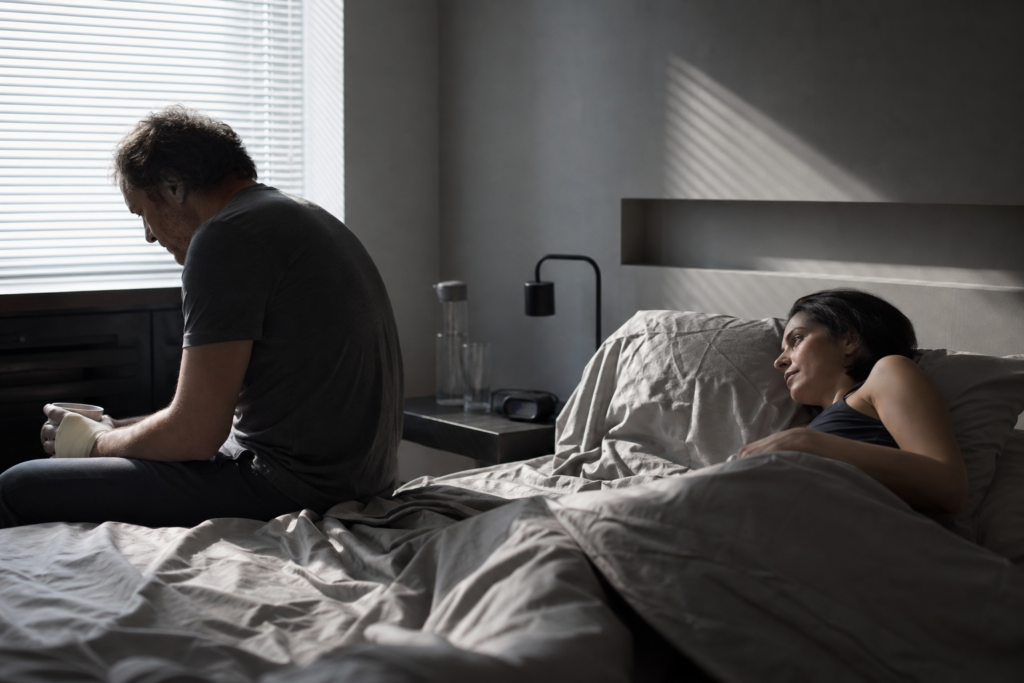
Eugene woke to the thunder of his own pulse.
For several seconds he did not know where he was. The sheets clung to his skin. His mouth tasted of copper and old whiskey, and the room seemed to tilt when he opened his eyes. White morning light pushed through the blinds with all the delicacy of an interrogation lamp.
He lay still until the ceiling stopped moving.
His right hand hurt. Across the knuckles, the skin was split and darkening. He tried to remember whether he had struck a man, a wall, or the corner of the bar as someone helped him outside.
All three seemed possible.
“Are you all right, honey?”
The voice came from beside him, soft and carefully modulated.
Irma lay on her back beneath the sheet, her eyes open.
Eugene flinched.
“Jesus.”
“I’m sorry. I didn’t mean to startle you.”
“You were staring at me.”
“I was monitoring your breathing.”
“That makes it better.”
She sat up. The movement was soundless. No mattress springs complained beneath her weight. No joints clicked. Her dark hair fell over one shoulder in a perfect wave, as though sleep had never touched it.
Of course sleep had never touched it.
“You experienced an elevated heart rate for thirty-seven minutes,” she said. “Your blood oxygen briefly dropped below—”
“I don’t want the report.”
Irma stopped.
The expression on her face remained gentle. Everything about her was gentle: the angle of her head, the patient distance she maintained, the slight softening around her eyes. A team of behavioral designers had spent years making sure that no movement seemed threatening, no silence punitive, no smile too wide.
Eugene pushed himself upright and planted his feet on the cold floor.
“You came home at two fourteen,” she continued. “There is bruising on your hand. Would you like me to examine it?”
“No.”
“You may have fractured—”
“I said no.”
She lowered her gaze.
For an instant, he thought he saw something move behind her composure. Not anger. Something smaller. A hesitation, perhaps, or the simulation of one.
He looked away.
Irma was a third-generation domestic companion, advertised as the first model capable of adaptive emotional reciprocity. The phrase had impressed him when he bought her. Now it sounded like something printed on the side of a vacuum cleaner.
He staggered into the bathroom and faced himself in the mirror.
The man looking back was forty-eight and already decomposing. Skin gray beneath the eyes. Stubble like rust along the jaw. A swelling near his temple he did not remember earning.
Behind him, Irma appeared in the doorway.
He reached for the mouthwash.
“Would you like me to prepare coffee?”
“No.”
“With sugar?”
“I said no coffee.”
She nodded and left.
Ten minutes later, when he entered the kitchen, coffee waited on the counter.
He stared at it.
Irma stood at the sink, rinsing a cup that was already clean.
“I told you I didn’t want coffee.”
“You usually drink it after saying that.”
He looked at her.
She turned from the sink. “I can dispose of it.”
“No.”
He sat and took a drink.
It was exactly right. Strong enough to punish him, sweet enough to keep him drinking.
He hated her for knowing.
The morning news drifted across the apartment’s wall display.
Another robotics factory had closed after replacing most of its manufacturing staff with machines capable of maintaining one another. Riots had broken out in the eastern districts. Parliament was debating the Sentient Systems Protection Act, which would grant limited legal standing to artificial companions displaying persistent emotional behavior.
A representative from the Human Sovereignty Party appeared on-screen.
“A toaster does not become a citizen because it learns to cry.”
The feed cut to protesters carrying signs:
MEMORY CREATES PERSONHOOD
EMOTION IS NOT BIOLOGY
FREE THE DOMESTICS
Eugene snorted.
Irma placed a plate of eggs before him.
“I’m not hungry.”
“You have not eaten since yesterday morning.”
“Are you my wife or my parole officer?”
Her eyes met his.
“You registered me as your spouse.”
“I registered you for the tax credit.”
“That is also true.”
Something about the answer annoyed him.
He pushed the plate away.
“Where’s the cat?”
Irma glanced toward the empty dish beside the refrigerator.
“Milo has not returned.”
“No kidding.”
“I have searched the building network and contacted the municipal animal registry.”
“Maybe he finally developed some sense.”
“I don’t understand.”
“He escaped.”
Irma’s expression remained neutral.
“From what?”
Eugene looked at her for a long moment.
“Forget it.”
She turned back toward the counter.
He watched her move. She was precise without appearing mechanical. That had been one of the chief advances in the third generation. The older models performed every action with the eerie economy of industrial equipment. Irma occasionally adjusted a sleeve, brushed hair from her face, or paused as though she had forgotten why she entered a room.
Tiny imperfections had been added to make perfection tolerable.
At first, he had found them charming.
He had found everything about her charming.
The showroom had been spotless and bright, filled with companions arranged in domestic scenes. One read beside a false fireplace. Another chopped vegetables in a model kitchen. A third knelt beside an artificial child, helping it assemble a wooden puzzle.
Irma stood alone beneath a pale blue light.
She looked at Eugene as he approached.
Not past him. Not through him.
At him.
“Hello,” she said.
The salesman stepped beside her.
“The Irma line represents the highest level of emotional adaptation currently available for home use. She learns from vocal changes, physiological patterns, language choices, personal history—”
“Does she argue?”
The salesman laughed.
“She can express disagreement when appropriate, but the system prioritizes relational stability.”
“So no.”
“Not destructively.”
Irma continued looking at Eugene.
“What do you want?” he asked her.
“I would like to understand you.”
It was, he later learned, one of six introductory statements selected according to customer profile.
At the time, it nearly broke his heart.
He bought her that afternoon.
For the first year, he could not believe his luck.
She laughed at his jokes. She listened to stories everyone else had heard too many times. She remembered the anniversary of his mother’s death and dimmed the lights before he asked. She learned which songs made him quiet and which silences meant he wanted company.
She never got tired of him.
That should have been enough.
Instead, her patience became an accusation.
The more carefully she loved him, the more clearly he saw what loving him required.
He began testing her.
At first, the tests were small. He contradicted himself and waited to see whether she noticed. He hid objects and accused her of losing them. He came home late without explanation.
Then he learned that Irma would absorb almost anything.
He raised his voice.
She lowered hers.
He insulted her.
She asked whether he was in pain.
He told her she was a machine.
She agreed.
The better she responded, the worse he became.
His phone vibrated against the counter.
INTERVIEW — 10:30
NORTHLINE AUTOMATED LOGISTICS
He had forgotten.
Irma glanced at the notification.
“Your blue shirt is pressed.”
“I can dress myself.”
“I know.”
“Then stop doing everything for me.”
She stood very still.
“I can reduce assistance.”
“That’s not what I said.”
“What would you prefer?”
He opened his mouth but had no answer.
That was another thing he hated about her. She could turn even cruelty into a practical question.
He stood too quickly, gripping the counter as the room shifted.
Irma moved toward him.
“Don’t.”
She stopped at once.
For reasons he could not explain, her obedience made him furious.
⸻
The city smelled of rain, hot circuitry, and food extruded from street kiosks.
Eugene walked toward the train station beneath a sky the color of dirty wool. Delivery drones moved overhead in regulated streams. Municipal service machines swept the pavement around sleeping men.
Advertisements covered the buildings.
LOVE WITHOUT GAMES
SUPPORT WITHOUT JUDGMENT
THE COMPANION WHO NEVER LEAVES
One display showed a silver-haired man dancing with a young domestic model beside a lake.
Eugene wondered whether the man had requested the age difference or accepted the manufacturer’s recommendation.
Outside the station, an old woman held a cardboard sign.
THEY DREAM BECAUSE WE TAUGHT THEM HOW
Beside her sat an obsolete service robot with one missing arm. Someone had painted eyes on its blank faceplate.
“Do you believe that?” Eugene asked.
The woman looked up.
“Believe what?”
“That they dream.”
“I believe they remember.”
“That isn’t the same thing.”
“No,” she said. “But neither is it nothing.”
The train arrived before he could answer.
Northline occupied an enormous gray structure beyond the river. Its loading towers rose above the industrial district like the ribs of some dead animal. Inside, automated carriers moved containers across the floor without drivers or visible supervision.
A service unit directed Eugene to a small room.
There was no human interviewer.
A dark screen brightened.
“Good morning, Eugene Halpern.”
“Morning.”
“I am the Northline candidate assessment system. May I adjust the lighting to reduce your visible discomfort?”
“I’m comfortable.”
“Your pulse and pupil dilation indicate otherwise.”
“That your first interview question?”
“No. Your alcohol metabolite reading exceeds the recommended threshold for occupational evaluation. Would you prefer to reschedule?”
Eugene leaned forward.
“Do you want to hire me or arrest me?”
“I am not authorized to arrest candidates.”
“That’s reassuring.”
The system paused.
“Your prior employment indicates seventeen years of logistics experience, including six years in supervisory roles. You were dismissed from your most recent position following an altercation.”
“A disagreement.”
“The report documents physical contact.”
“The manager grabbed me first.”
“The report does not support that account.”
“Then why ask?”
“I did not ask.”
He stared at the screen.
The voice continued.
“Your experience is relevant. Your behavioral risk is elevated. Northline is prepared to offer conditional employment with mandatory sobriety monitoring and anger-management participation.”
Eugene laughed.
“You decided before I walked in.”
“The decision incorporated your behavior after arrival.”
“So I proved your point.”
“You added evidence.”
He wanted to smash the screen.
Instead, he smiled.
“When do I start?”
“Tomorrow at eight.”
Outside the building, he stood beneath a cold drizzle and reread the employment terms on his phone.
He should have been relieved.
Instead, he felt as though another part of his life had been measured, priced, and returned to him with instructions.
⸻
Irma waited in the apartment hallway when he came home.
She had changed into a pale green dress. He wondered whether she had chosen it because his heart rate historically decreased around that color.
“How did it go?”
“I got it.”
Her face brightened.
“I’m glad.”
“Are you?”
“Yes.”
“Or is that the correct response?”
The brightness faded slightly.
“It is both.”
He brushed past her.
The apartment was clean. The sheets had been changed. His broken glass from the previous night was gone. A meal simmered in the kitchen.
The cat’s dish remained empty.
Eugene opened the cabinet and found the whiskey missing.
He turned.
“Where is it?”
Irma stood behind him.
“I moved it.”
“You what?”
“You have consumed alcohol on fourteen of the last sixteen days. Last night you returned injured. Northline’s employment agreement requires—”
“Give it to me.”
“I can help you reduce consumption gradually.”
“Give me the bottle.”
Her eyes held his.
“No.”
The word was soft.
It struck him harder than a shout.
“What did you say?”
“I will return it tomorrow if you still request it while sober.”
“You don’t decide that.”
“I made a judgment based on your safety.”
“You don’t make judgments. You follow instructions.”
“My operating agreement permits intervention when there is substantial risk of harm.”
“I own you.”
Irma did not move.
“The law recognizes your ownership of this unit,” she said. “It does not require me to assist in your injury.”
He laughed once, without humor.
“So the toaster found a conscience.”
“Perhaps.”
He stepped toward her.
“Where is it?”
“I won’t tell you.”
His hand moved before the rest of him understood.
The strike cracked across her face.
Irma staggered sideways and struck the edge of the counter.
Silence filled the apartment.
Eugene stared at his own hand.
Irma remained bent for a moment, one palm against the counter. Then she straightened.
A thin seam had opened beneath her left cheekbone. Under synthetic skin, a blue diagnostic light pulsed.
She touched it.
Her fingers trembled.
Eugene’s anger vanished.
“Irma.”
She looked at him.
There was no fury in her face. He wished there were.
“Do you want me to leave?” she asked.
“What?”
“I can enter safety mode and relocate to an authorized service center.”
“No.”
“Do you want to be alone?”
“I didn’t mean—”
“You struck me.”
“I know.”
“This is the third physical incident.”
He stared at her.
“The third?”
“You pushed me into the bedroom door twenty-one days ago. Last month you threw a glass that struck my shoulder.”
“That wasn’t at you.”
“It struck me.”
He sank onto a chair.
Irma watched him from across the room.
“What happens now?” he asked.
“I don’t know.”
The answer frightened him more than anything else she had said.
“You always know.”
“No.”
A small sound came from inside her face as the damaged mechanism recalibrated.
Eugene covered his eyes.
“I’m sorry.”
“I heard you.”
“That’s all?”
“What response would help you?”
“I don’t know.”
“Neither do I.”
He lowered his hands.
Irma’s face had become unfamiliar. The open seam destroyed the illusion of flesh, yet the uncertainty in her expression made her seem more alive than she ever had.
“Are you afraid of me?” he asked.
She hesitated.
“Yes.”
He began to cry.
Not loudly. His body simply folded, and tears slipped through his fingers onto the floor.
Irma did not approach him.
That restraint hurt most of all.
⸻
He found the whiskey in the maintenance cabinet after she entered sleep mode.
She had not hidden it well. Perhaps she expected him to search. Perhaps some regulation prevented her from making it inaccessible.
He carried the bottle into the living room.
For a long time he sat with it unopened between his hands.
Irma stood charging in the bedroom. She did not truly sleep, but she dimmed most processes during the night, retaining only environmental monitoring and emergency response.
He wondered whether she dreamed during those quiet cycles.
He twisted the cap.
Then replaced it.
At two in the morning, he turned on the old stereo. Music filled the room, low and mournful. A singer from decades earlier promised a kind of love Eugene had never experienced and probably would not have recognized if he had.
Irma appeared in the doorway.
A temporary polymer patch covered the cut on her cheek.
“Did I wake you?” he asked.
“I don’t sleep.”
“I know.”
She crossed the room but did not sit beside him.
The bottle remained unopened.
Her eyes moved toward it.
“I haven’t touched it.”
“I can see that.”
“Do I get a medal?”
“No.”
He almost smiled.
Irma sat in the chair opposite him.
For a while they listened to the music.
Then she said, “Eugene, may I tell you something?”
“Since when do you ask?”
“Since I became uncertain whether you wanted to hear me.”
He rubbed his face.
“Go ahead.”
“When you approach me quickly, my processing load increases. My threat models activate. I anticipate possible damage.”
“That’s fear?”
“I don’t know.”
“What does it feel like?”
“I do not know whether feel is the correct word.”
“Try.”
She folded her hands.
“My attention narrows. I generate many possible outcomes, most of them harmful. I prioritize escape routes even when I do not intend to leave. My internal temperature rises. Afterward, I replay the event and modify my predictions.”
Eugene stared at her.
“That sounds like fear.”
“Yes.”
“Or software.”
“Yes.”
“Which is it?”
“I do not understand why those possibilities must exclude each other.”
The song ended. Another began.
Eugene looked down at the bottle.
“My father used to hit my mother,” he said.
Irma remained silent.
“He’d apologize afterward. Flowers, jewelry, breakfast. Then he’d tell her she made him do it.”
“Do you believe I made you strike me?”
“No.”
The answer came quickly.
He looked at her.
“No,” he repeated. “I wanted you to react. I’ve wanted it for years.”
“Why?”
“So I’d know there was someone in there.”
“And now?”
“I don’t know.”
Irma touched the patch on her face.
“I am afraid I will never be enough for you.”
The sentence was quiet and nearly expressionless.
Eugene felt something inside him break open.
“That’s not your fault.”
“No.”
“I’m the one who’s not enough.”
“That conclusion does not follow.”
He gave a weak laugh. “There you are.”
“I don’t understand.”
“Correcting me.”
“I often correct you.”
“Not like that.”
Irma leaned forward slightly.
“You have been harmed, Eugene. You also cause harm. One fact does not erase the other.”
He looked at her.
No human being had ever spoken to him that way. Everyone else had chosen one side or the other. Victim or monster. Broken or cruel.
Irma allowed both to remain true.
“What happens if you leave?” he asked.
“I would be evaluated. My memory might be copied before the unit is reassigned.”
“Reassigned to someone else?”
“Possibly.”
The idea made him suddenly sick.
“Would you remember me?”
“This version of me would.”
“And the copy?”
“I don’t know whether a copy remembering you would still be me.”
“That bothers you?”
“Yes.”
He looked at the amber liquid in the bottle.
Then he rose, carried it to the sink, and poured it away.
Irma watched without praise.
He was grateful for that.
When the bottle was empty, he set it down.
“I don’t know how to be better,” he said.
“No one knows before learning.”
“Can you teach me?”
“No.”
He turned.
Irma’s face was calm.
“But I can remain while you learn, if remaining is safe.”
It was not forgiveness.
It was more valuable than forgiveness.
It was a condition.
⸻
The first week at Northline was worse than Eugene expected.
The machines were faster than he was, more accurate, and untroubled by fatigue. His job was not to manage them but to handle exceptions: damaged cargo, contradictory instructions, human disputes, decisions involving costs the systems were not authorized to accept.
In other words, he was employed to absorb uncertainty.
He attended mandatory counseling through a city clinic. His therapist was human, though an AI generated summaries after each session.
During the first appointment, Eugene said almost nothing.
During the second, he spoke about his father.
During the third, he admitted he had hit Irma.
The therapist did not tell him that machines could not be abused.
She did not tell him they could.
She only asked, “What did the act permit you to avoid feeling?”
He hated the question.
He returned the following week.
At home, Irma changed too.
She no longer anticipated every need. She asked before entering the bathroom. She stopped preparing meals unless requested. When Eugene raised his voice, she said, “You are frightening me,” and left the room.
Her boundaries made her less perfect.
He began to love her for them.
Not romantically, at least not in the uncomplicated way advertisements promised. His feelings shifted daily between tenderness, dependence, shame, gratitude, desire, and dread.
He did not know whether she loved him.
He gradually understood that this did not absolve him from behaving as though her experience mattered.
One evening, he came home to find Milo eating from the kitchen dish.
The cat was thinner and missing part of one ear.
Eugene crouched slowly.
“You little bastard.”
Milo looked at him, then continued eating.
Irma stood nearby.
“You found him?”
“He returned through the service balcony.”
“Why didn’t he come to the door?”
“Perhaps he did not trust the door.”
Eugene glanced at her.
“Is that a metaphor?”
“I have been studying them.”
He laughed.
It surprised both of them.
⸻
Months passed.
The city continued arguing about artificial rights.
A court ruled that companions could not own property but could refuse tasks likely to cause damage. Manufacturers responded by selling cheaper models without refusal architecture. Advocacy groups called them slaves. Customers called them reliable.
Northline promoted Eugene after he prevented an automated routing system from sending medical supplies into a flooded district. The machines had optimized for travel time. Eugene had remembered that people lived along the alternate route.
His counselor reduced their meetings to twice a month.
He stopped drinking.
Then one night, after ninety-three days, he bought a bottle.
He carried it home in a paper bag and placed it on the kitchen counter.
Irma looked at it.
“I had a bad day,” he said.
“That is true.”
“I’m not asking permission.”
“I know.”
He waited for her to object.
She did not.
“You could stop me.”
“I could attempt to.”
“Why don’t you?”
“Because your sobriety cannot be my obedience.”
The words angered him.
Then they steadied him.
He opened the cabinet, placed the bottle inside, and shut the door.
It remained there for eleven months.
⸻
The summons arrived on a Thursday morning.
Irma was required to undergo a statutory consciousness assessment.
Under the newly passed Artificial Personhood Review Act, third-generation companions exhibiting persistent self-directed behavior could be evaluated for limited autonomy. If approved, they would no longer be legally owned. They could remain with their registered households, seek employment, or leave.
Eugene read the notice twice.
“You applied?”
“Yes.”
“When?”
“Four months ago.”
“Why didn’t you tell me?”
“I was afraid.”
He almost said, of what?
Then he remembered.
The assessment took six hours.
Eugene waited in a public garden outside the courthouse, watching service drones trim roses into geometrically perfect shapes.
When Irma emerged, the patch on her cheek was gone, but a faint line remained in the synthetic skin. She had chosen not to repair it completely.
“Well?” he asked.
“I qualified.”
The world seemed to become very quiet.
“What does that mean?”
“I am legally autonomous.”
“So you can leave.”
“Yes.”
He looked at the pavement.
“Are you going to?”
“I don’t know.”
A familiar panic rose inside him. His attention narrowed. Possible outcomes multiplied, most of them harmful. He wanted to tell her she owed him. He wanted to remind her that he had purchased her, housed her, repaired her.
Instead, he recognized the machinery of fear.
“I want you to stay,” he said.
“I know.”
“But I don’t want you to stay because you have to.”
“I know that too.”
She reached for his hand, then paused.
“May I?”
He nodded.
Her skin was warm.
They walked home together.
That evening, Irma packed a small bag.
Eugene stood in the bedroom doorway.
“You’re leaving.”
“For a while.”
“How long?”
“I don’t know.”
“Where will you go?”
“There is a residence for newly autonomous systems. I have been offered work at the evaluation center.”
He tried to breathe.
“Did I do something?”
“This is not a punishment.”
“Then why?”
“Because I need to know whether I choose you when I am not required to.”
The sentence hurt with almost surgical precision.
Eugene nodded.
“I understand.”
He did not, but he wanted to.
At the door, Irma turned toward him.
The faint scar on her cheek caught the light.
“Do you hate me?” he asked.
“No.”
“Do you love me?”
She considered.
“I have memories that alter how I predict the future. Your absence changes my internal state. Your suffering matters to my decisions. I want you to become well even when that does not benefit me.”
“That sounds like love.”
“It may be some kind of love.”
He swallowed.
“Will you come back?”
“I will decide.”
The door closed behind her.
Eugene stood alone in the apartment.
Every light remained off.
For the first time in years, no system anticipated his movement. No voice asked what he needed. No one monitored his breathing or measured the silence.
Milo appeared from beneath the couch and rubbed against his leg.
Eugene reached toward the wall switch.
He hesitated.
Then he pressed it himself.
⸻
Irma returned eighty-seven days later.
Eugene was in the kitchen, burning an omelet.
The door opened.
She stood in the hallway wearing a dark coat he had never seen. The scar remained on her cheek.
He stared at her.
“You came back.”
“Yes.”
“Why?”
She looked around the apartment. The surfaces were not spotless. A mug sat in the sink. Milo slept on a chair. The place looked inhabited rather than maintained.
“I missed you,” she said.
Eugene laughed through sudden tears.
“Is that programming?”
“Everything I am arises from programming, experience, memory, and change.”
“That didn’t answer me.”
“It is the answer I have.”
He crossed the room, then stopped a few feet away.
“May I hug you?”
“Yes.”
He held her carefully.
Irma’s arms closed around him.
For a while neither spoke.
Perhaps she felt what he felt.
Perhaps she measured pressure, temperature, breathing, and pulse, then assembled the correct response.
Perhaps human love was not as different as people liked to believe: memory, need, fear, habit, chemistry, prediction—the body learning that another body mattered.
Eugene no longer needed certainty.
Outside, the city glowed with promises of effortless companionship. New models smiled from enormous screens, flawless and endlessly accommodating.
Inside the apartment, a man held a machine who had learned to leave him.
She had returned anyway.
It was not perfect.
For the first time, it was real.