Dreams and Reality.
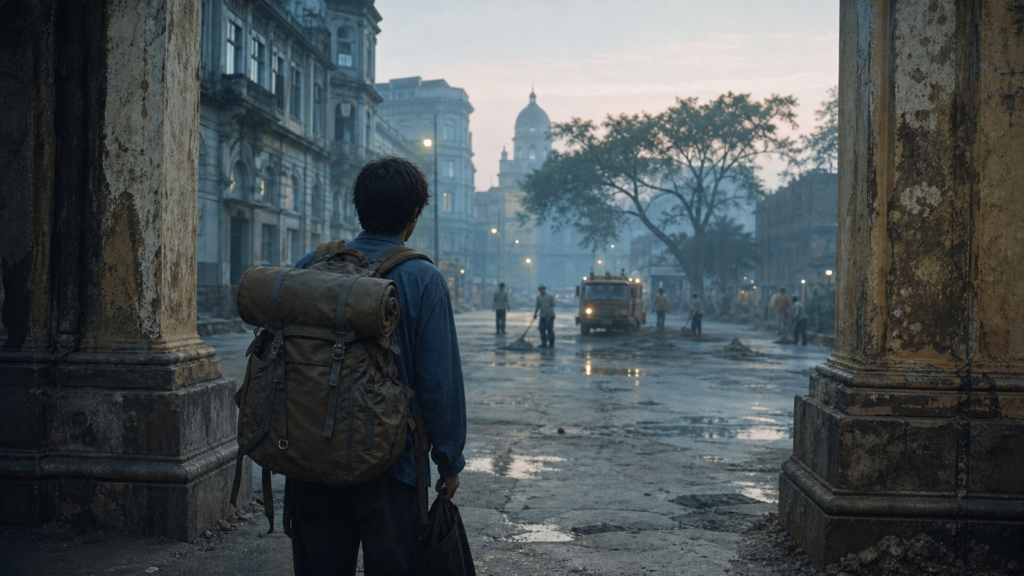
In Calcutta, in the eighties, the dead were collected from the streets in the early morning by trucks that paced the neighborhoods at hours most of the city was not yet awake. The collecting was an industry. It had to be. People lived and died on the streets in numbers that required logistics, and the logistics had been worked out, the way logistics always get worked out when the volume is sufficient, by people whose job it became to handle what nobody else wanted to see. By the time the streets filled with the day’s traffic, the bodies were gone. The city had been cleaned. The cleaning was the precondition for everything else that happened that day, including my walking through it.
I had a romantic notion of what India and Nepal would be. My brother had a different romantic notion. We were leaving Sweden together, with backpacks, with the kind of plans that are not plans, the way young travelers do when the going matters more than what they will do once arrived.
I was about to turn eighteen. He was older. He was about to get married when we returned. The marriage was waiting at the end of the trip, like a destination we were postponing by being elsewhere.
What I saw in Calcutta that week did not match the romantic notion. The romantic notion did not survive contact with the leprosy, the children on the sidewalks with their limbs missing, the unseeing eyes, the begging with tin cups. I learned, while I was there or shortly after, that some of the children had been dismembered by their parents. The dismemberment improved the child’s chances of surviving as a beggar, because beggars who could be seen as more pitiful received more, and what was received fed the family that had performed the dismemberment. I did not write this down at the time in any clear way. I carried it. The carrying is what writing eventually became, decades later. The original material was the carrying.
The beggars surrounded me when I walked. There were always many. I gave them most of what I had, most days, because not giving was not an option that I could find a way to live with at seventeen, even though giving accomplished nothing structural and may have produced effects that made things worse for the children whose income had to be turned over to whoever was managing them.
I did not yet know that charity has these problems. I did not yet know that the problems do not relieve the obligation, only complicate it. I gave because I could not bear not to. The bearing was already at its limit. Giving was the small action that allowed the bearing to continue.
One afternoon I mentioned, to no one in particular, that I wanted to bring silk back for my father. He was planning sheets and a bathrobe.
A large German man overheard me and said he knew exactly the place. He insisted on coming. We walked outside together and he called for a rickshaw. It appeared within seconds. The rickshaw was hand-pulled. I learned later that Calcutta in those years was one of the last cities anywhere that still used hand-pulled rickshaws. The man pulling it was thin and looked older than he probably was. He had a cotton sheet rolled up around him in the way people roll cotton in Calcutta. He had no shoes. We climbed in. The German began talking. I did not register what he was saying, because I had begun to register the man pulling us. His back was pulsing with the effort. The pulsing was not metaphor. It was visible through the sheet. I sat behind a working human body that was being driven by my weight and the German’s weight and our combined errand.
I said stop. I climbed out. I gave the man more rupees than I had given anyone, more than he likely earned in a week, a small amount in American dollars but a large amount in Calcutta. The German said something I did not hear. I walked back to the hotel alone.
Later I asked at the desk and was given a guide, an older woman who had been a schoolteacher and who spoke the Oxford English that some of the older educated Indians spoke better than most Oxford graduates. She helped me find the silk. The silk eventually made it home to my father. I have thought about the man with the rickshaw for quite some time. I do not know his name. I never asked. He could not have given it to me in any language I would have understood. I climbed into a vehicle pulled by another human being.
After a couple of weeks my brother and I had spent almost all of our money. We met a Swedish engineer in a bar. There was an old Indian man at the piano playing Chopin’s First Piano Concerto, and the contrast between the music and the city outside the bar was so absurd that the absurdity became its own atmosphere.
The engineer was very drunk. He felt sorry for us. He lent us a substantial amount that lasted us through the months remaining of the trip. I paid him back later, every cent of it, after I returned.
The engineer’s drunken generosity is one of the things that allowed the rest of the trip to happen, and one of the things that taught me that strangers sometimes save you, and that being saved by a stranger is a different experience than being saved by someone whose obligation to you is established. The stranger has no obligation. The stranger has only the impulse.
The impulse is rarer than people think. When it appears, it is almost holy.
We went north toward the Tibetan border. Pokhara. The monsoon was on. The skies stayed grey for days. I had wanted to see Machhapuchhre, the mountain whose name means fishtail in Nepali, with two peaks that look like a single tail seen from below. The mountain is sacred. It has never been climbed, by mutual agreement between the Nepalese government and the people who live in its sight. Climbing it was forbidden. The agreement has held. The mountain remained, in this small way, the way it had always been, while the rest of the Himalayas were turned into a project for the wealthy of other countries.
For part of the way I hitchhiked with an American journalist, a woman traveling through her own bucket list. She was dying. Nepal was on the list. She had hired an old Nepali Gurkha as her guide, a man who had fought with the British in the Second World War and who told stories in the impeccable Oxford English that some Gurkhas of his generation had acquired alongside their weapons.
The combination was unrepeatable. A dying American journalist, a Gurkha veteran of a war that ended before she was born, and a teenager riding along, listening to a man describe Burma in a voice that would not have been out of place in a college common room.
Everything seemed absurd, and the absurdity was not a complaint. It was the texture of the trip. The trip was made of these incongruities, and the incongruities were what taught me that the world is stranger than the categories one brings to it.
One morning the clouds opened. Machhapuchhre revealed itself for the time it took to reveal itself, and then the clouds closed again. I was speechless. I was grateful. I had been worried that the clouds would not lift. The lifting of the clouds was not for me. The lifting was the lifting, and I happened to be there when it occurred. The mountain has been doing this for as long as there have been clouds and as long as there have been mountains, and the people who happened to be there at any given lifting were incidental to it.
This is one of the things that produces religion in people. The witnessing of something that does not require your witness is a strange experience. You feel both small and present at once. The smallness is the accuracy. The presence is the gift. Most religious traditions are, in some way, attempts to keep that combination available to people who have not been to a mountain.
I spent my eighteenth birthday in Kathmandu. The city was dreamlike, in the specific sense that the rules of waking life seemed slightly modified there. I wandered alone for most of my time in the city, because my brother had decided that the trip was an opportunity to work on his tan. He spent his days on the roof of the house where we were staying, which belonged to an American doctor who had graciously hosted us. He bought tanning oils. He researched them. He applied them. He turned golden brown.
I learned later that the doctor wrote a letter to a friend expressing her bewilderment at this. She had hosted a young man who had traveled to the other side of the world and was using the time to perfect his color for his upcoming wedding. The letter survives somewhere, presumably. It is one of the small documents that other people sometimes preserve about us, that we never see, that record what we looked like to someone we did not know we were being observed by.
I felt alone in Kathmandu. I felt intimidated by my own solitary explorations. Roosevelt said that we have nothing to fear but fear itself. He was right, in the sense that I had nothing concrete to fear. He was also wrong, in the sense that fear itself is plenty, and naming it does not dissolve it. I walked through the city with the fear, and the fear did not protect me from anything that would have happened anyway, and the city did not harm me, and I returned each night to the doctor’s house where my brother was reading Narnia. The fear receded with the years. The walking and traveling did not.
The walking became the practice that has continued in different places around the world ever since.
Walking has been the way I have come to know places. There is no other way I know of to know a place. You walk. You return. You walk again. The place becomes, slowly, something other than the place you arrived expecting.
I have traveled alone for most of my life, except for a few early catastrophic experiences that taught me why.
Leaving Nepal we had no money. My brother had to sell his knives, which he had brought with him for reasons that had to do with being the kind of young man who travels with knives, to a soldier at the airport. The knives bought our exit taxes. Two hundred rupees each. Without them we could not leave the country.
Before we had left for the airport that morning, the Nepali man working at the front desk of our guesthouse had offered to lend us the money. It was a substantial sum for him, more than the engineer’s loan had been in real terms, because the engineer had had it to spare and the front desk man clearly did not. We declined the offer. We were boys, and we had pride, and we could not bring ourselves to take from someone who had so little. The declining was correct, in the moment. The carrying of the declining has been less simple. A poor man in Kathmandu was willing to give us what we needed, in late 1980-something, and we said no, and the saying no was the right thing to do.
The transaction at the airport took place in the hallway, with the soldier examining the knives and my brother explaining their qualities, and the soldier nodding, and the cash changing hands, and the knives changing hands, and the small bureaucratic obstacle to our return becoming, briefly, a problem that was solved by the conversion of metal into paper.
The plane out of Kathmandu was an old converted transport plane operated by Royal Nepal Airlines. As we boarded, an older woman next to me leaned over and said, in heavily accented English, Nepali airlines, always cancels, always crashes.
She seemed serene about this. She had presumably flown them before. We boarded. We did not crash. We flew over the Himalayas in conditions I am happier not having known about at the time, and we landed in New Delhi.
From New Delhi we flew Aeroflot, the Soviet airline, because it was the cheapest route home. I do not know which airline was scarier in retrospect. The Aeroflot plane felt structurally sound but spiritually concerning. The crew did not smile. The instructions were minimal. The Soviet Union still existed, technically. The Cold War still structured the geography we were moving through. We had to spend a few days in Moscow on the way back, in a hotel that had been arranged for us by some bureaucratic process I no longer remember.
In Moscow we met Joseph. He was from Malaysia. He had decided to seek political asylum in Europe. We did not know why. He did not explain. He had set his mind on it.
We took Joseph with us. He came to Europe on whatever paperwork made that possible at the time, which was less rigorous than it would be now.
He ended up living with our family for the next year. My father was delighted. My father jokingly called Joseph his butler, which is not a phrase one would use now and which was perfectly normal then, and which Joseph absorbed and returned with the sense of humor that made the friendship work.
Joseph was a Black Christian Malaysian. My father was a rather large Swedish man with a sense of humor that not everyone could absorb.
They went on adventures together across the country. They were an unlikely pair. They genuinely enjoyed each other’s company. They made each other laugh in a household that did not always laugh.
Joseph eventually got his Swedish citizenship. Over the years we lost touch. He sent occasional letters describing his life. The letters became sadder. The isolation he felt in Sweden, away from his family, in a country whose climate and culture were not designed to receive someone like him, accumulated into something that the early excitement of arrival had not predicted.
The last I heard, he was deeply depressed, very isolated, and a raving alcoholic. His dream of a better life in the West had collided with the reality of being a refugee in a strange country. He had achieved the dream. The achievement had not delivered what the dream had promised. The dream had said the West, freedom, a better life. The reality had said a small apartment, a foreign language, the slow erosion of the family ties that had been the actual structure of his previous life, and the discovery that freedom from one set of conditions is not the same as the conditions one had imagined finding instead.
His dream became his reality. The phrase is the inversion of the usual one. We usually say that someone’s dream came true. Joseph’s dream became his reality, which is a different thing, because dreams have a texture that reality does not.
Dreams are the imagined version, free of the small daily costs that any actual life accumulates. Reality is the imagined version with the costs added back in. When the dream becomes the reality, the costs arrive. The costs are the part that the dream did not include. The costs are what the dreamer has to live with, having achieved the thing they wanted, and discovered that the thing was different than they had imagined.
This is the lesson that Calcutta had been teaching me, in different form, when I was seventeen. The romantic notion of India did not survive India. The romantic notion of travel did not survive travel. The actual encounter was different from the imagined one. The difference was the lesson. The lesson was not disillusionment exactly, because disillusionment implies that the original illusion should have continued. The lesson was that all encounters are like this.
Every dream becomes a reality at the point of its meeting with the world, and the reality is different, and the difference is the texture of being alive rather than dreaming.
This is also what would shape every subsequent place I went. Istanbul during the first Gulf War, with a girlfriend who was Muslim and was being called things in the street that I did not learn for a long time, because she did not tell me, she knew that the telling would change something between us that she did not want changed.
East Berlin shortly after the wall came down, and the rest of East Germany, which was poorer than I knew European places could be, with three-cylinder cars and unpainted buildings and a quality of attention in the people that was different from the attention I had grown up with.
Czechoslovakia and Hungary, where the same system had produced different shades of the same thing, and Hungary had been the most normal of them, in the sense that the people there seemed least surprised to be alive. Each place was different from the dream I had carried into it. Each place taught me, again, that the dream is not the place, and that the not-being-the-place is what the place is for. Places teach this. Places that are very different from where you are from teach it faster. Places that are similar enough to feel familiar but different enough to surprise you teach it most clearly. There is no substitute for going.
There is something I have come to think about all of this, which is that the position of being able to observe without taking sides is not a virtue I was born with. It was earned, slowly, by being on enough sides to know that the side you are on is mostly a function of where you happen to be standing.
The Cold War child in Sweden, hiding under the school desk during atomic drills, was taught that the Soviet Union was the threat. The teenage traveler crossing the Soviet border learned that the Soviet Union was a place where people lived, and lived strangely, and were neither monsters nor saints but were trying, like everyone, to find a way through their lives in conditions they had not chosen.
The young man in Istanbul during the war learned that the side his country was on was the side that was producing slurs in the street directed at the woman he loved. The man watching East Germany learned that the system he had been raised to oppose was producing, in its collapse, a kind of bewildered poverty that was not what the propaganda had described but was also not what the opposing propaganda had described.
You stop taking sides when you have been on enough of them to see that sides are a function of perspective. You become, instead, an observer. The observation is not neutral. The observation has its own shape, formed by the particular sequence of places that produced it. The observation does not commit to the side it happens to be standing on at any given moment, because it has learned that the standing is incidental to what is being observed.
Joseph is one of the people who taught me this, by living the inversion. He had gone toward what he had imagined was freedom, and the freedom had become the small specific reality of being lonely in Gothenburg, drinking too much, writing letters back to a family that he could not return to. The teaching was not didactic. He did not teach me anything on purpose. He just lived his life, and his life was a version of the same lesson I was learning in other forms, which is that everyone is doing this, in different keys, with different consequences. The doing is what humans do, regardless of which side of which border they end up on.
I am older now than my brother was when we took that trip. The trip defined me. The defining was not visible at the time. It became visible decades later, in writing like this, where the events get arranged into the shape they had already been working toward. Calcutta is in here. Kathmandu is in here. Joseph is in here. The Swedish engineer is in here, and the man at the rickshaw, and the front desk man with the offer we declined, and the Gurkha telling Burma stories in Oxford English, and the soldier with the knives, and the woman on the plane saying always cancels, always crashes. None of them knew they were teaching me anything. I did not know I was being taught. The teaching happened anyway, in the structure of what occurred and what I was carrying when it occurred, and the structure has been doing its work, quietly, for decades, until I could finally write it down.
Most of life is like this. Most of what shapes you is invisible at the time of the shaping. The visibility comes later, in retrospect, when the patterns become available because enough time has passed for patterns to form. This is one of the few real arguments for getting older, which has otherwise nothing to recommend it. You see what was happening. You see who you were becoming. You see what the dreams cost when they became realities, and what the realities offered that the dreams did not include, and which trades were worth making and which were not. The accounting is private. Nobody else can do it. The accounting is also the only thing that turns the accumulated days of a life into what we mean by a life rather than just a sequence of conditions one happened to pass through.
Dreams and reality.
They are not opposites. They are stages of the same thing, the dream being the imagined version and the reality being the imagined version after it has met the world. One does not exist without the other. The dreaming is what produces the going. The going is what produces the discovery that the dream was incomplete. The discovery is what produces the next dream, more accurate, partially corrected, which then in turn becomes its own reality when it is pursued, and the cycle continues, until the cycle stops, which is the only thing that can be predicted with certainty about any of this.
Joseph deserved better. He had courage. He pursued what he had imagined, and what he had imagined did not turn out to be what he had imagined. He stayed anyway, in a country whose conditions he had not predicted, until the staying became the life. He died, eventually, the way everyone does. He lived his dream. The dream cost him. The cost was real. The courage was also real. He was a good man. He was a true gentleman. The world he had wanted to enter was less generous than he had hoped. He entered it anyway. That is the part that should be remembered.
The trip defined me. So did the others, after. The defining is what travel does, when one is paying attention. The paying attention is the only thing that converts the trip into something other than a vacation. Most people take vacations. A smaller number take trips. A smaller number still are changed by the trips they take. The change is not predictable. The change requires conditions that cannot be engineered in advance. You go. You walk. You meet whoever you meet. You see what you see. You return. You carry it. The carrying becomes, eventually, the writing, or the conversations, or the slightly different way you stand in your own life, depending on what kind of person the trip produced.
The trips are still happening. They are still doing their work, in the form of this, which is the small persistent attempt to make the events do something other than disappear.
The events will disappear anyway. So will I. So will everyone who appears in this. The disappearing is the structural condition.
Inside the structural condition, what remains is what gets written down, by the small number of people who write it down, and what gets read by the small number of people who happen to read it. The chain is small and frequently broken. The chain is also the only thing of this kind that humans have ever had.
The dream and the reality. The collision. The carrying. The writing. The chain. This is what I have. It is enough, in the limited sense in which enough applies, and the limitation is the point, because what is unlimited is not a life and what is limited is.
Originally published May 10, 2026 on 2nd Revolution. Migrated as part of the Selenius Magazine archive.