Béla Tarr — The Collapse of Time
You’re listening to Filmmaking Giants. Today’s filmmaker does not ask for your attention. He demands your time. Béla Tarr is a director who understood something most cinema spends its energy denying: that time itself is the central experience of life, and that when hope collapses, time does not speed up or dramatize itself. It slows down. It drags. It repeats. It weighs on the body. Tarr’s cinema is built from that weight.
To watch a Béla Tarr film is to feel duration in your bones. His films do not move forward in the way stories usually move. They circle. They stall. They advance a few steps and retreat again. This is not an aesthetic trick. It is a worldview. Tarr believed that modern life—especially in societies hollowed out by failed political promises—does not progress toward redemption. It erodes. And the most honest way to show that erosion is to let time unfold without mercy.
Born in Hungary in 1955, Tarr began filmmaking as a teenager and initially worked in a raw, socially realist mode. His early films focused on working-class life, domestic conflict, and institutional failure. But over time, realism was not enough. Tarr came to believe that conventional narrative—cause and effect, conflict and resolution—was itself a kind of lie. It imposed meaning where lived experience offered only repetition.
As Hungary passed through the collapse of socialism and into a period of disillusionment, Tarr’s cinema transformed. Dialogue thinned. Plots dissolved. Time expanded. The films became black and white, not as nostalgia, but as subtraction. Color, like narrative certainty, was something he no longer trusted.
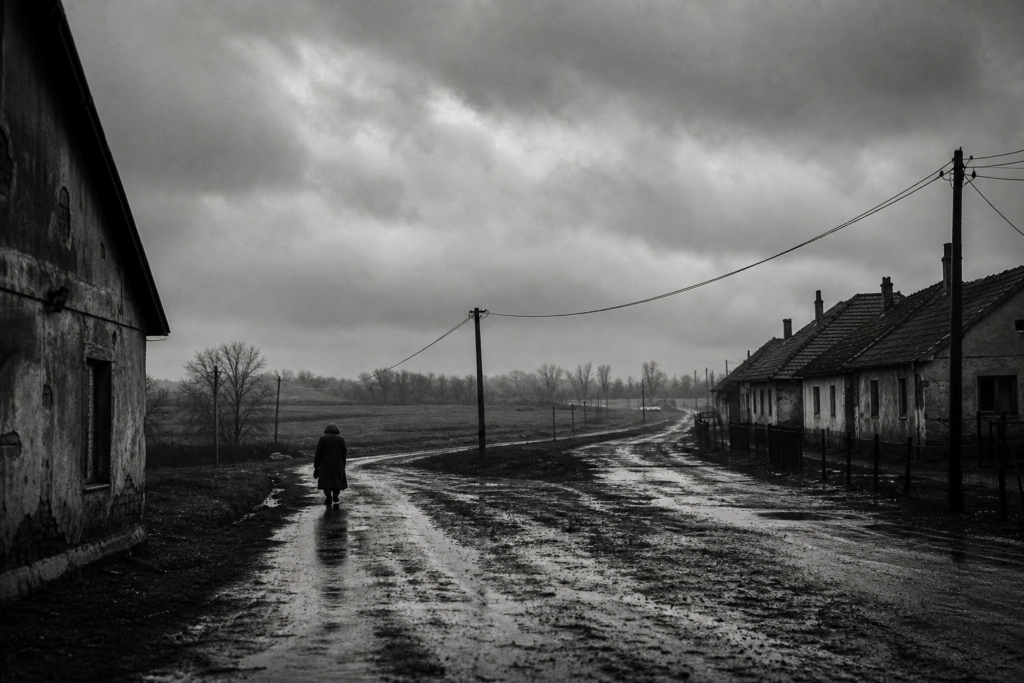
Tarr’s films are often labeled “slow cinema,” but slowness is only the surface. The deeper issue is that Tarr refuses to compress reality for the viewer’s comfort. His long takes are not indulgent; they are confrontational. They deny the viewer the relief of cutting away. If a character walks across a muddy field, you walk with them. If they sit in silence, you sit in silence. If nothing happens, you confront the fact that nothing happening is itself something.
Time in Tarr’s cinema is not neutral. It is oppressive. It wears people down. It exposes the gap between hope and outcome.
This philosophy reaches its fullest expression in Sátántangó, a film that has become legendary not only for its length—over seven hours—but for what that length accomplishes. The film follows a small rural community after the collapse of a collective farming system. The people are poor, tired, and adrift. They believe salvation may be coming. They believe someone has a plan. They believe movement is possible.
The title refers to a tango: steps forward, steps back. That rhythm defines the entire film. Characters gather. They plan. They wait. They move. And then they are undone. Again and again. Hope arrives not as light, but as repetition. Tarr shows how easily people accept false narratives when they are exhausted, and how charisma fills the vacuum left when institutions collapse.
What makes Sátántangó extraordinary is not its bleakness, but its patience. Tarr does not rush to make his point. He lets behavior speak. Long takes observe people drinking, waiting, arguing, walking through rain and mud. These scenes feel almost unbearable at times, and that discomfort is essential. Tarr is not entertaining despair; he is making you inhabit it.
His camera often moves slowly, gliding through space like an exhausted witness. It does not judge. It does not rescue. It simply observes. Tarr believed that judgment too easily becomes simplification. By withholding it, he forces the viewer to confront complicity—not in the characters’ choices, but in the desire for easy meaning.
One of the most devastating elements of Sátántangó is its portrayal of time as circular. Events do not accumulate toward progress. They loop. People repeat mistakes not because they are foolish, but because alternatives have vanished. Tarr presents despair not as personal failure, but as structural condition.
In Werckmeister Harmonies, Tarr refines these ideas into something more concentrated, though no less haunting. The film centers on a small town thrown into chaos by the arrival of a circus attraction: a massive whale and an unseen agitator known only as “the Prince.” The town’s fragile order begins to fracture. Rumors spread. Violence simmers.
The film is often interpreted politically, and rightly so, but Tarr resists allegory as explanation. The whale is not a symbol to be decoded. The Prince is not a villain to be unmasked. They function as catalysts, exposing how easily people surrender reason when meaning dissolves.
One of Tarr’s central insights is that when belief systems fail, people do not become rational. They become vulnerable. They look for certainty wherever it can be found. Tarr films this vulnerability with compassion, even as he shows its consequences.
The film’s most famous sequence—a long, unbroken shot inside a hospital as a mob moves through corridors—contains almost no dialogue. The horror is not loud. It is methodical. The camera follows, refuses to intervene, refuses to cut. Violence emerges not as chaos, but as grim procedure. Tarr suggests that cruelty often wears the mask of order.
At the center of Werckmeister Harmonies is a young man who believes in harmony—cosmic, musical, moral. He tries to understand the universe as structured and meaningful. Tarr places this belief inside a world that no longer supports it. The tragedy is not that harmony is mocked, but that it cannot survive contact with reality.
Tarr’s final film, The Turin Horse, is his most stripped-down and uncompromising work. Inspired by an anecdote about Nietzsche witnessing a horse being beaten and collapsing into madness, Tarr imagines the life of the horse’s owner and daughter. Day after day, they repeat the same routines: waking, dressing, eating boiled potatoes, enduring the wind, returning to their chairs.
The world does not explode. It shuts down. Light dims. Water disappears. The wind howls endlessly. Even language begins to fail. There is no revelation, no redemption, no escape. Tarr presents the end of the world not as spectacle, but as attrition.
This film clarifies Tarr’s ultimate position. He was not interested in despair as drama. He was interested in despair as condition. What happens when all narratives collapse? When progress is no longer believable? When endurance is the only remaining virtue?
And yet, Tarr is not nihilistic. He does not sneer at his characters. He films their routines with solemn respect. Eating a potato becomes an act of defiance. Getting dressed becomes labor. Survival itself becomes tragic.
What makes Tarr a giant is that he forced cinema to confront something it avoids at all costs: the honest experience of time. Most films are machines designed to make time disappear. Tarr makes time inescapable. He understood that when you strip away illusion, what remains is duration—and that duration shapes who we become.
His influence is visible in many contemporary filmmakers who adopt long takes and minimalism, but Tarr’s work remains singular because it is philosophical to its core. His slowness is not aesthetic; it is ethical. He believed it was dishonest to speed through suffering.
Béla Tarr collapsed cinematic time not to provoke, but to tell the truth. He showed that when systems fail, when belief erodes, when hope becomes dangerous, life does not resolve into meaning. It continues. Slowly. Relentlessly. And cinema, if it is to be honest, must be willing to continue with it.
You’ve been listening to Filmmaking Giants. Today’s episode was Béla Tarr — the collapse of time, and the courage to let cinema endure what life endures.