Deep Dive — John Stuart Mill: Collectivism vs. Individualism
John Stuart Mill is one of those philosophers who never really becomes “historical,” because the world keeps reproducing the dilemmas he cared about in new forms. How should we balance individual freedom against collective well-being? When does a majority become a moral danger to minorities? What do we do with ideas we find offensive or frightening? How do we protect truth in a society that loves comfort more than inquiry? And beneath all of that, a quieter, more personal question: what kind of human being does a free society require, and what kind of society does a fully human life require?
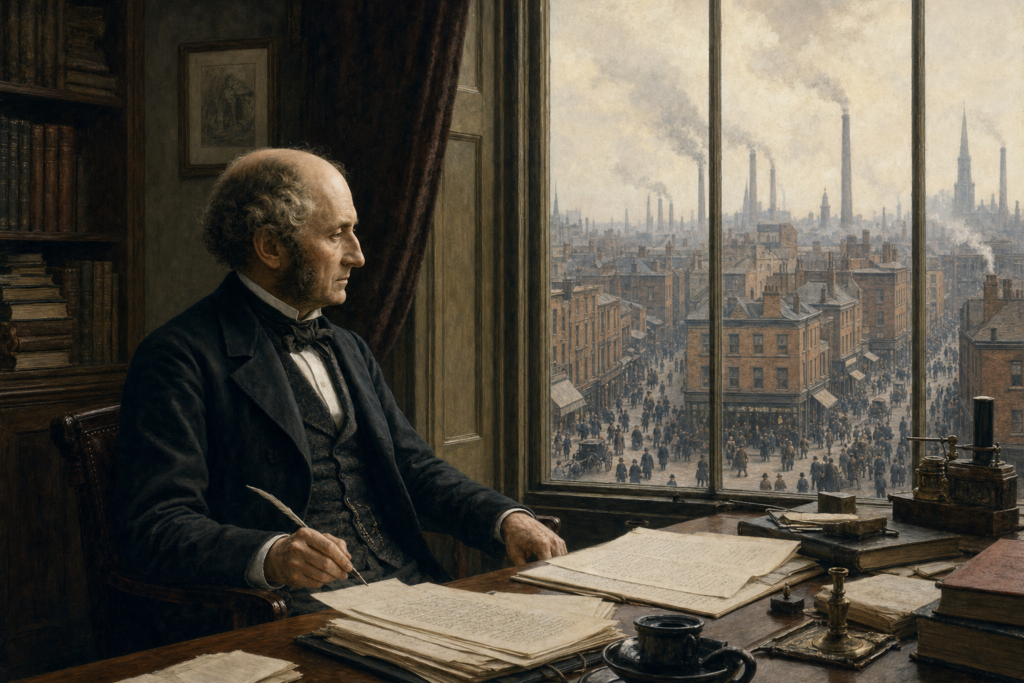
Mill was born in London in 1806 and died in 1873. Those dates place him inside a Britain transforming itself with industrial speed. Factories multiply, cities swell, wealth concentrates, and the British state becomes more sophisticated and more intrusive at the same time. The modern world is arriving: newspapers and mass public opinion, administrative bureaucracies, an expanding empire, and a growing working class living close to the edge of survival. Mill grows up amid a paradox that will haunt his philosophy: unprecedented progress in knowledge and production alongside stubborn cruelty, inequality, and conformity. He’s surrounded by the promise of improvement, but also by the fear that improvement might come at the cost of the human spirit.
His story begins with an education so intense it sounds like a laboratory experiment. Mill’s father, James Mill, was a formidable intellect and a close ally of Jeremy Bentham. Together, James Mill and Bentham belonged to the utilitarian reform movement that believed society could be made more humane if we stopped worshipping tradition and started judging institutions by their consequences for human well-being. Bentham gave that movement its sharp moral engine: maximize happiness, minimize suffering, and refuse to sanctify pain. James Mill took that engine and decided to build a human being around it.
John Stuart Mill was the experiment.
He was taught Greek almost from childhood. He read ancient history and philosophy earlier than most people read novels. He absorbed logic, political economy, and moral reasoning as if they were a native language. This education produced a mind of astonishing range, but it also produced a peculiar emotional strain. There is a temptation to romanticize the prodigy: the brilliant boy, the early genius, the mind racing ahead of everyone else. Mill’s own recollection is much less romantic. He describes the pressure of being shaped toward a single aim—reform, rational improvement, the utilitarian mission—without having the ordinary emotional development that makes life feel like more than a set of tasks.
Then the crisis comes, and it matters because it changes the kind of utilitarian Mill will become.
In his early twenties, Mill suffered a severe depression. The most revealing part of his account is the question that triggered it. He asked himself: if the world reforms I have worked for were suddenly achieved—if misery were reduced, if injustice were corrected, if the Benthamite program of social improvement succeeded—would I be happy? The answer that rose up in him was no. And that answer terrified him. It suggested that the whole project, as he had internalized it, was missing something essential. He had been trained to pursue a goal, but not to live. He had been trained to calculate public good, but not to cultivate the inner resources that make public good meaningful.
This is more than biography; it’s philosophical evidence. It shows where utilitarianism can become spiritually thin if it is treated as mere arithmetic. Bentham’s original clarity is powerful—count the pain, count the pleasure, justify institutions by their effects—but if you treat happiness as nothing more than summed sensations, you risk designing a world that produces comfort without depth. Mill’s crisis forced him to widen the meaning of happiness, and in doing so he widened the utilitarian tradition itself.
His recovery tells you what he thought was missing. Mill says that poetry and the Romantic imagination helped restore him. That detail is not decorative. It is a statement about moral psychology. It means he did not recover by abandoning reason, but by supplementing reason with feeling and imagination. He came to believe that the capacity to care is not automatic, and that the capacity to care intelligently requires cultivation. You need sympathy, yes, but you also need the imagination to picture lives unlike your own. You need aesthetic sensibility not because beauty is a luxury, but because the human mind needs more than utility in the narrow sense; it needs meaning, aspiration, and the freedom to become.
Mill’s adult life was a blend of thought and institution. For decades he worked at the East India Company, the organization that administered British rule over large parts of India. This is one of the facts that prevents any shallow hero-worship of Mill. His career was embedded in empire. His daily work participated in a system of domination. That doesn’t mean he was a cartoon villain, and it doesn’t mean his philosophy is worthless. It means that a serious deep dive has to include a hard lesson: liberal ideals can coexist with imperial structures, and moral insight can be uneven. Mill’s life forces us to ask whether a philosophy of liberty is truly universal in practice, or whether it sometimes becomes a privilege reserved for those inside the circle of “civilization.”
At the same time, Mill became one of the most important public intellectuals of the nineteenth century, and eventually a Member of Parliament. He wrote on logic, economics, ethics, and political theory. The range of his work is dizzying, but the center of gravity remains consistent: he is always trying to understand what makes human development possible, and what kinds of social power threaten that development.
Two relationships shaped his moral imagination in different ways. One is his relationship with Benthamism through his father, a kind of inherited intellectual discipline that gave him clarity and reformist ambition. The other is his relationship with Harriet Taylor. Harriet was not merely a muse; she was a powerful thinker, and Mill himself insisted that she profoundly influenced his views, especially on marriage and women’s rights. Their partnership, controversial in a prudish Victorian world, pushed Mill to see how oppression can live inside “private” life and how custom can be as coercive as law. It also reinforced one of his deepest convictions: that people are not born into fixed roles for the benefit of tradition. They are beings who must be allowed to grow.
Now, to Mill’s moral philosophy—because this is the heart of your final episode.
Mill remains a utilitarian. He never fully abandons the idea that morality is ultimately about promoting happiness and reducing suffering. But he argues that Bentham’s form of utilitarianism is incomplete if it treats pleasures as essentially the same in kind and different only in degree. Mill introduces the famous distinction between higher and lower pleasures. The problem he is trying to solve is not merely intellectual. It is deeply human: how do you defend an ethics of happiness without reducing human life to a soft animal comfort?
Mill’s answer is that human beings have faculties—reason, imagination, moral feeling, aesthetic appreciation—that generate pleasures different in quality, not merely in quantity. He argues that people who have experienced both kinds of pleasure tend to prefer the higher pleasures even when the higher pleasures bring more dissatisfaction. This is where he produces one of the most quoted claims in modern ethics: it is better to be a human being dissatisfied than a pig satisfied; better to be Socrates dissatisfied than a fool satisfied. The point is not to sneer at ordinary enjoyment. The point is to insist that a “happy life” worthy of the name includes more than comfort. It includes the exercise of the mind, the development of character, the experience of beauty, the pursuit of truth, the cultivation of conscience.
This move expands utilitarianism. Happiness becomes not merely the sum of pleasures but a richer condition of human flourishing. And once you accept that, the political implications explode, because the state and society are no longer responsible merely for preventing pain. They are responsible, at least indirectly, for protecting the conditions in which higher forms of happiness can exist: education, free discussion, cultural development, and the freedom to experiment with ways of life.
From here, Mill’s most famous work emerges naturally: On Liberty.
Mill’s central principle in On Liberty is the harm principle: the only legitimate reason for society—whether through law or social coercion—to restrict an adult’s liberty is to prevent harm to others. If a person’s action affects only themselves, society has no right to force them “for their own good.” This is one of the most influential sentences in political philosophy, and it is easy to repeat it like a slogan, so it’s worth slowing down and hearing what Mill is trying to protect.
He is protecting growth.
Mill does not believe individuals are always wise. He knows people make foolish choices. He knows people ruin themselves. But he argues that a life guided by external coercion cannot develop the inner capacities that make a person fully human. If you are always forced into what others call your best interest, you do not develop judgment; you develop obedience. Mill believes that human beings become capable by practicing choice, learning from consequences, and building a personal relationship with truth and responsibility. A society that treats adults like children may reduce certain visible harms, but it produces a deeper harm: it stunts moral agency.
This is why Mill’s liberty is not simply the freedom to do whatever you want. It is the freedom to become. Liberty, for Mill, is a condition for the development of character, and character is a major component of the higher happiness his refined utilitarianism requires.
Mill’s deepest political fear is not the tyrant with a crown. It is the tyranny of the majority. He is writing at a time when democratic reform is expanding political participation, and he supports that expansion, but he also sees a new danger. When “the people” become powerful, the people can become oppressive. The majority can use law, and even more effectively social pressure, to enforce conformity. It can punish differences that do not fit the reigning moral taste. It can shame, exclude, ruin reputations, and create a culture where deviation feels unsafe even when it harms no one.
Mill’s insight here is sharper than it first appears: coercion does not only happen through police and prisons. It happens through respectability. It happens through the threat of being treated as morally contaminated. It happens when the crowd decides which opinions are “allowed” and which are treated as proof of wickedness. You can be legally free and socially suffocated. Mill saw that clearly, and he feared that industrial modernity—mass society, mass institutions, mass opinion—would intensify the pressure to become average.
This brings us to his defense of free speech, which remains painfully relevant.
Mill argues that silencing an opinion is always harmful. If the silenced opinion is true, society loses truth. If the silenced opinion is false, the contest with error strengthens society’s understanding of truth. Beliefs held without challenge, Mill says, become dead dogma. People repeat them like prayers without grasping why they are true. They lose the living relationship to evidence and reasoning that makes a belief meaningful. In this way, even false opinions can be useful, because they force defenders of truth to clarify, refine, and sometimes correct their own views.
Mill also adds a subtler point that is often forgotten: an unpopular opinion might be partly true. Reality is complex. The minority may see something the majority is blind to. The only way to discover that is to keep discussion open. Free speech, in this sense, is not a sentimental permission; it is a method of collective self-correction. It is society admitting that it might be wrong and building a mechanism for discovering its own errors.
But Mill is not naive about context. He recognizes that speech can function as action. The same words can be harmless in one setting and dangerous in another. A claim printed in a journal is different from the same claim shouted to an angry crowd outside a person’s home. Mill’s standard is still harm: expression that directly becomes incitement or coercion can be restricted because it crosses from opinion into immediate injury. Yet he is wary of expanding “harm” so far that it becomes a weapon for silencing whatever the majority dislikes. His worry is that discomfort will be mistaken for harm, and the fragile comfort of the majority will become the new censor.
Then there is Mill’s celebration of individuality, which is not mere self-expression. Mill argues that individuality is a social good. When people are allowed to live differently, society benefits from a diversity of experiments in living. Some experiments fail; society learns what not to do. Some experiments succeed; society gains new possibilities. A uniform society becomes stagnant because it loses its capacity to adapt. Mill even praises eccentricity, not because oddness is automatically wise, but because a society that can tolerate eccentricity is a society that has not become spiritually rigid.
This is where Mill’s thought becomes almost prophetic. He feared the “despotism of custom,” the way habit can become invisible tyranny. Industrial society, he suspected, would produce standardization: standard work, standard taste, standard opinion. The danger is not only that people become unhappy, but that they become smaller. The human being becomes a replaceable unit rather than a self-directing life.
So far, Mill might sound like a pure libertarian, but he isn’t. His liberty is bounded by harm to others, and his utilitarian foundation keeps him concerned with social welfare. He is trying to fuse two impulses that often collide: the impulse to protect individuals and the impulse to improve society. This fusion produces a tension that makes Mill interesting: if we are utilitarians, shouldn’t we sometimes coerce for the sake of the greater happiness? Mill’s answer is that liberty itself is one of the deepest sources of long-term happiness and progress. Coercion, even well-intended, produces dependence, mediocrity, and resentment. A society of coerced goodness becomes morally lazy. A society of free individuals has a chance—only a chance, not a guarantee—of developing a richer and more resilient form of life.
Mill’s political and economic writings broaden this picture. He supported representative government and democratic reform, but he worried about an uneducated electorate being manipulated or acting from ignorance. Some of his proposals in this area feel elitist today, like his flirtation with giving more voting power to the more educated. You don’t have to endorse that to see the underlying concern: democracy without education can become democracy without judgment, and democracy without judgment can become tyranny with a smile. Mill’s best solution was not permanent hierarchy but moral and intellectual development—education, free discussion, and institutions that encourage competence.
In economics, Mill accepted much of classical political economy but made a crucial distinction: the production of wealth follows certain constraints, but the distribution of wealth is shaped by social institutions and can be changed. That distinction matters because it undercuts the fatalistic idea that poverty and inequality are simply natural outcomes. Mill becomes increasingly open to cooperative and socialist experiments, not because he worships state control, but because he is searching for arrangements that increase security and dignity for the many while preserving liberty and development.
Then comes The Subjection of Women, which is one of the most courageous moral documents of his era.
Mill argues that the legal and social subordination of women is not natural; it is a system of domination maintained by custom and law. He insists that marriage, as traditionally structured, grants men coercive power and reduces women to dependency. He argues for legal equality, equal education, and access to professions. This is not only an argument about justice; it is also an argument about human flourishing. A society that blocks half its population from full development wastes immense potential and corrupts the moral character of everyone. Domination degrades the dominator. Submission degrades the submitted. Equality, for Mill, is not a sentimental ideal; it is a condition for genuine happiness understood as the development of human capacities.
Here, Mill’s critique of custom becomes a moral weapon. People confuse “what is” with “what must be.” They treat familiar arrangements as natural. Mill trains you to suspect that confusion. The fact that something has always been done does not prove it is good. It proves only that it has been done. If moral progress is possible, it requires the courage to imagine that the ordinary might be wrong.
Now we confront the contradiction we promised: Mill and empire.
Mill’s involvement in the East India Company and some of his writings about “civilizational stages” reveal a paternalism that is hard to ignore. At times he suggests that despotism might be justifiable in dealing with “barbarians” if it serves their improvement. Today, that reasoning looks like a classic colonial excuse: domination presented as education. It violates the universal spirit of liberty that Mill otherwise defends. A modern listener can feel the fracture: how can a philosopher so attuned to the tyranny of custom and the coercion of social power accept the coercion of imperial rule?
The most honest approach is not to protect Mill from this tension but to learn from it. Mill’s own method demands that we apply criticism even to him. If dissent is necessary for truth, then dissent that exposes liberal hypocrisy is necessary too. If individuality matters, it matters for colonized peoples as well, not only for Europeans. If harm to others limits liberty, then imperial domination—so often justified by abstract “progress”—must be evaluated by the actual harms it produces: exploitation, cultural destruction, violence, and the theft of self-determination. In this way, Mill can become a tool for criticizing the limitations of his own context, which is, in a strange way, a fitting tribute to his belief that no idea should be protected from examination.
Now bring Mill into the present, because this is your final episode, and it should close the series by connecting philosophy to life.
Mill’s fears about the tyranny of the majority look newly relevant in an age where public opinion can be amplified instantly and globally. Social media can create a permanent public courtroom. Reputation can be destroyed in hours. People can be pressured into conformity not by law, but by the threat of collective shaming and exclusion. Mill would recognize this as social coercion, and he would ask: are we punishing people for causing harm, or are we punishing them for violating the comfort of the crowd? He would also ask whether our public discourse is genuinely aimed at truth or whether it has become performance aimed at status.
His defense of free speech becomes more complex in our world because speech now spreads at scale, and misinformation can erode shared reality. Mill would still insist that censorship is dangerous and that open debate is essential, but he would also insist on the conditions that make open debate productive: education, critical thinking, good-faith norms, and institutions that reward truth-seeking rather than outrage. In other words, Mill’s free speech is not merely permission; it is a demanding ideal. It requires citizens capable of reason, not just citizens capable of shouting.
Mill’s harm principle also speaks directly to AI governance and algorithmic power. When systems decide who gets a job interview, who receives a loan, whose content is amplified, or who is flagged as “risky,” the harms are not always dramatic and immediate. They can be statistical, cumulative, and invisible: a thousand small exclusions that shape a life. Mill’s framework forces clarity. If we restrict liberty—whether through surveillance, automated scoring, or predictive control—we must be able to show harm prevented, and we must be honest about harms created. He would likely push hard against vague claims of “safety” used as a blanket justification for coercion. He would demand evidence, transparency, and public accountability, because without them the machinery of “public good” becomes a mask for domination.
And then there is Mill’s deepest personal lesson: happiness is not merely comfort. A life of higher happiness requires development—intellectual, moral, aesthetic. It requires the freedom to choose, to err, to revise, to become. When a society removes that freedom “for your own good,” it may reduce certain immediate risks, but it risks producing a population of trained dependence. Mill’s warning is not romantic. It is practical: a society that does not allow individuals to become capable will eventually lack the capabilities it needs to remain free.
So if we end this series with Mill, we end with a set of living questions rather than a finished doctrine.
When you feel pressure to conform, ask whether the pressure is protecting others from harm or merely enforcing comfort. When you encounter an idea you despise, ask whether you want it silenced because it is harmful or because it is threatening to your identity. When you see a minority being targeted, ask whether the majority’s certainty is actually moral laziness—an unwillingness to do the hard work of thinking. When you feel the urge to outsource your judgment to a crowd, ask what kind of person you become when you stop practicing your own reasoning.
Mill does not promise that liberty will make life easy. He promises that without liberty, life becomes smaller. A society that systematically makes life smaller—by punishing dissent, shaming difference, freezing people into roles, and treating custom as sacred—may achieve a certain stability, but it will not achieve the kind of happiness that an honest utilitarian should care about: a happiness that includes dignity, growth, and the power to direct one’s own life.
If Bentham gave us the demand that suffering must be justified and minimized, Mill gives us the demand that human beings must not be reduced to contented instruments. They must be allowed to become themselves. And that demand is not sentimental. It is ethical and political. It is the condition for a civilization that can keep learning, keep correcting itself, and keep expanding the circle of those who are allowed to live with dignity.