NOMOTO MEDIA Read, listen and watch Articles, podcasts, films, stories, books, music and research.
CHAPTER 00 / THE WET SEAT
One passenger is missing.
The seat is wet. It has not rained. Someone says the passenger was carrying an empty birdcage.
Browse all content Explore the subway
READ ARTICLES
EXPLORE RESEARCH
SEARCH ALL WORK
BULLSHIT CENTRIFUGE
A dreamlike journey through the human condition: moral philosophy from Thales to Arendt and Camus, psychology, science, film, and AI as a new test of old human questions. There is no required route.
Nomoto Media system map
Power, Thought, Art, and Memory cross at shared stations. Each interchange connects films, voices, and texts through a common question.
AI: An Uncertain Future AI articles Psychology Philosophy Scientific Giants Research Short Stories Books Films Filmmaking Giants Theatre Classical Music Music Addiction & Recovery Articles All Content The Mapmaker American Presidency How Empires Rise and Fall CLOSED LINE / NEW YORK CLOSED LINE / PARIS CLOSED LINE / MOSCOW
DEPARTURE / THE SYSTEM IS WAKING ENTER TRANSIT THE MAP WILL OPEN WHEN READY
POWER LINE THE WATCHING ROOM BETWEEN STATIONS
← Back to map
LOCAL YEAR 2026 SHIFT YEAR ↻ N STATION TOUCH SIGN
NOMOTO MEDIA
Title
Description
← PREVIOUS STORY 01 / 05 NEXT → RANDOM STORY ↻ ALL STORIES
THE POSTER IS MOVING
×
A PASSENGER SAYS
READ IN THE CARRIAGE →
LISTEN IN THE CARRIAGE →
SHIFT YEAR AGAIN ↻
FOLLOW THE TRANSFER →
CONTINUE THE JOURNEY →
WORDS BESIDE THE FILM / DRAG TO MOVE
READ THIS PASSAGE →
GIVE ME ANOTHER QUOTE ↻
LOOK AGAIN THE QUESTION FOUND OBJECT
×
EVIDENCE / UNFILED
A detail refuses to disappear.
KEEP THIS CLUE
01 FILM ARCHIVE
FILM / RELATED WORK FOLLOW THE SIGNAL READ IN THE CARRIAGE → LISTEN IN THE CARRIAGE → THINK WITH THIS → ALL PODCAST EPISODES → TAKE THE NEXT TRAIN → ASK THE CONDUCTOR →
PLAY FILM DOWNLOAD SHORT NEXT FILM → HIDE QUOTE FILM CONTROLS ← Back to journey
ORIGINAL NOMOTO SECTION ARTICLES 220 works · original categories and publication pages ORIGINAL NOMOTO SECTION COLLECTIONS Connected bodies of work ORIGINAL NOMOTO SECTION BOOKS Long-form work and complete manuscripts ORIGINAL NOMOTO SECTION SHORT STORIES Fiction · memory · absurdity · human consequence ORIGINAL NOMOTO SECTION VIDEO Films and moving-image work ORIGINAL NOMOTO SECTION MUSIC Original sound and audiovisual work ORIGINAL NOMOTO SECTION RESEARCH Evidence · prediction · power · consequence ORIGINAL NOMOTO SECTION ABOUT NOMOTO The work, author, and contact route 02 / PHILOSOPHY THE COMPASSIONATE STOIC Enter the inner chamber 03 / HUMAN CONDITION FACES REMEMBER All witness fragments · one film 04 / UNBUILT THE CITY BORROWS OUR BODY Travel forward 09 / NOMOTO MEDIA LONELY ROBOT NOMOTO MEDIA archive · music/video experiment 12 / NATURAL HISTORY GREEN RIVER FOSSIL COMPANY Quarry · preparation · geological design 13 / PHILOSOPHY MARCUS AURELIUS / THE INNER CITADEL Film → thinker → text → narration 15 / LABOR THE ASCENT AFTER THE SHIFT Film → essay → local narration 17 / MEMORY THE MEASURE THAT OUTLIVED THE MAKER Film → Little Book 18 / FUTURE THE LAST TRAIN LEAVES EARTH Film → Newton dramatic script 19 / AI ROBOT LOVE / RUNNING Film → friendship and attachment 20 / CARE THE REACH Film → A Little Book of No Consequence 05 / FICTION / SHORT STORY THE WATCHER READ IN THE CARRIAGE 06 / FICTION / SHORT STORY THE LAST MANUAL GENERATION “THE INVITATION ARRIVED ON PAPER.” PHILOSOPHY 01 WHO WAS HERACLITUS? Original script · existing audio PHILOSOPHY 02 WHO WAS SOCRATES? Original script · existing audio PHILOSOPHY 03 WHO WAS PLATO? Original script · existing audio PHILOSOPHY / THEATRE Seneca — Stoic tragedy and rhetoric Original script · existing audio PHILOSOPHY 05 WHO WAS RENÉ DESCARTES? Original script · existing audio PHILOSOPHY 06 WHO WAS JOHN LOCKE? Original script · existing audio PHILOSOPHY 07 WHO WAS DAVID HUME? Original script · existing audio PHILOSOPHY 08 WHO WAS IMMANUEL KANT? Original script · existing audio PHILOSOPHY 09 WHO WAS JOHN STUART MILL? Original script · existing audio PHILOSOPHY 10 WHO WAS KARL MARX? Original script · existing audio PHILOSOPHY 11 WHO WAS FRIEDRICH NIETZSCHE? Original script · existing audio PHILOSOPHY 12 WHO WAS MARTIN HEIDEGGER? Original script · existing audio PHILOSOPHY 13 WHO WAS JEAN-PAUL SARTRE? Original script · existing audio PHILOSOPHY 14 WHO WAS HANNAH ARENDT? Original script · existing audio PHILOSOPHY 15 WHO WAS SIMONE DE BEAUVOIR? Original script · existing audio PHILOSOPHY 16 WHO WAS ALBERT CAMUS? Original script · existing audio PHILOSOPHY 17 WHO WAS JOHN RAWLS? Original script · existing audio PHILOSOPHY 18 WHO WAS MICHEL FOUCAULT? Original script · existing audio 08 / PSYCHOLOGY WHO WAS JUNG? Read · listen · enter the shadow 09 / SCIENCE WHO WAS NEWTON? The complete original episode 09A / ORIGINAL DRAMA / STAGE OR TELEVISION NEWTON — FOUR EPISODES Complete 152-page script · read or download 10 / SCIENCE WHO WAS DARWIN? Variation · time · consequence 11 / SCIENCE BREAD FROM AIR / POISON FROM SCIENCE Follow discovery into consequence 12 / PSYCHOLOGY WHO WAS KAREN HORNEY? Against Freud · toward culture 13 / PSYCHOLOGY THE LISTENING REVOLUTION What changes when someone is heard? 15 / POWER THE WATCHING ROOM Read in the carriage 16 / COMPLETE PUBLICATION ALL 464 PUBLISHED WORKS Original sections · categories · canonical links 01 / FICTION / NARRATED SOME KIND OF LOVE LISTEN · READ · CONTINUE 02 / FICTION / NARRATED THE MIRROR LISTEN · READ · CONTINUE 03 / FICTION / NARRATED THE WATCHER LISTEN · READ · CONTINUE 04 / FICTION / NARRATED THE LAST MANUAL GENERATION LISTEN · READ · CONTINUE 05 / FICTION / COMPLETE TEXT THE ASTEROID THE ASTEROID WAS SUPPOSED TO KILL US ON THURSDAY. 20 / A LITTLE BOOK OF NO CONSEQUENCE THE BOULDER HAS EXCELLENT ATTENDANCE Read · listen · return to the hill 20B / COMPLETE BOOK LINE A LITTLE BOOK OF NO CONSEQUENCE PROLOGUE · SEVEN PARTS · COMPLETE MANUSCRIPT DOWNLOAD 23 / MEMORY LINE / 2020–2025 THIRTY OLDER WORKS RETURN TO SERVICE Democracy · economy · AI · care · war · philosophy COMPLETE ARTICLE ARCHIVE 464 ORIGINAL WORKS Ordered by original publication date 2026 / FRONT PAGE TETRIS Original text OPEN BOOKS PHILOSOPHY & HISTORICAL PSYCHOLOGY Six verified public-domain editions · read or download 17 PUBLISHED EPISODES PSYCHOLOGY All published episodes · cover art · audio 30 PUBLISHED EPISODES CLASSICAL MUSIC All published episodes · cover art · audio 39 PUBLISHED EPISODES SCIENTIFIC GIANTS All published episodes · cover art · audio 19 PUBLISHED EPISODES AI & SOCIETY All published episodes · cover art · audio 31 PUBLISHED EPISODES FILMMAKING GIANTS All published episodes · cover art · audio 34 PUBLISHED EPISODES THEATRE All published episodes · cover art · audio 62 PUBLISHED EPISODES AMERICAN PRESIDENCY All published episodes · cover art · audio 18 PUBLISHED EPISODES ADDICTION & RECOVERY All published episodes · cover art · audio 29 PUBLISHED EPISODES CIVILISATIONS RISE AND FALL War: How Empires Rise and Fall · cover art · audio 31 / FILMMAKING GIANTS OLIVER STONE The provocateur of American politics · 11 min 32 / FILMMAKING GIANTS LUIS BUÑUEL The surrealist provocateur · 19 min 33 / FILMMAKING GIANTS QUENTIN TARANTINO The pop-culture alchemist · 23 min 34 / FILMMAKING GIANTS ANDREI TARKOVSKY The sculptor of time · 18 min 35 / FILMMAKING GIANTS AKIRA KUROSAWA The bridge between East and West · 17 min 36 / SCIENTIFIC GIANTS ANTOINE LAVOISIER Matter · measure · revolution · 27 min 37 / SCIENTIFIC GIANTS MICHAEL FARADAY A new language for nature · 23 min 38 / SCIENTIFIC GIANTS GREGOR MENDEL The monk who discovered heredity · 22 min
THE SHELVES CONTINUE BEYOND THE WALL · NEW CARDS APPEAR AS THE JOURNEY GROWS
ONE PASSENGER IS MISSING / NO WRONG ANSWER
SOUND ON
Centrifuge
Read, listen and watch
07 CONTINUE MY JOURNEY Return to the marked place
Return to opening page Read this passage → Another quote ↻
← Back to map
NOMOTO MEDIA
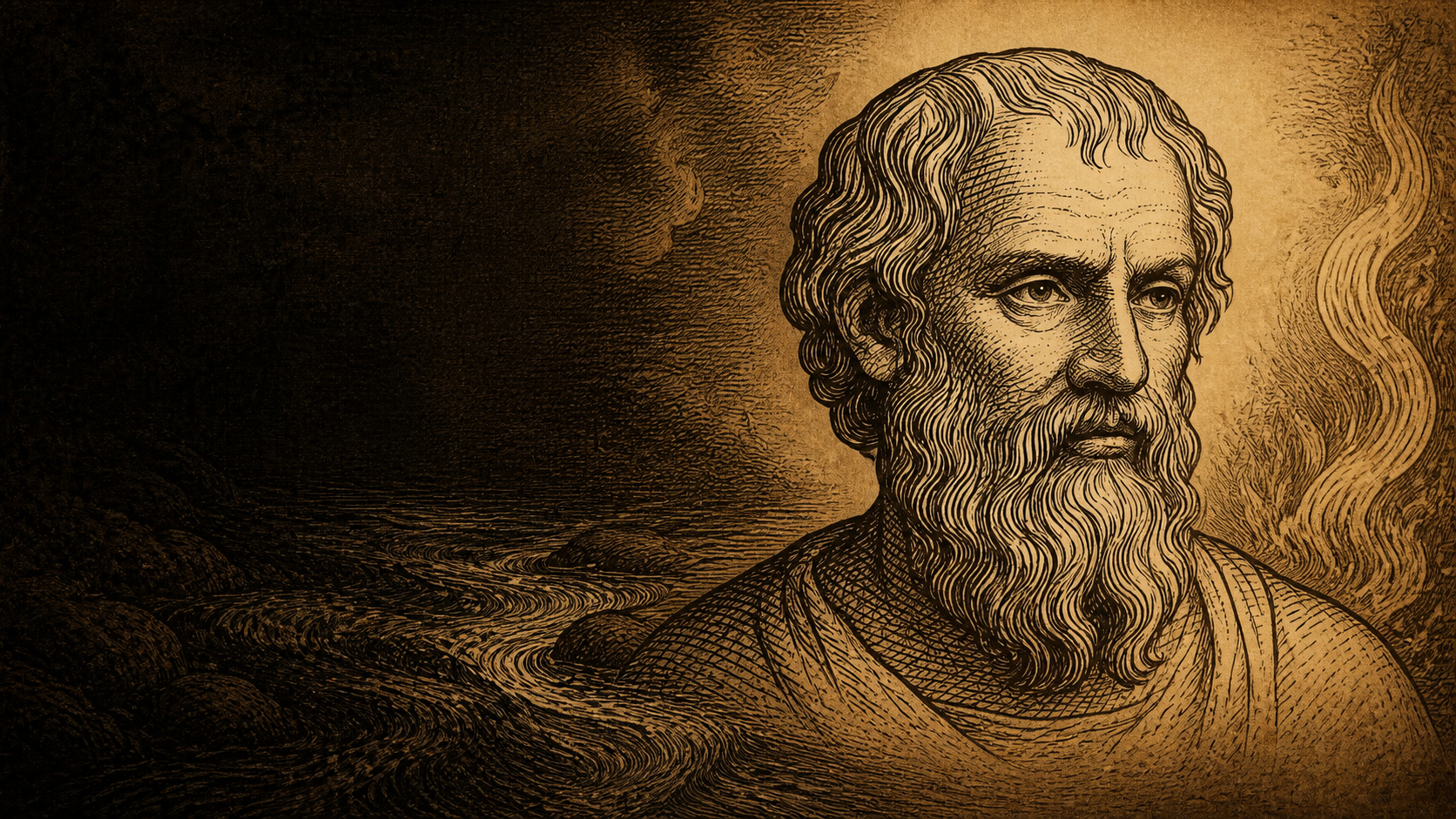
Who was Heraclitus?
LOCAL ARCHIVE VOICE / PLAYING
PAUSE / RESUME EPISODE ALL PODCASTS → READ FULL TEXT → DOWNLOAD TEXT DOWNLOAD AUDIO SAVE MY PLACE COPY LINK READ RELATED WORK → READ A PRIMARY SOURCE → THINK WITH THIS → CONTINUE THIS IDEA →
THE NEXT MOVE BELONGS TO YOU
How do you want to continue?
I WANT TO READ Open the complete text in the carriage.
I WANT TO LISTEN Resume—or begin the narration again.
CONTINUE THE JOURNEY Carry this idea to another station.
RETURN TO THE PORTRAIT ×
RETURN TO THE PLATFORM ×
NOMOTO Transit is an interactive audiovisual journey and requires JavaScript. You can still read the articles , explore the research , or browse every work .
Antoine‑Laurent Lavoisier You’re listening to “Scientific Giants Who Changed Our world.” Each episode stands beside one mind and follows a thread of curiosity until it ties to the world we inhabit. Today we unlock a small laboratory in Paris where the air is weighed as carefully as gold and names are chosen with the seriousness of treaties. On a bench sit a water‑sealed gasometer, a balance so sensitive that breathing on its pans could ruin an afternoon, glass retorts with long swan necks, a furnace that keeps its temper because the person who tends it keeps his. In this room a familiar world of elements will be sorted again, and a rumor with a pleasing name will be weighed and found wanting. The man is Antoine‑Laurent Lavoisier. He will show that air is not a single thing, that water is not an element, that burning is not a spirit fleeing but a combination proceeding, and that chemistry is not kitchen prestidigitation but an exact craft done under the supervision of numbers. He will make a language to keep what he has made. He will tie law to flame, and then politics will cut the cord at the neck. His head will fall in a square; his sentences will keep working in laboratories he never saw.
Begin with the bad idea because a good reformer needs a villain. For chemists in the eighteenth century, that villain was a gentleman with a smooth name: phlogiston. Take a piece of metal and heat it until it glows, and it gains weight as it turns to a calx, a powder that looks like ash. Take charcoal and burn it, and you are left with less than you began with. Theories thrive where you can choose your example to match your preference. Phlogiston was said to be a fiery principle that was released during burning and calcination. If a metal gained weight, perhaps phlogiston had negative weight; if charcoal lost weight, perhaps phlogiston was escaping into the air. A single elastic premise—an essence that could weigh less than nothing—patched every tear. It was a generous story. It kept company with the idea that nature’s changes are the motions of essences—earth, water, air, fire—across a stage without props. It let chemists talk as if their stoves were altars and their vessels religious. Only one thing annoyed the story. It refused to balance.
Lavoisier disliked fables. He had trained as a lawyer, mastered geometry with pleasure, and entered the Academy of Sciences young, where a prize for lighting the streets of Paris certified his love of practical devices. He also joined, by investment, the Ferme générale, a consortium that farmed the king’s taxes, and later the gunpowder administration, which made him responsible for the purity and supply of saltpeter. Those roles paid well and compromised him politically; they also put him in rooms where numbers mattered and where the reward for method was not applause but fewer accidents. He set up his laboratory in the Arsenal, the government’s great storehouse, with Marie‑Anne Pierrette Paulze—his wife, his translator, his illustrator, and often his second pair of hands—turning apparatus into engravings and English pamphlets into French sentences. He had the tools a reformer needs: patience, a balance, and a partner who could make a drawing understandable in bad light.
The air, in his hands, became a reagent rather than a rumor. The balance became a conscience. He learned the trick that made his century’s chemistry leap ahead of the last: include the container and the air in the account. When a metal was heated in a sealed vessel, its calx weighed more than the metal—but the trapped air weighed less than before. The increase and the decrease canceled. Nothing had been created or destroyed. Matter changed partners and clothing. The total remained the same. Others had glimpsed this conservation earlier, in Russia and in Germany and in Scotland, but Lavoisier made the principle public and promiscuous. He insisted that it govern every reaction and that it be printed on the first page of a new chemistry. He never tired of saying it in modest words: in all the operations of art and nature, nothing is created; an equal quantity of matter exists before and after the experiment; the quality and form may change, but the mass is the same.
He did not overthrow phlogiston with rhetoric. He did it by changing what counted as a good explanation. In the 1770s, Joseph Priestley in England heated a red calx of mercury and collected a gas that made flames burn fiercely and mice live longer. He called it “dephlogisticated air,” because his grammar preferred to describe the world by what it lacked. Lavoisier repeated the heating, watched mercury return from its calx, and weighed the air. He called the gas “oxygen,” from Greek roots meaning “acid‑former,” because he believed, not unreasonably for his time, that oxygen gave acids their force. The name was wrong in part, but the direction was right. Oxygen was not the absence of a myth; it was the presence of a partner. Air, ordinarily, is a mixture; combustion is the rapid union of a combustible with oxygen; respiration is a slow combustion. Chemists could stop hunting the history of a spirit’s escape and start writing ledgers of combinations that matched before and after. A flame stopped looking like a scandal and started looking like arithmetic in a bright mood.
Once oxygen had a seat at the table, other airs had new names and habits. “Fixed air,” Joseph Black’s gas that would not support life or flame, became carbonic acid gas and then carbon dioxide. The “inflammable air” that Henry Cavendish collected around metals in acid became hydrogen, water‑former. Lavoisier set about doing publicly what many labs had done privately: he made a ledger of the atmosphere. Ordinary air was mostly a part that did not support combustion—azote, later nitrogen—and a part that did—oxygen. Nitrogen would not be banished as useless; it would become the quiet majority in every breath, a ballast that steadies flames and lungs alike. Hydrogen and oxygen together would be the key to water. Carbon would be seen in its gas as carbonic acid. The muddle of airs dissolved into a small chorus with parts.
Water, in his hands, ceased to be an element. It had long worn the dignity of basicness. Lavoisier decomposed it and made it again. He passed steam over hot iron and collected hydrogen as the water was absorbed by the metal; he burned hydrogen in oxygen and weighed the water that formed on glass walls. The balance did not lie. Two gases could become a liquid if you chose the partners and the proportions. With those demonstrations he closed one large door of the ancient world. If water can be taken apart and built again, you must revise your list of the simple. In his Traité élémentaire de chimie—the textbook that was really a constitution—he defined an element not as a philosophical atom but as a substance that cannot be decomposed by any known chemical operation. The definition was humble and generous; it allowed future chemists to remove things from the list without calling their predecessors fools. You commit to methods, not to metaphysics.
He and Pierre‑Simon Laplace built an instrument that looked like a riddle and behaved like a ledger: an ice calorimeter. A chamber held a small animal—often a guinea pig—whose breath and warmth would do what breath and warmth always do, and around the chamber sat a jacket of ice. Meltwater was collected and weighed. The same apparatus could hold a burning piece of charcoal. The water that trickled told them that respiration and combustion liberate comparable quantities of heat; in Laplace’s calculus and Lavoisier’s scales, a living creature and a coal fire took their places on the same page. They measured the heat of a chemical reaction without flinching at the poverty of their theory of heat. They believed in caloric, a subtle fluid that flowed from warmer to colder bodies; we believe in energy, a conserved book‑keeping that lives in motions large and small. The metaphors changed; the measurements did not need to. The ice melted all the same.
He was as happy to end a myth as to propose a name. Diamonds had been praised as miraculous substances beyond corruption. He placed a small diamond in a sealed vessel, filled the vessel with oxygen, and heated it until the jewel vanished. The balance did not shrug; the scale that measured the diamond’s loss matched the new carbonic acid gas that appeared. Diamonds are carbon, not miracle. Corruption had been renamed combination, and opulence had been exposed as chemistry. It was a small experiment with a large moral. Value is not a metaphysical category; it is a choice human beings make about what to prize. In the lab, everything obeys the same gravity of method.
Because language shapes thought, he changed the language. With Guyton de Morveau, Claude‑Louis Berthollet, and Antoine Fourcroy he wrote the Méthode de nomenclature chimique. Instead of “vitriolic acid,” “oil of vitriol,” and “spirit of sulfur,” say sulfuric acid; instead of “flowers of antimony,” say antimony trioxide; instead of “luna cornea,” say silver chloride. Name salts by the acid and base that form them. Attach suffixes to denote oxidation state. Let words carry structure. The reform was not a quarrel in print; it was a public utility. If a chemist in Stockholm and a chemist in Naples write the same name, their students can talk without carrying a cabinet of synonyms on their backs. A science becomes mobile when its language can be learned in months. He wanted a chemistry that could survive war and poor memory, and for that you need words that carry instructions.
He knew that chemistry could not be kept in small rooms. Gunpowder, that mixture of saltpeter, sulfur, and charcoal, is chemistry with consequences. In the Régie des poudres, he learned to carry method into a national supply chain. Saltpeter is not a mystical exhalation; it forms where nitrogenous waste meets air and time, in soils and walls and manure. He designed nitre beds, improved leaching and crystallization, insisted on purity, and by this insistence gave the state powder that was more reliable, less smoky, more powerful. He applied the same steadiness to the management of people as to the crystallization of salts: write rules down, count carefully, correct processes instead of blaming hands. A nation that wants its armies to fire needs chemists who accept boredom and budgets. He did not romanticize the work. He made it behave.
Fermentation, too, passed through his scales. He mixed sugar and water with yeast, trapped the gas that left the mixture, and weighed the alcohol that remained. The new arithmetic of reactions came into view: sugar splits into alcohol and carbonic acid gas with little else left behind. He did not draw the structural formula a later century would put in a student’s book, but he wrote in a line what bakers and brewers had always known in the hands: the weight of the gas you smell and the drink you pour accounts for the sugar you began with. In that simple calculation the future of biochemistry is already visible. Life’s processes can be written with the same ledgers as flames.
The battles were public and sometimes unkind. Priestley, a dissenting minister and an experimental genius, disliked Lavoisier’s claims on nomenclature and cause. He thought phlogiston a better servant than oxygen for telling a story about flames. He distrusted the French taste for theory; he prized messy, productive tinkering. Carl Wilhelm Scheele in Sweden had also found the active part of air—call it fire air—in the early 1770s, quietly, in a small town, sending manuscripts off too slowly to claim priority before louder men arrived. Lavoisier replied with a tone that struck some as imperious and many as necessary. Priority mattered less, he said, than putting the right words on the right shelves and making the numbers add. He did not deny that others had sniffed oxygen first; he insisted that the explanation that would rule must be attached to measurements any stranger could reproduce. The world will forgive a boast less readily than it will tolerate a muddle. He tried to live in the forgiveness.
His experiments had the elegance of a ledger that balances on both pages. Heat a known mass of tin in a closed vessel. It calcines, the tin’s mass rising as it unites with oxygen. The air’s “elasticity” drops as oxygen is consumed. Break the seal, and the air rushes in, an accountant correcting a misstated line. Weigh again. The total is as it was. Burn phosphorus in a bell jar over water and watch the water rise as the oxygen is removed; weigh the phosphorus before and the acid afterward. Use a eudiometer to test air’s quality and learn that a city’s breath turns honest air into a remainder too indolent to keep candles alive. Twice on the page and once in the apparatus, the totals match. You can lie to yourself with words; you cannot lie with a beam balance that has agreed to keep your secrets only if you honor its habits.
Because he thought with balances, he thought about law. Conservation was not merely a hunch about kindness in nature. It was a rule you could use. If a reaction on paper violated the equality of masses, the paper needed a new line, not nature a new permission. Stoichiometry, not yet named, was already being practiced: fixed combining ratios, reproducible proportions, the discipline of equivalence. Chemistry began to look less like kitchen magic and more like engineering for the small, done with glass and heat and careful hands. In time Dalton would give this arithmetic a particulate picture, and Proust and Berthollet would fight over whether proportions were fixed or conditions could bend affinities. Lavoisier did not fight with metaphors when numbers would do. He kept weighing.
He served on the Committee of Weights and Measures alongside Lagrange, Borda, Monge, and others, building the scaffold for the metric system. The work sounds bureaucratic until you try to buy grain in two provinces that hate each other’s measures. A meter fixed by the Earth’s meridian and a kilogram fixed by water’s mass put a nation’s trade on the same page and a laboratory’s notebooks in conversation with factories. Decimalization was a mercy to shopkeepers and schoolchildren. Standard liters and meters were not only an Enlightenment affectation; they were protection against being cheated at the scale and salvation for a chemistry that wanted to print recipes that strangers could follow without conversion tables. If a science is to be public, its units must be public too.
He cared about air not only as a reagent but as a civic duty. In memoranda on public health he urged ventilation in workshops and barracks, better water for neighborhoods that carried fever from street to street, rules for sewers and markets that treated hygiene as infrastructure rather than as a private virtue. Oxygen was not a sermon, but it could become good policy when the state learned to spend money on clean air where men sleep.
The oxygen theory was not perfect; the name was wrong about acids and remained wrong into the next century, as chemists learned that muriatic acid (hydrochloric) and prussic acid (hydrocyanic) could be strong without oxygen, and that hydrogen helped make many acids what they were. He thought heat a subtle fluid—caloric—whose flow could be calculated; later workers would replace caloric with energy and show that heat is motion hidden in crowds of particles. But he used these ideas as scaffolding to reach measurements that did not fall when the scaffolding was removed. The permanences outlast the metaphors: conservation, composition of water, the union of respiration and combustion.
He was not alone, and his greatness is more interesting when seen in company. Berthollet would argue for chemical affinities that change with conditions, complicating the neat arithmetic of fixed proportions and drawing ire from Proust; Dalton would carry the arithmetic further into an atomic picture, giving chemists a way to write recipes not only by mass but by imagined particles; Gay‑Lussac would add the law of combining volumes of gases; Avogadro would say quietly that equal volumes of gases at the same temperature and pressure contain equal numbers of molecules. These are not refutations of him. They are what happens when a discipline learns that it can correct itself without losing its manners.
Step again into the Arsenal courtyard and look at the politics that made the work possible. The Ancien Régime created rooms where a man could be both a public servant and a private patron. The Revolution hated those rooms and tried to burn them. The new Republic then hired chemists to make saltpeter—because armies need nitre—and to standardize measures—because tax justice is impossible without them. The sciences survived on both sides of the fire because they were useful and because habits once put into hands are hard to unteach. His lab, for a time, was an embassy of civility across a city that had begun to eat itself.
If you wish to argue with him, you have choices. You can say that conservation had been said before, and you would be right. You can say that his oxygen theory rode to victory on a position of social strength, and you would be right. You can say that he misnamed, misattributed, and sometimes misread, and you would be right. You can also look around at any refinery, any pharmaceutical plant, any forensic lab, any water works, any classroom where a teacher writes “mass of reactants equals mass of products” and hear his voice. Credit is a poor instrument for measuring how deeply a method has entered a culture. It is easier to assign paternity than to notice that an idea has been adopted and forgotten precisely because it is now ordinary.
The Revolution that loved decimalism learned to hate his other office. As a Fermier général he had profited from a system that farmed taxes and fed resentment. He had tried to reform from within—the Ferme funded public works, and he used his sway to hire and protect savants—but the tide was larger than a single conscience. In 1794 the Tribunal révolutionnaire summoned him. Accusations came in a handful: that he adulterated tobacco with water, that he misused public funds, that as a tax farmer he had oppressed the people. The charges were efficient and deadly. He asked for time to finish an experiment; the court told him the Republic had no need of savants. He was guillotined the same day. A witness would later put into a mathematician’s mouth the sentence we still use to mourn him: it took them only an instant to cut off that head, and perhaps a hundred years will not produce another like it. It is a line both sentimental and accurate. A head is not only the skull it wears. It is the habits it has taught to other hands.
What he left is easier to use than to eulogize. Open his Traité and you find definitions that are dry in the way a decent map is dry. An element is a substance you cannot decompose by present means. A compound is a union of elements. A combustion is a rapid combination with oxygen accompanied by heat and light. An acid has a sour taste and reddens vegetable dyes, and its name should indicate its acidic principle. A base combines with an acid to make a neutral salt. The entries are spare, not because the author is unimaginative but because he prefers the imagination to operate on apparatus, not adjectives. Behind the definitions lie plates that Marie‑Anne engraved from drawings she made at the bench, each joint and stopper exact, the posture of each vessel a sentence about how the gas must be led and the water kept out.
Marie‑Anne’s part deserves its own hour, but it cannot be absent here. She learned English because her husband needed Priestley translated fast and without flattery. She learned engraving because plates convert a paragraph of apparatus into a moment of comprehension across borders and bad lighting. Her drawings are not decorative. The curved necks, the valves, the connections, the scales, the stoppers—each is placed as a verb in a sentence that would fall apart if a novice placed it wrong. She kept notebooks that historians would later rescue from dispersion. She hosted conversations where visiting Americans, Dutchmen, Scots, Germans, and Italians could argue under a roof friendly to weights. Decades after his death she would marry again—Count Rumford, another man of fire—and that marriage would fail. Her first work did not. She preserved what could be preserved of a life cut short and made it legible.
If you want to bring him down to earth, visit a nitre bed. The recipe is unglamorous: manure and urine, earth and ash, turn and wet, wait and turn again; crystals bloom, scrape and leach, add lime, boil and cool, purify. It is a miniature agriculture built to harvest a salt the way fields harvest grain. He insisted that such work was chemistry and that chemistry is not made less honorable by smell or labor. The same exactness that asked an elegant apparatus to confess oxygen also asked a foreman to count barrels and record ambient temperature and to keep notes about weather and time because salts have calendars as grievances. This temper is as modern as any theory: do not despise the process because it is dirty. Improve it until it becomes cleaner.
Because a life must be walked through to be understood, remember also his beginnings. He was born in 1743, studied at the Collège Mazarin, won the prize for lighting Paris’s streets, wrote on the geology of the Paris basin, bought into the Ferme, married Marie‑Anne Paulze, moved to the Arsenal, filled rooms with apparatus he sometimes designed at his desk and sometimes bargained for across the river. He served on commissions—on sanitation, on agriculture, on education, on prisons—because he believed that chemical knowledge could be spent like coin to purchase public goods. He trained clerks to weigh and soldiers to ventilate. He wrote with a hand that curved toward modesty when modesty would keep a method alive and toward insistence when insistence would save a student from error. He liked a clean figure more than a sharp sentence and chose them accordingly.
There is a pressure in telling his story to conclude that chemistry became modern when one man closed a door on phlogiston and opened a window onto oxygen. It is more faithful to say that chemistry became modern when its workers agreed that weighing and naming were not clerical chores but central acts. He was their persuader. He taught them that air counts, that vessels count, that loss to smoke or spatter is not a story but an error term to be estimated. He taught them that to be believed you must leave another person a path to your result that goes through apparatus, not through you. He taught them that a language with rules is kinder than a storehouse of folklore. He did not give chemistry a soul. He gave it manners, and the manners made a soul possible.
I would like to end with a scene that might have pleased him. A young chemist stands in a quiet lab, late, because a day’s weighing will not be hurried. On a bench a beaker cools; on a screen a spreadsheet waits; in the corner a balance hums with the small fan that keeps the air inside it still. The chemist adds up a column and the numbers refuse to match the other side. A sigh. A check of a tare. A recalibration. Another trial. This time the two totals agree to within a fraction the notebook will accept. No trumpets. No prophecy. Only a line that balances and a method that has kept its promise. Lavoisier would have nodded. The dignity was not in the novelty. It was in the obedience to a rule that forgives error but not vagueness.
You have been listening to “Scientific Giants Who Changed Our Understanding of the World We Live In.” Today we stood in an Arsenal laboratory and watched a tax collector with a gift for balances and names weigh air, banish a story that would not weigh, and give chemistry a language it could keep across revolutions. In our next episode we will cross the Channel and the century to a basement laboratory that smells of oil and ozone, where a quiet bookbinder’s son wraps wire around iron and makes motion from magnetism, and then discovers that light and electricity speak to one another—Michael Faraday, who will teach a world that fields are not metaphors but things, and that invisible lines can do work you can hold. Until then, thank you for your attention and your time. This episode was written as a continuous story for the ear; if it moved you, bring a friend along next time. Until our next hour together, keep an eye on the sums you lean on—they are closer than they look.
Return to Transit