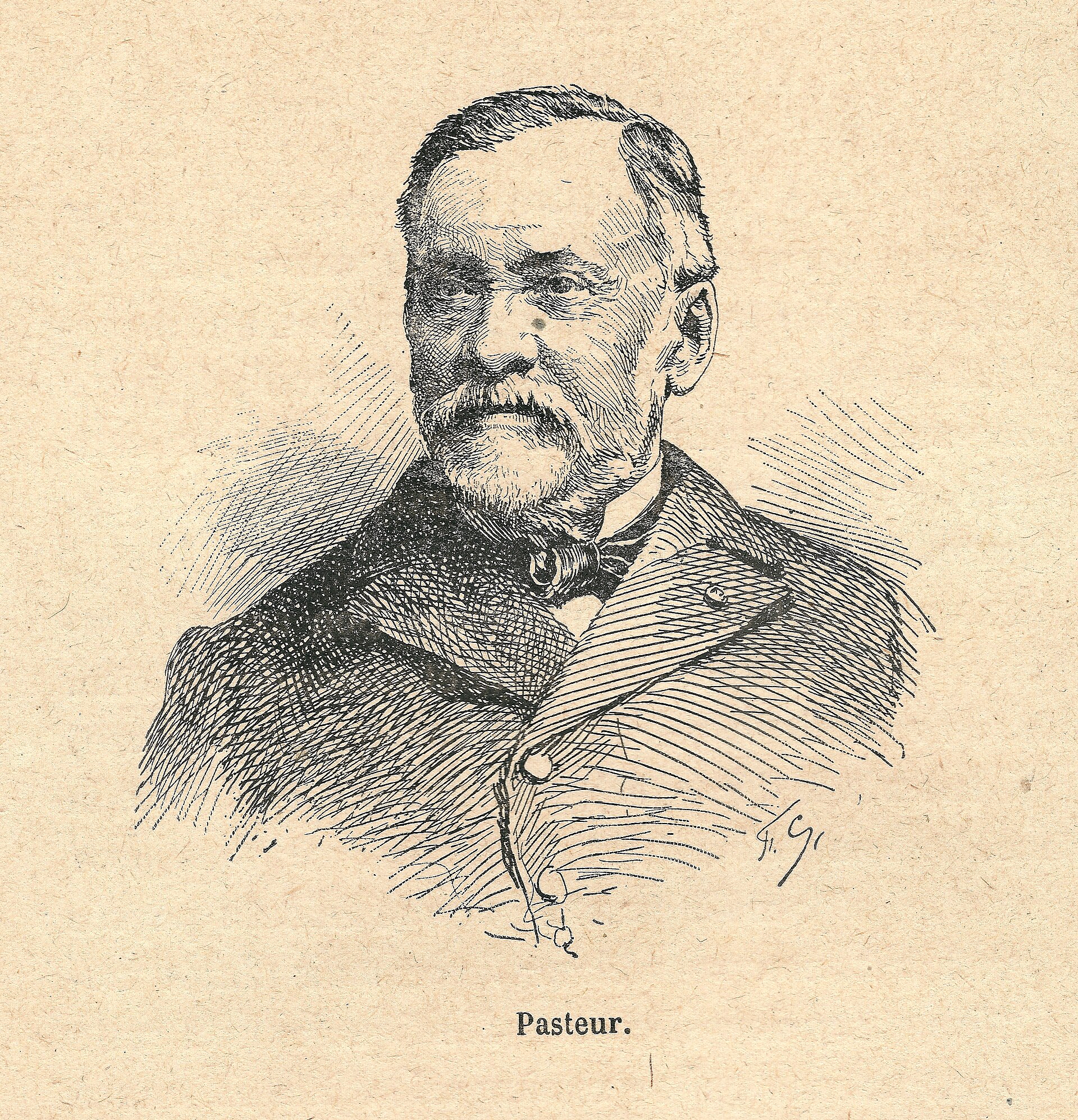
Louis Pasteur
You’re listening to “Scientific Giants Who Changed Our Understanding of the World .” Each episode stands beside one mind and follows a thread of curiosity until it ties to the world we inhabit. Today we unlock a laboratory door in Paris and a faint sweetness greets us—a broth of sugar and yeast, a tang of wine gone wrong, the metallic breath of steam. On one bench a row of glass vessels stands like a choir, each with a long, swan‑curved neck. On another, flasks cradle broths that were boiled and then left to cool under arches of glass that invite air but trap dust. A small flame licks at a burner; a hand adjusts it until the liquid shivers and then calms. The hand belongs to a man with a large brow, a steady gaze, and a patience that can be stern. He lifts a flask, tips it, watches nothing grow, and smiles because nothing is sometimes the most eloquent answer the world can give. The man is Louis Pasteur. Over four decades he will show that asymmetry in crystals reflects an asymmetry in life; that fermentation is the work of living agents rather than a spontaneous rot; that dust, not air itself, carries the seeds of decay; that heating can make food safe without erasing its character; that specific microbes cause specific diseases; that beating those microbes sometimes requires teaching the body in advance—vaccination—and sometimes requires heat, cleanliness, and nerve. His experiments—plain and theatrical, careful and public—will pull medicine out of charm and into rule. He will save wine, silk, sheep, and children, and he will make the laboratory a courtroom where microbes confess.
Begin far from Paris, in 1822, in the small town of Dole in the Jura. Pasteur’s father is a tanner, a veteran of Napoleon’s army, proud and exacting; his mother keeps order with warmth and thrift. The boy is not precocious in the way stories like to tell. He is good at school without being brilliant; he draws with ordinary talent and extraordinary patience; he blends colors with a care that his teachers notice. He makes portraits in pastel of neighbors and of his father with a soldier’s straightness to the mouth. The faces are not art for galleries; they are practice in looking. Looking will be his trade.
He studies at Besançon, then at the École Normale Supérieure in Paris. The Rue d’Ulm becomes his address, and the laboratory becomes his shelter. He is trained a chemist, writing two theses in 1847: one on the water content of crystallizable bodies, another on the cause and effects of the crystalline form of liquids. What sounds like a dry preoccupation—the arrangement of matter in small, hard forms—will open a door nobody else had thought to walk through. Tartaric acid, a by‑product of wine casks, crystallizes from grape juice as white crust; chemists know its salts as “tartrates.” A puzzling cousin, “paratartrate,” seems to share the same composition but behaves differently. Pasteur sits with crystals and light, a polarizer at hand. He notices that tartrate crystals are not symmetrical: each possesses tiny facets arranged in a way that no mirror can lay on its twin. Hold them to polarized light and they rotate the plane of polarization—twist it—always in the same direction. Paratartrate rotates not at all. He notices, then, that paratartrate is not one substance but a mixture of two kinds of crystals—each a mirror image of the other, twins intertwined. Separate the left‑hand crystals from the right‑hand ones with tweezers and patience, dissolve each: each solution rotates light, one way and the other. Mix them again: the twists cancel. He has performed a delicate surgery on symmetry.
From this slender operation a new science, stereochemistry, takes heart. Molecules, it turns out, can be the same in formula and mass and yet differ in handedness; life, at least the life we know, prefers one hand. Sugars, amino acids—most of the building blocks of cells—come with a bias: left‑handed or right‑handed in geometry, and that choice matters. Pasteur has not yet found a microbe or saved a child, but he has put his finger on a principle that will turn out to be general: when you see a consistent asymmetry in nature, you are near life. Years later he will say, with a piety that suits both science and theology, that the universe is asymmetric and life is a function of that asymmetry. The sentence is too grand for a bench, but the bench gave it to him honestly.
He marries Marie Laurent, the daughter of the rector of the University of Strasbourg, where he takes a professorship in 1848. She will be his partner in a manner old laboratories knew well and too easily forgot later: she copies papers, keeps accounts, hosts visitors, steadies a man who will be fierce with his time and gentle with children. They will have five; three will die of typhoid. The losses fold a private ache into his work on disease; when he says later that science and peace will triumph, the sentence is not naive; it is defiance.
In 1854 he takes up the post of dean of the new Faculty of Sciences in Lille, a city of mills, beet sugar refineries, breweries. Industry is a better university for chemistry than some universities are: brewers know when their vats are ill; distillers can tell when their wash sours; farmers can see when the sugar in beets turns to acids that spoil the yield. Pasteur listens to complaints and offers not rhetoric but apparatus. He looks at the froth in a fermenting vat under a microscope and sees crowds of small, living things. In one vat, plump oval cells with buds—yeast—dominate and alcohol is produced. In another, small rods—bacteria—invade and sourness follows, lactic acid where ethanol should have flowed. He heats the wash gently and the bad actors vanish; the good ones, when added on purpose, thrive. The conclusion upends a tidy doctrine in chemistry: fermentation is not a mysterious chemical decomposition that matter performs on itself; it is the work of living agents performing their own life’s business. He will later use the words “aerobic” and “anaerobic” to describe whether microbes work with oxygen or refuse it; he will show that some cells—yeast—ferment because they are forced to find energy without air. His rival Justus von Liebig scoffs from Germany that chemistry need not be polluted by life; Pasteur replies that chemistry cannot ignore a cause that can be seen, counted, killed.
From Lille he moves back to Paris. The Emperor, Napoleon III, permits him to speak before a commission; the Académie listens; the press repeats. By 1857 he is ensconced at the École Normale again; in 1857 he writes “Mémoire sur la fermentation,” a paper that all but baptizes a new discipline in warm broth. The debate is not merely academic. Whole harvests ride on it. France’s wine—its cash crop and its pride—spoils in casks; an “illness” turns it ropey, another turns it sour, another makes it stink. Pasteur looks, sorts, heats. If you raise wine gently to a temperature below the boil and hold it there—about the heat of a warm bath—the microbes that cause disease die; the wine’s character remains. He shows vintners how to bathe their barrels in hot water and how to keep air from carrying in new trouble. He writes Études sur le vin, a book that reads like both a rescue and a scold. Brewers, too, learn from him: heat your wort; keep your fittings clean; seed with a chosen yeast; mistrust the fog.
Spontaneous generation remains the ghost in the room. Even intelligent men, and more than a few wags, cling to the idea that life seeps from non‑life the way fog condenses from air—that meat spawns maggots by its own rotting, that hay infusions “breed” microbes from the principle of life in matter. The doctrine is old, comfortable, and convenient; it rescues us from having to look for sources. Pasteur sets up an arrangement as plain as a proverb. He prepares a clear broth in a flask and draws out the glass neck into a gentle S‑curve. He boils the broth to kill what lives within; then he leaves the flask open to air. Dust cannot fall into the bend; air can move freely. Days pass; the broth remains clear. Tilt the flask so that the broth wets the bottom of the curve, where dust has settled: cloudiness blooms. Snap the neck off so air and dust can fall in: cloudiness blooms. Keep the neck; keep the broth away from the dust; nothing grows. He does this again and again, invites audiences that include critics, carts flasks to lectures, breaks this one, leaves that one intact, and lets time make his argument for him. It is not air that “corrupts,” he says; it is particles carried in air. Kill them, or keep them out, and matter does not invent life. “La génération spontanée n’existe pas”—spontaneous generation does not exist. Others—Félix Pouchet of Rouen prominent among them—protest that he has stacked the deck, that the heat changes the “germinal force” of the air; Pasteur brings a supply of dust‑free air to public demonstrations in sealed vessels scraped clean by heat or by time in caverns; still, unboiled broths cloud and boiled ones do not. John Tyndall, across the Channel, uses light to show how dust thickens and thins in a room and builds his own dust‑free boxes. The case closes for almost everyone willing to watch.
From food and wine to silk is a small jump if your country’s prosperity depends on silk. In the early 1860s a plague devastates silkworms in the south of France. The disease is given names—pébrine for pepper‑like spots in the larvae, flacherie for a flaccid rot—and blamed, by turns, on everything. Pasteur goes to Alais and the Cévennes and peers at eggs, larvae, moths. He sees small corpuscles under the microscope; he learns to pick out healthy stock and to discard infected eggs; he invents a rule for selection that is hard to keep because it asks farmers to destroy the fruits of their labor. He persists, drawing diagrams, writing instructions, turning his advice into a production line of cleanliness. The disease ebbs. The industry lives. Behind the parochial victory lies a universal claim: specific diseases of animals (and plants) are caused by specific living agents; diagnose the agent, and you can intervene.
He suffers a stroke in 1868, partial paralysis on the left that never fully leaves him, and he works around it with stubborn grace. He writes with his right hand, dictates when he must, refuses to let his body teach his mind to be small. He returns to broths and inoculations.
The next leap is the one schoolchildren learn as a sequence of fables that are not fables: an inattentive assistant, a culture of chicken cholera left on a shelf and then used weeks later; the chickens, when injected, fall ill but do not die; later, injected with fresh virulent culture, they live. The older culture had lost force; exposure to it had protected the birds. Chance favored the prepared mind, Pasteur will say—“Le hasard ne favorise que les esprits préparés”—and the maxim will become a proverb that flatters readiness and hides how much work preparation is. The principle is “attenuation”: take a microbe that causes disease; pass it through conditions that blunt its virulence—time in air, heat, passage through another species; inject the weakened organism; the host lives and becomes, mysteriously, robust against the strong form. Pasteur will repeat the trick with anthrax, the disease of sheep and cattle that has turned fields into graveyards.
Anthrax is a difficult subject because other hands have already been here. In 1876 Robert Koch, a country doctor in Germany, will demonstrate the life cycle of Bacillus anthracis—rod‑shaped bacteria that form spores, hardy seeds that can sleep in the soil and wake to kill again—and will put forward a logical chain (later called Koch’s postulates) for linking an organism to a disease. Pasteur knows the ground he stands on. He is a fierce patriot and an even fiercer partisan of his own methods; Franco‑Prussian resentments, scientific styles, and personal vanities turn the anthrax story into a duel fought in the press as much as in barns. What is clear is the public trial at Pouilly‑le‑Fort in 1881. On a farm near Melun, under the eyes of farmers and journalists and skeptics, Pasteur’s team—Émile Roux, Louis Thuillier, Charles Chamberland—splits fifty sheep into two flocks. They vaccinate one flock with attenuated Bacillus anthracis; the other they leave untouched. Weeks later both flocks receive injections of virulent anthrax. In a day, the unvaccinated animals die; the vaccinated live. The demonstration is theater with a conscience. It does not settle fine points of priority; it settles the public matter that concerns butchers and shepherds: vaccination can protect herds. Pasteur’s enemies argue about the details; his reputation in the countryside hardens into trust.
The boldest of the vaccines, and the one that still moves the imagination in a way no diagram can, is for rabies. The disease is ancient and monstrous. A bite from a sick dog, wolf, or bat strikes terror because nothing visible follows at once; then, weeks later, fever, fear of water, paralysis, delirium, and death in almost all cases. An agile virus travels along nerves; no one in Pasteur’s time knows what a virus is yet. They know only that filtration that stops bacteria does not stop this. Pasteur works in a small room at the École Normale and then in a stable at a suburban estate lent by a patron, passing the disease from dog to dog through trephined skulls and bites, attenuating by drying the spinal cords of infected rabbits in sterile flasks, testing on dogs the principle that inoculation first with the least virulent material and then with progressively less attenuated material can prevent disease after exposure. The method is born in anguish: one too‑virulent dose kills; weaker doses protect. He hesitates to try on human beings. On July 6, 1885, a nine‑year‑old boy, Joseph Meister, is brought from Alsace, bitten badly by a rabid dog two days earlier. The family begs. The doctors press. Pasteur is not a physician and is mindful of laws; he assembles a jury of colleagues, begins the series that evening—thirteen injections over ten days—and the boy does not develop rabies. Later that year, a shepherd, Jean‑Baptiste Jupille, saves children from a rabid dog, is bitten, and receives the new treatment; he survives. The institute that will soon bear Pasteur’s name fills with people seeking salvation from a horror, each with a bite and a story; the newspapers fill with arguments about numbers; statistics stumble in the crowds; the trend is hard to deny: far fewer people die with vaccination than without. There are failures—bites from wolves and deep facial wounds leave too little time—but a therapy for after exposure exists in a world that had none. Pasteur is hailed as savior and villanized by opponents; he keeps working.
Pasteur lives to see a network built from his days in the basement. The Institut Pasteur, founded by subscription in 1887 and opened in 1888, is dedicated to rabies treatment and research in microbiology, hygiene, and immunology. It will train generations of researchers; among its early staff are men whose names now anchor other chapters: Émile Roux, who with Alexandre Yersin isolates diphtheria toxin and pioneers serum therapy; Albert Calmette and Camille Guérin, who will develop the BCG vaccine for tuberculosis; Amédée Borrel, working on tumors and viruses; and later, decades later, teams that will map new viruses and immune responses. Pasteur will move through the building in a wheelchair, stand for a moment to greet visitors, sit for portraits he would rather avoid, and return to the rooms that smell of steam and carbolic. His face, in old age, is familiar to Parisians; his hand, when not shaking, still steadies glass.
A revolution as sweeping as his does not pass without dissent and dispute. Antoine Béchamp, a contemporary and fierce critic, claims that Pasteur stole ideas and that disease arises from “microzymas,” native entities in tissue that change under stress. Pasteur’s notebooks, studied long after his death, show a man who revised, who protected his claims, who did not publish every control at once, who improved his protocols with failures that the public did not see; they do not reveal a charlatan. Karl Ludwig and others in Germany resist the implication that fermentation is life and that chemistry must be kneaded by biology. Surgeons resent being told to wash their hands; Joseph Lister takes Pasteur’s ideas and turns them, with carbolic acid, into safer surgery; resistance to the smell and the bother will delay adoption for years in some places. There are accusations about the anthrax vaccine—was it truly the method Pasteur described, or did his assistants tweak it with potassium bichromate?—and about the rabies treatment—were all cases truly rabies, were failures hidden? The most generous reading of the archive is also the most demanding: science is a sequence of approximations hammered into robustness by hostile witnesses. Pasteur invited witnesses and endured hostilities because he knew that public demonstrations, when cleanly done, do not need tenderness.
His method carries features that have become our manners. He uses controls that try to answer the exact alternative believers prefer (“air corrupts”) by arranging for air to enter freely and dust not to. He chooses, whenever possible, numbers as the arbiter—how many animals live, how many die—and chooses, when numbers are not yet available, arrangements that a hostile hand can repeat. He is theatrical when public health needs theater; the swan‑necked flasks are beautiful because they make an invisible cause behave as if it had elbows you can bump into. He works with industry rather than against it; to him a brewery is a laboratory with wages attached. He refuses to segregate pure from applied work, seeing that curiosity and utility fatten each other. He speaks well enough to be quoted, badly enough to be misquoted, and long enough to become a target.
Because we live in a time that both worships and mistrusts heroes, it is worth pausing over his faults in the light of his successes. He was hard on rivals; he pushed his own interpretation of attenuation with more certainty than his data sometimes allowed; he could be possessive of priority; he made enemies out of men who might have been colleagues. He tied his nationalism to his science in ways that sharpened both beyond usefulness. He did not know viruses; he did not know immunity’s molecular grammar; he did not know that some of his vaccines worked for reasons other than the ones he guessed. He is not, in other words, an idol. He is a craftsman who put new tools into a city’s hands and taught others to use them better than he did.
Pasteur’s achievements live not only in vaccines and safe milk but in the way hospitals sound. Before him, a ward had a smell that doctors had learned to ignore; after him, the smell changed—less rot in bandages, more steam in the laundry, fewer moans that end in a priest’s step. Before him, a kitchen’s safety depended on habit and season; after him, a temperature and a time could be written on the wall. Before him, a physician guessed at cause and prayed over specifics; after him, a laboratory could say “this” with a finger and a stain. He helped invent a profession—microbiology—that other minds, Koch’s among them, would harden into an art of pure culture, solid media, stains, Petri dishes, and postulates that could be taught in an afternoon and practiced for a lifetime. He taught that to cure was to name, and to name was to see.
The man who spared children with injections carries other scenes in his pockets. He stands in a vineyard in 1865 with a glass in his hand and a vintner asking why his year has gone wrong; Pasteur puts the glass down and asks about barrels, about the temperature of the cellar, about a stain on a stave; he suggests a hot bath for the cask and a clean cloth for the bung. He walks in the Cévennes under a sky hot enough to warp the edges of a microscope slide and tells a farmer that spotting an egg under a lens is as important as feeding a moth mulberry leaves. He sits in his study and reads letters from soldiers on a distant front, men who have been inoculated against disease and who say so in lines that tremble with exhaustion and gratitude that feel embarrassingly strong on paper. He tells his students to mistrust their last experiment until the next one agrees. He quotes no scripture in lectures but uses phrases that smell like sermons: “In the fields of observation, chance favors only the prepared mind.” He is an old Catholic who uses his piety on method rather than on metaphysics.
His influence reaches into kitchens where nobody knows his name. Milk used to be a negotiation with luck; now it is a promise. The promise came slowly—pasteurization for wine and beer in the 1860s, for milk in the decades after, against opposition from farmers and consumers who swore they could taste the heat and called it a theft. Cities learned, sometimes by slaughter of infants from summer milk peddled warm, that the theft was imaginary and the gift was real: fewer dead children. The principle extends outward—safe canned food, safe syrups, a whole discipline of “food science” that is not jokes about instant pudding but a doctrine of temperature curves and pH limits and hazard analysis that keeps families from grieving because a jar failed.
The germ theory that Pasteur made useful became a frame that allowed other minds to discover other weapons. John Snow in London—earlier—had suspected water; Robert Koch will find tubercle bacilli and cholera vibrios and build a laboratory grammar; Elie Metchnikoff will watch cells ingest particles and call the appetite “phagocytosis”; Emil von Behring and Shibasaburo Kitasato will turn diphtheria from a child‑killer into a disease doctors can treat by neutralizing a toxin with antitoxin raised in horses; Émile Roux at the Institut Pasteur will make the antitoxin practical and change the sound of children’s wards. Pasteur did not discover everything; he gave house keys to those who did.
For an hour, leave the catalogues and watch him work a single instrument. He lifts a flask by its neck and lets the curved glass rest in his palm the way a violinist holds a bow when he is thinking without playing. He inspects the dust on the bend, the faint brown line that tells him where powder from the street has settled. He turns the flask in a shaft of light from a window and waits for scattered specks to reveal themselves. He holds the curve over a flame and then away; he is not trying to frighten what he cannot see; he is trying to coax it into candor. He places the flask on a shelf over a water bath to keep the temperature steady. He writes a line in a book: “No change.” Then, after a pause, another line: “Neck broken, cloud in sixteen hours.” He is not a magician. He is a clerk of truth.
He could be sentimental; he could be harsh. He refused a prize from Berlin after the Franco‑Prussian War, returned medals to a nation that had humiliated his own, wrote letters that curled with pride and hurt. He accepted honors until his breast could carry no more ribbon; he liked the security and the influence they bought and was embarrassed by the poses required. He did not learn German and so missed some of his rivals’ best papers; he did not learn humility at all times and so missed opportunities for collaboration. He did, however, learn to teach his science to non‑scientists. He could speak to senators, to craftsmen, to farmers, to princes and to their children without lying. He founded a way of being a scientist in public that has not been equaled often: confident without insolence, persuasive without jargon, ready to perform a clean experiment in front of a hostile crowd.
He dies in 1895 at Marnes‑la‑Coquette, out beyond the Bois de Boulogne, in a house where gardens still hold dew until mid‑morning. The academy mourns; the city takes off its hat; the institute becomes a shrine for a day and then returns to work. In the crypt of the Institut Pasteur his body lies under mosaics that show a life as a sequence of scenes—the crystals, the flasks, the silkworms, the sheep, the child rescued from fear. The mosaics are heavy‑handed and, in their way, just. He is not a saint; he is a man who put limits on tragedy.
It is easy, when a figure casts a long shadow, to hold up the tallest achievements and forget the infrastructure he built below them. Pasteur’s true monument is not a museum’s wall of instruments; it is a method that any honest hand can use with equipment as simple as a pot, a thermometer, a tube, and a will to stop guessing. It is a discipline of cleanliness that every ward can master without a new budget. It is an alliance with farmers and brewers and nurses and midwives that says science enters the world through doors that somebody else holds open. It is, above all, the habit of arranging the world so that it must answer. In a time that likes to treat “science” as an oracle that pronounces, Pasteur teaches a different grammar: show, not say; repeat, not proclaim; invite witnesses; insist on manners.
If you need one last scene to hold him in, lift one of those swan‑necked flasks and look through the curve at the street. A carriage passes; a baker’s boy shoulders a tray; a woman with a pail hesitates before a door. Dust hangs in the air where the sun sees it. The curve is a tiny horizon that keeps what floats from falling into the broth that will feed your children. You lower the flask and feel the weight of a principle in glass. Somewhere a doctor rinses his hands without complaint; somewhere a farmer pours milk into a vat with a thermometer clipped to the lip; somewhere a child walks home from a clinic with a bandage on a small arm and does not know that, a century and a half ago, fear of water was rational. A civilization is made of such unremembered mercies.
You have been listening to “Scientific Giants Who Changed Our Understanding of the World We Live In.” Today we stood beside glass curved like a question mark and watched a chemist turn rot into rule, dust into doctrine, and fear into procedures—Louis Pasteur, who taught us to see life where others saw fog and to fight it with heat, with cleanliness, and with the strange courage of teaching the body to be ready. In our next episode we will climb a stair in Edinburgh and then in Cambridge to watch a quiet Scot gather Faraday’s lines of force into equations that say light itself is an electromagnetic wave—James Clerk Maxwell, who will give physics a grammar as compact and vast as any human book.
Return to Transit