NOMOTO MEDIA Read, listen and watch Articles, podcasts, films, stories, books, music and research.
CHAPTER 00 / THE WET SEAT
One passenger is missing.
The seat is wet. It has not rained. Someone says the passenger was carrying an empty birdcage.
Browse all content Explore the subway
READ ARTICLES
EXPLORE RESEARCH
SEARCH ALL WORK
BULLSHIT CENTRIFUGE
A dreamlike journey through the human condition: moral philosophy from Thales to Arendt and Camus, psychology, science, film, and AI as a new test of old human questions. There is no required route.
Nomoto Media system map
Power, Thought, Art, and Memory cross at shared stations. Each interchange connects films, voices, and texts through a common question.
AI: An Uncertain Future AI articles Psychology Philosophy Scientific Giants Research Short Stories Books Films Filmmaking Giants Theatre Classical Music Music Addiction & Recovery Articles All Content The Mapmaker American Presidency How Empires Rise and Fall CLOSED LINE / NEW YORK CLOSED LINE / PARIS CLOSED LINE / MOSCOW
DEPARTURE / THE SYSTEM IS WAKING ENTER TRANSIT THE MAP WILL OPEN WHEN READY
POWER LINE THE WATCHING ROOM BETWEEN STATIONS
← Back to map
LOCAL YEAR 2026 SHIFT YEAR ↻ N STATION TOUCH SIGN
NOMOTO MEDIA
Title
Description
← PREVIOUS STORY 01 / 05 NEXT → RANDOM STORY ↻ ALL STORIES
THE POSTER IS MOVING
×
A PASSENGER SAYS
READ IN THE CARRIAGE →
LISTEN IN THE CARRIAGE →
SHIFT YEAR AGAIN ↻
FOLLOW THE TRANSFER →
CONTINUE THE JOURNEY →
WORDS BESIDE THE FILM / DRAG TO MOVE
READ THIS PASSAGE →
GIVE ME ANOTHER QUOTE ↻
LOOK AGAIN THE QUESTION FOUND OBJECT
×
EVIDENCE / UNFILED
A detail refuses to disappear.
KEEP THIS CLUE
01 FILM ARCHIVE
FILM / RELATED WORK FOLLOW THE SIGNAL READ IN THE CARRIAGE → LISTEN IN THE CARRIAGE → THINK WITH THIS → ALL PODCAST EPISODES → TAKE THE NEXT TRAIN → ASK THE CONDUCTOR →
PLAY FILM DOWNLOAD SHORT NEXT FILM → HIDE QUOTE FILM CONTROLS ← Back to journey
ORIGINAL NOMOTO SECTION ARTICLES 220 works · original categories and publication pages ORIGINAL NOMOTO SECTION COLLECTIONS Connected bodies of work ORIGINAL NOMOTO SECTION BOOKS Long-form work and complete manuscripts ORIGINAL NOMOTO SECTION SHORT STORIES Fiction · memory · absurdity · human consequence ORIGINAL NOMOTO SECTION VIDEO Films and moving-image work ORIGINAL NOMOTO SECTION MUSIC Original sound and audiovisual work ORIGINAL NOMOTO SECTION RESEARCH Evidence · prediction · power · consequence ORIGINAL NOMOTO SECTION ABOUT NOMOTO The work, author, and contact route 02 / PHILOSOPHY THE COMPASSIONATE STOIC Enter the inner chamber 03 / HUMAN CONDITION FACES REMEMBER All witness fragments · one film 04 / UNBUILT THE CITY BORROWS OUR BODY Travel forward 09 / NOMOTO MEDIA LONELY ROBOT NOMOTO MEDIA archive · music/video experiment 12 / NATURAL HISTORY GREEN RIVER FOSSIL COMPANY Quarry · preparation · geological design 13 / PHILOSOPHY MARCUS AURELIUS / THE INNER CITADEL Film → thinker → text → narration 15 / LABOR THE ASCENT AFTER THE SHIFT Film → essay → local narration 17 / MEMORY THE MEASURE THAT OUTLIVED THE MAKER Film → Little Book 18 / FUTURE THE LAST TRAIN LEAVES EARTH Film → Newton dramatic script 19 / AI ROBOT LOVE / RUNNING Film → friendship and attachment 20 / CARE THE REACH Film → A Little Book of No Consequence 05 / FICTION / SHORT STORY THE WATCHER READ IN THE CARRIAGE 06 / FICTION / SHORT STORY THE LAST MANUAL GENERATION “THE INVITATION ARRIVED ON PAPER.” PHILOSOPHY 01 WHO WAS HERACLITUS? Original script · existing audio PHILOSOPHY 02 WHO WAS SOCRATES? Original script · existing audio PHILOSOPHY 03 WHO WAS PLATO? Original script · existing audio PHILOSOPHY / THEATRE Seneca — Stoic tragedy and rhetoric Original script · existing audio PHILOSOPHY 05 WHO WAS RENÉ DESCARTES? Original script · existing audio PHILOSOPHY 06 WHO WAS JOHN LOCKE? Original script · existing audio PHILOSOPHY 07 WHO WAS DAVID HUME? Original script · existing audio PHILOSOPHY 08 WHO WAS IMMANUEL KANT? Original script · existing audio PHILOSOPHY 09 WHO WAS JOHN STUART MILL? Original script · existing audio PHILOSOPHY 10 WHO WAS KARL MARX? Original script · existing audio PHILOSOPHY 11 WHO WAS FRIEDRICH NIETZSCHE? Original script · existing audio PHILOSOPHY 12 WHO WAS MARTIN HEIDEGGER? Original script · existing audio PHILOSOPHY 13 WHO WAS JEAN-PAUL SARTRE? Original script · existing audio PHILOSOPHY 14 WHO WAS HANNAH ARENDT? Original script · existing audio PHILOSOPHY 15 WHO WAS SIMONE DE BEAUVOIR? Original script · existing audio PHILOSOPHY 16 WHO WAS ALBERT CAMUS? Original script · existing audio PHILOSOPHY 17 WHO WAS JOHN RAWLS? Original script · existing audio PHILOSOPHY 18 WHO WAS MICHEL FOUCAULT? Original script · existing audio 08 / PSYCHOLOGY WHO WAS JUNG? Read · listen · enter the shadow 09 / SCIENCE WHO WAS NEWTON? The complete original episode 09A / ORIGINAL DRAMA / STAGE OR TELEVISION NEWTON — FOUR EPISODES Complete 152-page script · read or download 10 / SCIENCE WHO WAS DARWIN? Variation · time · consequence 11 / SCIENCE BREAD FROM AIR / POISON FROM SCIENCE Follow discovery into consequence 12 / PSYCHOLOGY WHO WAS KAREN HORNEY? Against Freud · toward culture 13 / PSYCHOLOGY THE LISTENING REVOLUTION What changes when someone is heard? 15 / POWER THE WATCHING ROOM Read in the carriage 16 / COMPLETE PUBLICATION ALL 464 PUBLISHED WORKS Original sections · categories · canonical links 01 / FICTION / NARRATED SOME KIND OF LOVE LISTEN · READ · CONTINUE 02 / FICTION / NARRATED THE MIRROR LISTEN · READ · CONTINUE 03 / FICTION / NARRATED THE WATCHER LISTEN · READ · CONTINUE 04 / FICTION / NARRATED THE LAST MANUAL GENERATION LISTEN · READ · CONTINUE 05 / FICTION / COMPLETE TEXT THE ASTEROID THE ASTEROID WAS SUPPOSED TO KILL US ON THURSDAY. 20 / A LITTLE BOOK OF NO CONSEQUENCE THE BOULDER HAS EXCELLENT ATTENDANCE Read · listen · return to the hill 20B / COMPLETE BOOK LINE A LITTLE BOOK OF NO CONSEQUENCE PROLOGUE · SEVEN PARTS · COMPLETE MANUSCRIPT DOWNLOAD 23 / MEMORY LINE / 2020–2025 THIRTY OLDER WORKS RETURN TO SERVICE Democracy · economy · AI · care · war · philosophy COMPLETE ARTICLE ARCHIVE 464 ORIGINAL WORKS Ordered by original publication date 2026 / FRONT PAGE TETRIS Original text OPEN BOOKS PHILOSOPHY & HISTORICAL PSYCHOLOGY Six verified public-domain editions · read or download 17 PUBLISHED EPISODES PSYCHOLOGY All published episodes · cover art · audio 30 PUBLISHED EPISODES CLASSICAL MUSIC All published episodes · cover art · audio 39 PUBLISHED EPISODES SCIENTIFIC GIANTS All published episodes · cover art · audio 19 PUBLISHED EPISODES AI & SOCIETY All published episodes · cover art · audio 31 PUBLISHED EPISODES FILMMAKING GIANTS All published episodes · cover art · audio 34 PUBLISHED EPISODES THEATRE All published episodes · cover art · audio 62 PUBLISHED EPISODES AMERICAN PRESIDENCY All published episodes · cover art · audio 18 PUBLISHED EPISODES ADDICTION & RECOVERY All published episodes · cover art · audio 29 PUBLISHED EPISODES CIVILISATIONS RISE AND FALL War: How Empires Rise and Fall · cover art · audio 31 / FILMMAKING GIANTS OLIVER STONE The provocateur of American politics · 11 min 32 / FILMMAKING GIANTS LUIS BUÑUEL The surrealist provocateur · 19 min 33 / FILMMAKING GIANTS QUENTIN TARANTINO The pop-culture alchemist · 23 min 34 / FILMMAKING GIANTS ANDREI TARKOVSKY The sculptor of time · 18 min 35 / FILMMAKING GIANTS AKIRA KUROSAWA The bridge between East and West · 17 min 36 / SCIENTIFIC GIANTS ANTOINE LAVOISIER Matter · measure · revolution · 27 min 37 / SCIENTIFIC GIANTS MICHAEL FARADAY A new language for nature · 23 min 38 / SCIENTIFIC GIANTS GREGOR MENDEL The monk who discovered heredity · 22 min
THE SHELVES CONTINUE BEYOND THE WALL · NEW CARDS APPEAR AS THE JOURNEY GROWS
ONE PASSENGER IS MISSING / NO WRONG ANSWER
SOUND ON
Centrifuge
Read, listen and watch
07 CONTINUE MY JOURNEY Return to the marked place
Return to opening page Read this passage → Another quote ↻
← Back to map
NOMOTO MEDIA
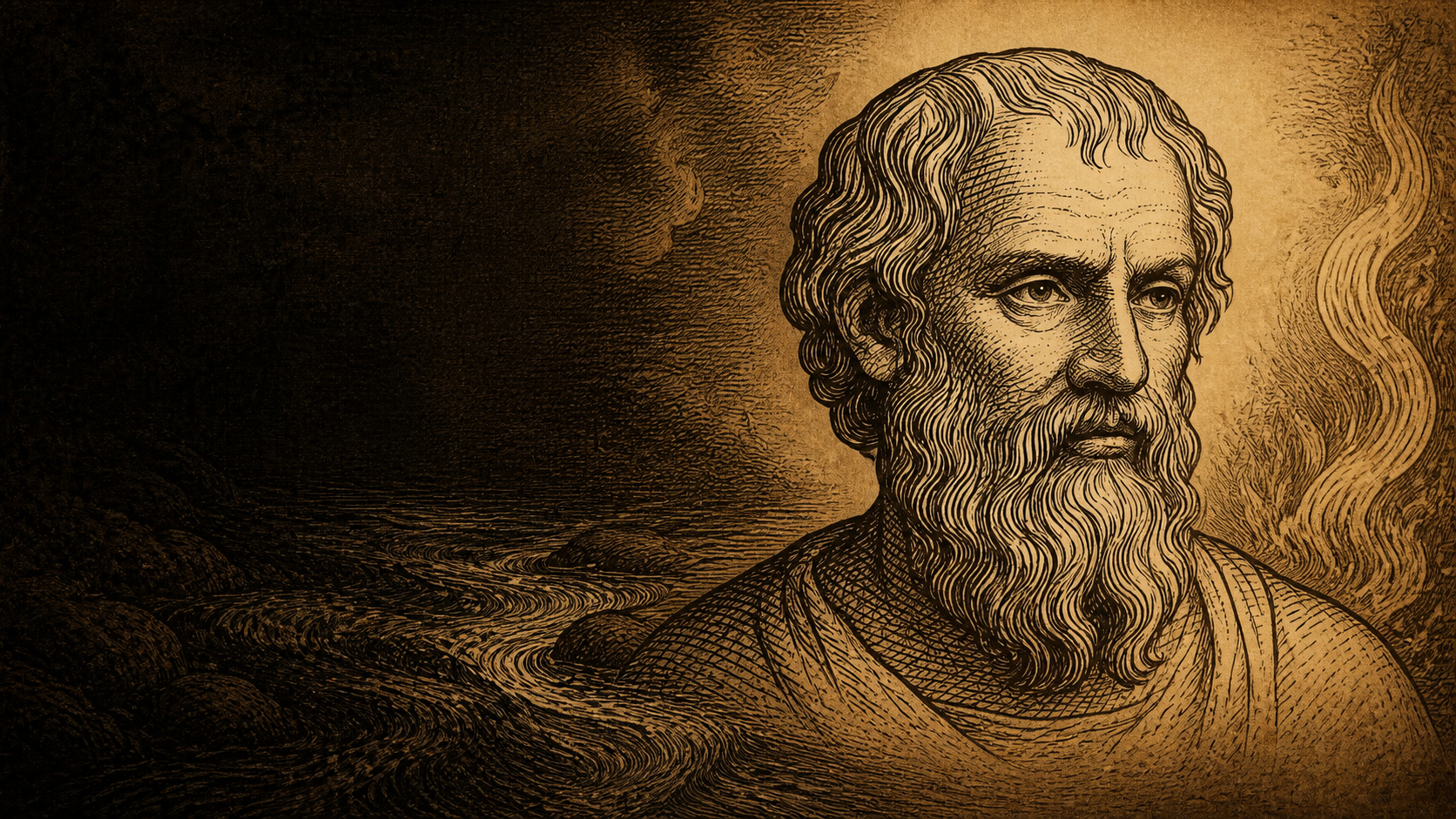
Who was Heraclitus?
LOCAL ARCHIVE VOICE / PLAYING
PAUSE / RESUME EPISODE ALL PODCASTS → READ FULL TEXT → DOWNLOAD TEXT DOWNLOAD AUDIO SAVE MY PLACE COPY LINK READ RELATED WORK → READ A PRIMARY SOURCE → THINK WITH THIS → CONTINUE THIS IDEA →
THE NEXT MOVE BELONGS TO YOU
How do you want to continue?
I WANT TO READ Open the complete text in the carriage.
I WANT TO LISTEN Resume—or begin the narration again.
CONTINUE THE JOURNEY Carry this idea to another station.
RETURN TO THE PORTRAIT ×
RETURN TO THE PLATFORM ×
NOMOTO Transit is an interactive audiovisual journey and requires JavaScript. You can still read the articles , explore the research , or browse every work .