NOMOTO MEDIA Read, listen and watch Articles, podcasts, films, stories, books, music and research.
CHAPTER 00 / THE WET SEAT
One passenger is missing.
The seat is wet. It has not rained. Someone says the passenger was carrying an empty birdcage.
Browse all content Explore the subway
READ ARTICLES
EXPLORE RESEARCH
SEARCH ALL WORK
BULLSHIT CENTRIFUGE
A dreamlike journey through the human condition: moral philosophy from Thales to Arendt and Camus, psychology, science, film, and AI as a new test of old human questions. There is no required route.
Nomoto Media system map
Power, Thought, Art, and Memory cross at shared stations. Each interchange connects films, voices, and texts through a common question.
AI: An Uncertain Future AI articles Psychology Philosophy Scientific Giants Research Short Stories Books Films Filmmaking Giants Theatre Classical Music Music Addiction & Recovery Articles All Content The Mapmaker American Presidency How Empires Rise and Fall CLOSED LINE / NEW YORK CLOSED LINE / PARIS CLOSED LINE / MOSCOW
DEPARTURE / THE SYSTEM IS WAKING ENTER TRANSIT THE MAP WILL OPEN WHEN READY
POWER LINE THE WATCHING ROOM BETWEEN STATIONS
← Back to map
LOCAL YEAR 2026 SHIFT YEAR ↻ N STATION TOUCH SIGN
NOMOTO MEDIA
Title
Description
← PREVIOUS STORY 01 / 05 NEXT → RANDOM STORY ↻ ALL STORIES
THE POSTER IS MOVING
×
A PASSENGER SAYS
READ IN THE CARRIAGE →
LISTEN IN THE CARRIAGE →
SHIFT YEAR AGAIN ↻
FOLLOW THE TRANSFER →
CONTINUE THE JOURNEY →
WORDS BESIDE THE FILM / DRAG TO MOVE
READ THIS PASSAGE →
GIVE ME ANOTHER QUOTE ↻
LOOK AGAIN THE QUESTION FOUND OBJECT
×
EVIDENCE / UNFILED
A detail refuses to disappear.
KEEP THIS CLUE
01 FILM ARCHIVE
FILM / RELATED WORK FOLLOW THE SIGNAL READ IN THE CARRIAGE → LISTEN IN THE CARRIAGE → THINK WITH THIS → ALL PODCAST EPISODES → TAKE THE NEXT TRAIN → ASK THE CONDUCTOR →
PLAY FILM DOWNLOAD SHORT NEXT FILM → HIDE QUOTE FILM CONTROLS ← Back to journey
ORIGINAL NOMOTO SECTION ARTICLES 220 works · original categories and publication pages ORIGINAL NOMOTO SECTION COLLECTIONS Connected bodies of work ORIGINAL NOMOTO SECTION BOOKS Long-form work and complete manuscripts ORIGINAL NOMOTO SECTION SHORT STORIES Fiction · memory · absurdity · human consequence ORIGINAL NOMOTO SECTION VIDEO Films and moving-image work ORIGINAL NOMOTO SECTION MUSIC Original sound and audiovisual work ORIGINAL NOMOTO SECTION RESEARCH Evidence · prediction · power · consequence ORIGINAL NOMOTO SECTION ABOUT NOMOTO The work, author, and contact route 02 / PHILOSOPHY THE COMPASSIONATE STOIC Enter the inner chamber 03 / HUMAN CONDITION FACES REMEMBER All witness fragments · one film 04 / UNBUILT THE CITY BORROWS OUR BODY Travel forward 09 / NOMOTO MEDIA LONELY ROBOT NOMOTO MEDIA archive · music/video experiment 12 / NATURAL HISTORY GREEN RIVER FOSSIL COMPANY Quarry · preparation · geological design 13 / PHILOSOPHY MARCUS AURELIUS / THE INNER CITADEL Film → thinker → text → narration 15 / LABOR THE ASCENT AFTER THE SHIFT Film → essay → local narration 17 / MEMORY THE MEASURE THAT OUTLIVED THE MAKER Film → Little Book 18 / FUTURE THE LAST TRAIN LEAVES EARTH Film → Newton dramatic script 19 / AI ROBOT LOVE / RUNNING Film → friendship and attachment 20 / CARE THE REACH Film → A Little Book of No Consequence 05 / FICTION / SHORT STORY THE WATCHER READ IN THE CARRIAGE 06 / FICTION / SHORT STORY THE LAST MANUAL GENERATION “THE INVITATION ARRIVED ON PAPER.” PHILOSOPHY 01 WHO WAS HERACLITUS? Original script · existing audio PHILOSOPHY 02 WHO WAS SOCRATES? Original script · existing audio PHILOSOPHY 03 WHO WAS PLATO? Original script · existing audio PHILOSOPHY / THEATRE Seneca — Stoic tragedy and rhetoric Original script · existing audio PHILOSOPHY 05 WHO WAS RENÉ DESCARTES? Original script · existing audio PHILOSOPHY 06 WHO WAS JOHN LOCKE? Original script · existing audio PHILOSOPHY 07 WHO WAS DAVID HUME? Original script · existing audio PHILOSOPHY 08 WHO WAS IMMANUEL KANT? Original script · existing audio PHILOSOPHY 09 WHO WAS JOHN STUART MILL? Original script · existing audio PHILOSOPHY 10 WHO WAS KARL MARX? Original script · existing audio PHILOSOPHY 11 WHO WAS FRIEDRICH NIETZSCHE? Original script · existing audio PHILOSOPHY 12 WHO WAS MARTIN HEIDEGGER? Original script · existing audio PHILOSOPHY 13 WHO WAS JEAN-PAUL SARTRE? Original script · existing audio PHILOSOPHY 14 WHO WAS HANNAH ARENDT? Original script · existing audio PHILOSOPHY 15 WHO WAS SIMONE DE BEAUVOIR? Original script · existing audio PHILOSOPHY 16 WHO WAS ALBERT CAMUS? Original script · existing audio PHILOSOPHY 17 WHO WAS JOHN RAWLS? Original script · existing audio PHILOSOPHY 18 WHO WAS MICHEL FOUCAULT? Original script · existing audio 08 / PSYCHOLOGY WHO WAS JUNG? Read · listen · enter the shadow 09 / SCIENCE WHO WAS NEWTON? The complete original episode 09A / ORIGINAL DRAMA / STAGE OR TELEVISION NEWTON — FOUR EPISODES Complete 152-page script · read or download 10 / SCIENCE WHO WAS DARWIN? Variation · time · consequence 11 / SCIENCE BREAD FROM AIR / POISON FROM SCIENCE Follow discovery into consequence 12 / PSYCHOLOGY WHO WAS KAREN HORNEY? Against Freud · toward culture 13 / PSYCHOLOGY THE LISTENING REVOLUTION What changes when someone is heard? 15 / POWER THE WATCHING ROOM Read in the carriage 16 / COMPLETE PUBLICATION ALL 464 PUBLISHED WORKS Original sections · categories · canonical links 01 / FICTION / NARRATED SOME KIND OF LOVE LISTEN · READ · CONTINUE 02 / FICTION / NARRATED THE MIRROR LISTEN · READ · CONTINUE 03 / FICTION / NARRATED THE WATCHER LISTEN · READ · CONTINUE 04 / FICTION / NARRATED THE LAST MANUAL GENERATION LISTEN · READ · CONTINUE 05 / FICTION / COMPLETE TEXT THE ASTEROID THE ASTEROID WAS SUPPOSED TO KILL US ON THURSDAY. 20 / A LITTLE BOOK OF NO CONSEQUENCE THE BOULDER HAS EXCELLENT ATTENDANCE Read · listen · return to the hill 20B / COMPLETE BOOK LINE A LITTLE BOOK OF NO CONSEQUENCE PROLOGUE · SEVEN PARTS · COMPLETE MANUSCRIPT DOWNLOAD 23 / MEMORY LINE / 2020–2025 THIRTY OLDER WORKS RETURN TO SERVICE Democracy · economy · AI · care · war · philosophy COMPLETE ARTICLE ARCHIVE 464 ORIGINAL WORKS Ordered by original publication date 2026 / FRONT PAGE TETRIS Original text OPEN BOOKS PHILOSOPHY & HISTORICAL PSYCHOLOGY Six verified public-domain editions · read or download 17 PUBLISHED EPISODES PSYCHOLOGY All published episodes · cover art · audio 30 PUBLISHED EPISODES CLASSICAL MUSIC All published episodes · cover art · audio 39 PUBLISHED EPISODES SCIENTIFIC GIANTS All published episodes · cover art · audio 19 PUBLISHED EPISODES AI & SOCIETY All published episodes · cover art · audio 31 PUBLISHED EPISODES FILMMAKING GIANTS All published episodes · cover art · audio 34 PUBLISHED EPISODES THEATRE All published episodes · cover art · audio 62 PUBLISHED EPISODES AMERICAN PRESIDENCY All published episodes · cover art · audio 18 PUBLISHED EPISODES ADDICTION & RECOVERY All published episodes · cover art · audio 29 PUBLISHED EPISODES CIVILISATIONS RISE AND FALL War: How Empires Rise and Fall · cover art · audio 31 / FILMMAKING GIANTS OLIVER STONE The provocateur of American politics · 11 min 32 / FILMMAKING GIANTS LUIS BUÑUEL The surrealist provocateur · 19 min 33 / FILMMAKING GIANTS QUENTIN TARANTINO The pop-culture alchemist · 23 min 34 / FILMMAKING GIANTS ANDREI TARKOVSKY The sculptor of time · 18 min 35 / FILMMAKING GIANTS AKIRA KUROSAWA The bridge between East and West · 17 min 36 / SCIENTIFIC GIANTS ANTOINE LAVOISIER Matter · measure · revolution · 27 min 37 / SCIENTIFIC GIANTS MICHAEL FARADAY A new language for nature · 23 min 38 / SCIENTIFIC GIANTS GREGOR MENDEL The monk who discovered heredity · 22 min
THE SHELVES CONTINUE BEYOND THE WALL · NEW CARDS APPEAR AS THE JOURNEY GROWS
ONE PASSENGER IS MISSING / NO WRONG ANSWER
SOUND ON
Centrifuge
Read, listen and watch
07 CONTINUE MY JOURNEY Return to the marked place
Return to opening page Read this passage → Another quote ↻
← Back to map
NOMOTO MEDIA
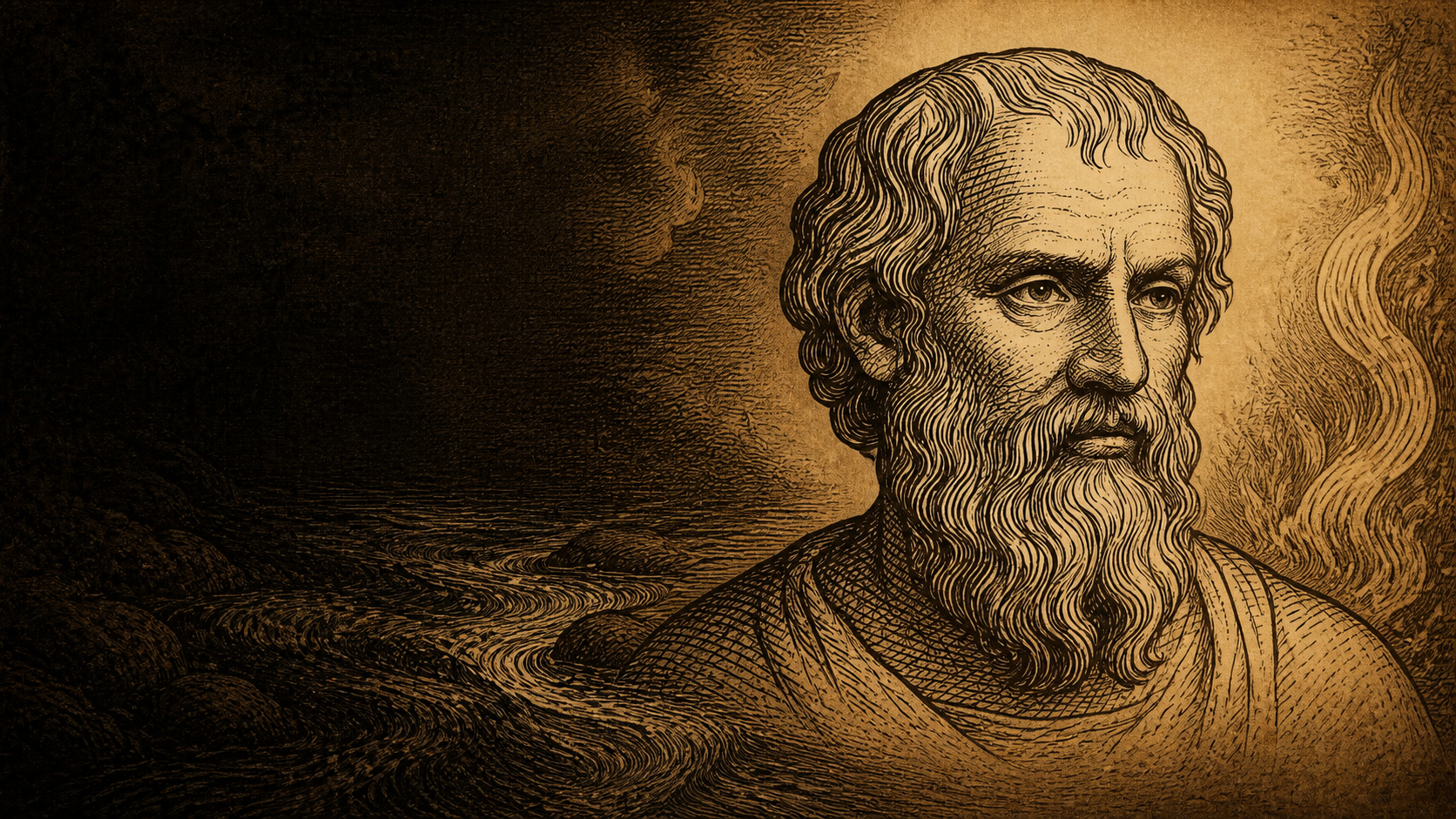
Who was Heraclitus?
LOCAL ARCHIVE VOICE / PLAYING
PAUSE / RESUME EPISODE ALL PODCASTS → READ FULL TEXT → DOWNLOAD TEXT DOWNLOAD AUDIO SAVE MY PLACE COPY LINK READ RELATED WORK → READ A PRIMARY SOURCE → THINK WITH THIS → CONTINUE THIS IDEA →
THE NEXT MOVE BELONGS TO YOU
How do you want to continue?
I WANT TO READ Open the complete text in the carriage.
I WANT TO LISTEN Resume—or begin the narration again.
CONTINUE THE JOURNEY Carry this idea to another station.
RETURN TO THE PORTRAIT ×
RETURN TO THE PLATFORM ×
NOMOTO Transit is an interactive audiovisual journey and requires JavaScript. You can still read the articles , explore the research , or browse every work .
Luis Buñuel – The Surrealist Provocateur Luis Buñuel
Hello and welcome back to Film making giants who changed how we see the world. After Fellini’s parades and memory palaces, we step into rooms where logic keeps its hat politely in its lap and desire rearranges the furniture. The doors open and sometimes will not let the guests out; a dinner is prepared and never happens; a bishop serves a Mass with hands that tremble with hunger and then discovers that the god he serves has a sense of humor colder than marble. If other directors have begged rationality to explain itself, Luis Buñuel smiles and lets it confess by misbehaving. He is the filmmaker who slit an eye—not yours, not mine, a woman in a black‑and‑white frame—and made audiences feel the slice on their own corneas, the man who took a cow to bed and ants out of a palm and then, for half a century, kept lying with the straightest face you have ever seen in a cinema. He changed how we see the world by restoring to images their right to dream—and then to hurt.
He was born in 1900 in Calanda, in Aragón, where drums are not instruments but weather. Easter processions drove rhythm into the day; Catholicism placed pictures in his head that would later reappear with the paint rearranged; a Jesuit education taught him how authority sounds when it is certain and how certainty looks when it is cornered. He landed in Madrid as Spain tried to rehearse modernity and fell into the Residence of Students where Lorca read poems out loud in a voice that made vowels carry dust and Dalí drew faces that saw your embarrassment a second before you did. They were a company of friends and frictions: theater and painting and arguments about how much of the world can be explained by manners. Paris called; Surrealism opened a door. He did not become a good soldier in André Breton’s army; he was too stubborn; but for a season he was delighted to discover a group willing to make laboratories out of dreams.
He met poverty in Paris and a breed of freedom that looks like hunger. In 1929 he made, with Dalí, Un Chien Andalou, a short that arrived with a manifesto disguised as mischief. “No idea or image that might lend itself to a rational explanation of any kind was accepted,” they promised each other, and then they did something even more dangerous: they designed their irrationality. The opening—Buñuel himself playing the man with the razor, a cloud crossing the moon like a lid over an eye, a woman’s eye sliced so cleanly that the cut made audiences blink half a century later when VHS reintroduced them to the crime—was not a scandal for scandal’s sake. It was a declaration of war against the illusion that respectability keeps harm out of the room. Ants flood from a hand; priests at one moment become luggage; the rules of continuity are respected just long enough to be broken strategically; the effect is less confusion than a private recognition: your mind dreams like this when you are honest.
He and Dalí followed with L’Âge d’Or, a feature‑length continuation that ends with a parody of Christ and a Marquis de Sade echo, and the Paris of policemen, patrons, and pieties stopped pretending to laugh. There were riots; the film was banned; investors hid; Surrealists argued; the church took notes. Buñuel did not apologize. He went to work. He served a spell at the Museum of Modern Art in New York learning how the projector operates and then returned to Spain to make Las Hurdes—Land Without Bread, a documentary so dry that it chafes. The region is poor; the voiceover is ironical; the camera records without sentiment and with cruelty; goat, cliff, child, bread—each receives the same tone. He was accused of lying because he did not pretend to be innocent. Later he would say that the film contains its own alibi: when reality is intolerable, the first duty is not to decorate it.
Exile is not a metaphor in his story. Civil war arrived in Spain and then the long regime; he left, circled, took a post at the Museum of Modern Art that ended badly, arrived in Mexico and, for years, worked like a man who owes money to someone he respects. The Mexican period made him—not the shock of the avant‑garde he had been, but a craftsman who could build a melodrama and then install, inside it, a ticking device. Los Olvidados puts slum boys on screen without asking pity to be polite; its dream sequences are not relief but prophecy; an egg smashed on a screen, a chunk of meat thrown and then transformed, a mother’s disgust—these are not symbols; they are stenography from a room where money has learned how to humiliate. People called the film cruel. The film called the world careless. In Él a devout man’s jealousy becomes an architecture; in Ensayo de un crimen—The Criminal Life of Archibaldo de la Cruz a music box becomes an accessory before the fact; in Nazarín a priest tries to live the Gospel among beggars and finds that holiness confuses the poor and enrages the police. Buñuel’s tone throughout is the deadpan of a witness who will not sign your petition and will not refuse to testify.
Return to Europe comes with scandal—as if scandal were an old friend who rented an apartment across the hall. Viridianaintroduces a young novice whose uncle desires her under the banner of etiquette; banquet, rope, a tableau vivant of the Last Supper that lasts long enough for an audience to decide whether it will blush or turn away. Spain banned it; the Vatican called it blasphemous; Cannes gave it a prize. Buñuel, in interviews, kept his voice level. The film is not a screed; it is a composure. A pious woman’s charity becomes an instrument for other people’s appetites; her dignity survives, damaged, and the film insists that survival is not a sin.
The 1960s give him budgets and mischief in equal measure. The Exterminating Angel invites a dinner party that cannot leave the room after the meal. There is no visible lock. The first attempt to exit fails; excuses are made; night falls; the servants escape by obeying a social instinct the masters can no longer remember how to access; days pass; hunger and rancor and revelation; a lamb wanders in; a murder almost happens; a confession does; the fleeing guests go to church to give thanks and discover that the church shares the disease of their house. The brilliant cruelty of the film is that it never explains the cause; it isn’t a puzzle; it’s a diagnosis. Buñuel understood that constraint is sometimes structural and sometimes chosen. The guests, stripped of coat and phone and status, discover that habit can be stronger than hunger. He made, in one gag filled with corpses and roses, the best lesson plan extant on how rituals teach us to accept our cages.
His 1964 Diary of a Chambermaid puts Jeanne Moreau in a house where class is the stage and secrets play for keeps; in Belle de Jour he gives Catherine Deneuve afternoon hours in a brothel because her marriage is a quiet where desire cannot survive. The film is not the pornography some viewers hoped for; it is anatomy. The images—coffin, mud, a client carrying boxes with something inside, a bell that rings inside the mind—are arranged with the rigor of a surgeon. The fantasies do not explain; they expose. He refuses to punish the woman who experiments with freedom; he refuses to free her from consequence. The calm is infuriating to the moralist and reassuring to the adult.
In the 1970s, he and Jean‑Claude Carrière wrote a suite of films whose titles are punch lines. The Discreet Charm of the Bourgeoisie sends six friends chasing a meal that keeps being postponed by death, revolution, a military exercise, theater, and their own delicacy. The connective tissue is a road with walkers on it—the dinner guests between dinners, moving through a landscape that refuses to turn into a destination. The dreams nested inside the film keep revealing who is deceiving whom; confessions turn out to be rehearsals for confessions inside a dream; at one point a curtain rises and the diners discover they are on a stage and cannot remember their lines. The Phantom of Liberty arranges sketches where social customs are inverted until they confess their absurdity: people sit on toilets at a formal table and sneak into a side room to eat privately; a little girl goes missing and remains present; police chase anarchists and then miss the point; the film ends with a stock shot of an ostrich staring at you as if you had asked the wrong questions all afternoon. That Obscure Object of Desire ends the career with a repetition: two different actresses (Carole Bouquet and Ángela Molina) play one woman, and the suitor who narrates his frustrations does not notice the swap because desire sees what it needs to see. A burlap sack recurs; a bomb explodes; the world continues as if explosions were punctuation. The film records fatigue without contempt.
Two habits organize all this mischief into a method. The first is the refusal to flatter explanation. Buñuel keeps the surface of scenes calm—the camera often still, the cutting patient—so that an audience cannot mistake momentum for meaning. Sound detaches from image to expose the lie: a solemn Mass over a scene of cruelty; a bird’s chirruping in a room where nothing grows; a shot fired and no one flinches because the real violence already happened when the invitation was sent. Because the direction is unshowy—no visual shout for attention—absurdity arrives with the authority we normally assign to factual statements. The second habit is kindness for the scapegoat, which is not the same as innocence. His priests are often ridiculous; his beggars sometimes mean; his women stubborn and sane; his men ridiculous with an intensity that would be funny if it were not dangerous. The equalizing device is appetite. Everyone wants; the question is who invented permission to want without harm.
The Catholic material is not a phase. It is the grammar. He loved ritual and distrusted its seductions. He took confession seriously enough to defend its capacity to heal and distrusted its utility as a performance. He populated films with clergy not to denounce God but to embarrass the human habit of deputizing heaven to excuse cruelty. “Thank God I am an atheist,” he joked, and the joke works because it contains two forms of love: for the God he cannot believe in, for the human beings who cannot help themselves from using that God as a mirror. If you flinch at blasphemy, his films will welcome your flinch and teach you to inspect what it protects.
A Buñuel set was famously practical. He storyboarded meticulously and shot quickly. He disliked improvisation when it lied. He preferred nonprofessional faces when the story belonged to the street and majors when the story required the glamour that would later be corrected by the film. He poured drink in moderation and kept lunch punctual. He loved insects—their purposefulness, their indifference—and would allow them to cross a shot because truth needs harmless intrusions. He trusted Carrière the way a poet trusts a prosodist; together they cut scripts until jokes could survive winter. He respected producers who protected him from committees and granted them the pleasure of coming to set to find a day ahead of schedule. The mischief, in other words, was supported by temperance.
He also wrote, near the end of his life, My Last Sigh, a book whose voice matches the films: courteous, impish, purposeful, occasionally savage to hypocrisy and oddly protective of embarrassed truths. He recorded dreams on note cards at breakfast. He made a list of what he loved and loathed and allowed both lists to assist him in choosing images. He remained in love with food and wine as if appetite were not the enemy of art but its mother tongue. He did not pretend that the Surrealist wars had matured into some serene clarity; he acknowledged they had ripened into craft. He took the trouble to speak plainly about technique: how to place a camera so that a miracle looks like an event rather than a special effect; how to time a pause so that politeness becomes a symptom; how to end a scene before a sigh because a sigh is vanity.
What, besides the pleasure of being astonished without being lied to, can we carry from him into work that must be done tomorrow? Begin with the practice of deliberate incongruity. Buñuel discovers what a habit is by making it collide with itself. In a meeting, that might mean asking each person to recite the rule they secretly obey and then staging a conversation where those rules contradict each other until the contradiction becomes visible. In policy, it might mean putting two procedures back to back that were designed to solve different problems and asking where they quietly sabotage each other. In a relationship, it might mean narrating kindly how a ritual meant to create intimacy has come to be a revenue stream for fear. He teaches that incongruity, administered with precision, is an instrument of truth.
Next, practice opaque causality. In The Exterminating Angel, the cause is never named; the effect dominates. In life, we often waste months seeking a clean cause where a tangle of habits is the real jailer. When a team keeps repeating a mistake though the process chart shows no flaw, do not rewrite the chart; throw a dinner and disallow the one unspoken etiquette that keeps the elite at the table and the apprentices at the kitchen door; see what breaks. When your household cannot seem to leave for school on time, forbid one object—say, phones—in the last ten minutes and see what law the panic reveals. Naming a cause after the fact is Buñuel’s smallest vice. Rearranging the room so that responsibility is no longer a rumor is his strength.
Then, learn the discipline of deadpan. His tone is not cruelty; it is anesthesia withheld. In places where an organization’s noise disguises harm—emails, dashboards, slogans—strip the voice to reportorial calm. “We say we value X. Today we chose Y. Here is who paid.” No scolding; the absurdity emerges without your help. This is the Buñuel cut: quiet and blunt. Try it carefully; it becomes a culture when repeated.
Practice ritual audits. Pick one ritual you inherit—weekly status, morning standup, quarterly objectives—and subject it to the Buñuel test: does it prevent the meal from being eaten? If so, reduce it until it passes food. In the home, audit bedtime, holiday, apology. Remove the lines that turn love into a formality. If the ritual is essential—Mass, oath, safety check—restore it to meaning by taking away every flourish that allows a liar to pass without sweating. He would have been a good compliance officer; he would have been the worst possible one for lazy managers.
Finally, keep a dream ledger you actually use. Do not romanticize it. Use it as a diagnostic: what recurs? Which faces arrive when your guard is down? What does your mind do when you refuse to explain yourself? A director uses such notes to stage; a leader uses them to notice which problems their language never seems to reach; a parent uses them to discover which scene in the house keeps repeating. Buñuel’s ethics are simple: the mind is not a ministry spokesperson for the soul; it is a department of transportation. If the same truck keeps crossing the same bridge in the dark, build a toll booth there or widen the span. But first, write down where it squeaks.
Why does his method still feel contemporary when so much contemporary culture is already surreal? Precisely because he does not use strangeness as décor. He uses it to make the ordinary audible. The dinner table is a room where class and hunger meet; refuse to let the food arrive and everyone’s true formal education appears. A bishop disguised as a gardener learns that service is a better theology than hierarchy the minute you remove the costume. A woman’s erotic life, shamed by a polite marriage, becomes visible when she chooses honesty over performance and then must live with the bills desire sends. A political rally, filmed with an ear for the drum and an eye for the faces that resist the chant, reveals not a platform but a rhythm people wished would make choices for them. He restores agency not by cheering it but by showing what kills it.
For artists, the craft notations are portable. Cut a scene a beat early and let the audience perform the sigh. Place a camera at eye level and then, when ritual takes over, drop it a few inches so the room looks taller than the people speaking. Let a sound continue across a cut to explain that the thought has not finished though the shot has. Borrow his plain light until your image can bear fancy. When you stage a blasphemy, refuse to laugh; insist that offense be earned, not borrowed. When you direct actors, ask them to do without explaining; in the absence of instruction, meaning reveals itself as action. When your sponsor wants a guarantee, promise only what your edit can defend.
For citizens, the Buñuel habit is a defense against a century whose illusions are both louder and cheaper than the 1930s. When you feel your attention dragged toward a spectacle, ask what meal is being delayed. When you feel a room becoming obedient to a symbol, ask who gains by postponing dinner. When you witness power using ritual to dissolve responsibility, remember that you can step out of the room, like the servants, by obeying an older rule than the invitation letter quotes. The older rule is neighborliness. It breaks most enchantments on contact.
He aged without surrendering mischief. The bourbon glass stayed small; the suits stayed plain; the anecdotes grew more precise. At the end, he imagined a contraption that would let him dream on demand and then laugh at the arrogance of the wish. He died in 1983 in Mexico City with a body of work that made students of dinner guests. People called him a nihilist; he is anything but. His films insist that meaning is a stubborn weed; you will find it in courtyards where priests smoke, in cheap apartments where mothers make rice, in chambers where judges adjust their cuffs, in beds where women have decided to regard their desires with respect. The images that shock—the eye, the ants, the bomb—survive because they are caretakers for more delicate truths. Without an eye pried open, the smaller lights would go unnoticed.
If you want to try him at home, don’t start by slicing any eyes. Start by refusing one ritual that makes your day stupider. Start by carrying a notebook for a week and writing down one moment each day when you felt a room wanting to be honest but choosing a custom. Start by staging one dinner where phones cannot cross the threshold. Start by letting a silence finish its sentence. Start by apologizing without adjectives. Start by allowing a dream to correct tomorrow morning’s plan rather than be corrected by it. Buñuel will not give you comfort for this; he will give you company. His movies make you less lonely for having noticed what you noticed long ago and were taught to disbelieve.
He changed how we see the world by insisting that our habits are not harmless and that our desires are not criminal; by proving that images, properly arranged, can tell truths the pulpit and the podium have rehearsed too long to deliver; by inventing a cinema where dinner is always almost served, not to starve us, but to teach us what we are like when appetite and manners shake hands. When the guests finally walk again, it is not freedom that delights—freedom is only the absence of a lock—it is the absurd kindness of bread.
Thank you for listening to this episode of Film making giants who changed how we see the world.
Produced by NOMOTO MEDIA – Music by NOMOTO MEDIA.
Return to Transit