NOMOTO MEDIA Read, listen and watch Articles, podcasts, films, stories, books, music and research.
CHAPTER 00 / THE WET SEAT
One passenger is missing.
The seat is wet. It has not rained. Someone says the passenger was carrying an empty birdcage.
Browse all content Explore the subway
READ ARTICLES
EXPLORE RESEARCH
SEARCH ALL WORK
BULLSHIT CENTRIFUGE
A dreamlike journey through the human condition: moral philosophy from Thales to Arendt and Camus, psychology, science, film, and AI as a new test of old human questions. There is no required route.
Nomoto Media system map
Power, Thought, Art, and Memory cross at shared stations. Each interchange connects films, voices, and texts through a common question.
AI: An Uncertain Future AI articles Psychology Philosophy Scientific Giants Research Short Stories Books Films Filmmaking Giants Theatre Classical Music Music Addiction & Recovery Articles All Content The Mapmaker American Presidency How Empires Rise and Fall CLOSED LINE / NEW YORK CLOSED LINE / PARIS CLOSED LINE / MOSCOW
DEPARTURE / THE SYSTEM IS WAKING ENTER TRANSIT THE MAP WILL OPEN WHEN READY
POWER LINE THE WATCHING ROOM BETWEEN STATIONS
← Back to map
LOCAL YEAR 2026 SHIFT YEAR ↻ N STATION TOUCH SIGN
NOMOTO MEDIA
Title
Description
← PREVIOUS STORY 01 / 05 NEXT → RANDOM STORY ↻ ALL STORIES
THE POSTER IS MOVING
×
A PASSENGER SAYS
READ IN THE CARRIAGE →
LISTEN IN THE CARRIAGE →
SHIFT YEAR AGAIN ↻
FOLLOW THE TRANSFER →
CONTINUE THE JOURNEY →
WORDS BESIDE THE FILM / DRAG TO MOVE
READ THIS PASSAGE →
GIVE ME ANOTHER QUOTE ↻
LOOK AGAIN THE QUESTION FOUND OBJECT
×
EVIDENCE / UNFILED
A detail refuses to disappear.
KEEP THIS CLUE
01 FILM ARCHIVE
FILM / RELATED WORK FOLLOW THE SIGNAL READ IN THE CARRIAGE → LISTEN IN THE CARRIAGE → THINK WITH THIS → ALL PODCAST EPISODES → TAKE THE NEXT TRAIN → ASK THE CONDUCTOR →
PLAY FILM DOWNLOAD SHORT NEXT FILM → HIDE QUOTE FILM CONTROLS ← Back to journey
ORIGINAL NOMOTO SECTION ARTICLES 220 works · original categories and publication pages ORIGINAL NOMOTO SECTION COLLECTIONS Connected bodies of work ORIGINAL NOMOTO SECTION BOOKS Long-form work and complete manuscripts ORIGINAL NOMOTO SECTION SHORT STORIES Fiction · memory · absurdity · human consequence ORIGINAL NOMOTO SECTION VIDEO Films and moving-image work ORIGINAL NOMOTO SECTION MUSIC Original sound and audiovisual work ORIGINAL NOMOTO SECTION RESEARCH Evidence · prediction · power · consequence ORIGINAL NOMOTO SECTION ABOUT NOMOTO The work, author, and contact route 02 / PHILOSOPHY THE COMPASSIONATE STOIC Enter the inner chamber 03 / HUMAN CONDITION FACES REMEMBER All witness fragments · one film 04 / UNBUILT THE CITY BORROWS OUR BODY Travel forward 09 / NOMOTO MEDIA LONELY ROBOT NOMOTO MEDIA archive · music/video experiment 12 / NATURAL HISTORY GREEN RIVER FOSSIL COMPANY Quarry · preparation · geological design 13 / PHILOSOPHY MARCUS AURELIUS / THE INNER CITADEL Film → thinker → text → narration 15 / LABOR THE ASCENT AFTER THE SHIFT Film → essay → local narration 17 / MEMORY THE MEASURE THAT OUTLIVED THE MAKER Film → Little Book 18 / FUTURE THE LAST TRAIN LEAVES EARTH Film → Newton dramatic script 19 / AI ROBOT LOVE / RUNNING Film → friendship and attachment 20 / CARE THE REACH Film → A Little Book of No Consequence 05 / FICTION / SHORT STORY THE WATCHER READ IN THE CARRIAGE 06 / FICTION / SHORT STORY THE LAST MANUAL GENERATION “THE INVITATION ARRIVED ON PAPER.” PHILOSOPHY 01 WHO WAS HERACLITUS? Original script · existing audio PHILOSOPHY 02 WHO WAS SOCRATES? Original script · existing audio PHILOSOPHY 03 WHO WAS PLATO? Original script · existing audio PHILOSOPHY / THEATRE Seneca — Stoic tragedy and rhetoric Original script · existing audio PHILOSOPHY 05 WHO WAS RENÉ DESCARTES? Original script · existing audio PHILOSOPHY 06 WHO WAS JOHN LOCKE? Original script · existing audio PHILOSOPHY 07 WHO WAS DAVID HUME? Original script · existing audio PHILOSOPHY 08 WHO WAS IMMANUEL KANT? Original script · existing audio PHILOSOPHY 09 WHO WAS JOHN STUART MILL? Original script · existing audio PHILOSOPHY 10 WHO WAS KARL MARX? Original script · existing audio PHILOSOPHY 11 WHO WAS FRIEDRICH NIETZSCHE? Original script · existing audio PHILOSOPHY 12 WHO WAS MARTIN HEIDEGGER? Original script · existing audio PHILOSOPHY 13 WHO WAS JEAN-PAUL SARTRE? Original script · existing audio PHILOSOPHY 14 WHO WAS HANNAH ARENDT? Original script · existing audio PHILOSOPHY 15 WHO WAS SIMONE DE BEAUVOIR? Original script · existing audio PHILOSOPHY 16 WHO WAS ALBERT CAMUS? Original script · existing audio PHILOSOPHY 17 WHO WAS JOHN RAWLS? Original script · existing audio PHILOSOPHY 18 WHO WAS MICHEL FOUCAULT? Original script · existing audio 08 / PSYCHOLOGY WHO WAS JUNG? Read · listen · enter the shadow 09 / SCIENCE WHO WAS NEWTON? The complete original episode 09A / ORIGINAL DRAMA / STAGE OR TELEVISION NEWTON — FOUR EPISODES Complete 152-page script · read or download 10 / SCIENCE WHO WAS DARWIN? Variation · time · consequence 11 / SCIENCE BREAD FROM AIR / POISON FROM SCIENCE Follow discovery into consequence 12 / PSYCHOLOGY WHO WAS KAREN HORNEY? Against Freud · toward culture 13 / PSYCHOLOGY THE LISTENING REVOLUTION What changes when someone is heard? 15 / POWER THE WATCHING ROOM Read in the carriage 16 / COMPLETE PUBLICATION ALL 464 PUBLISHED WORKS Original sections · categories · canonical links 01 / FICTION / NARRATED SOME KIND OF LOVE LISTEN · READ · CONTINUE 02 / FICTION / NARRATED THE MIRROR LISTEN · READ · CONTINUE 03 / FICTION / NARRATED THE WATCHER LISTEN · READ · CONTINUE 04 / FICTION / NARRATED THE LAST MANUAL GENERATION LISTEN · READ · CONTINUE 05 / FICTION / COMPLETE TEXT THE ASTEROID THE ASTEROID WAS SUPPOSED TO KILL US ON THURSDAY. 20 / A LITTLE BOOK OF NO CONSEQUENCE THE BOULDER HAS EXCELLENT ATTENDANCE Read · listen · return to the hill 20B / COMPLETE BOOK LINE A LITTLE BOOK OF NO CONSEQUENCE PROLOGUE · SEVEN PARTS · COMPLETE MANUSCRIPT DOWNLOAD 23 / MEMORY LINE / 2020–2025 THIRTY OLDER WORKS RETURN TO SERVICE Democracy · economy · AI · care · war · philosophy COMPLETE ARTICLE ARCHIVE 464 ORIGINAL WORKS Ordered by original publication date 2026 / FRONT PAGE TETRIS Original text OPEN BOOKS PHILOSOPHY & HISTORICAL PSYCHOLOGY Six verified public-domain editions · read or download 17 PUBLISHED EPISODES PSYCHOLOGY All published episodes · cover art · audio 30 PUBLISHED EPISODES CLASSICAL MUSIC All published episodes · cover art · audio 39 PUBLISHED EPISODES SCIENTIFIC GIANTS All published episodes · cover art · audio 19 PUBLISHED EPISODES AI & SOCIETY All published episodes · cover art · audio 31 PUBLISHED EPISODES FILMMAKING GIANTS All published episodes · cover art · audio 34 PUBLISHED EPISODES THEATRE All published episodes · cover art · audio 62 PUBLISHED EPISODES AMERICAN PRESIDENCY All published episodes · cover art · audio 18 PUBLISHED EPISODES ADDICTION & RECOVERY All published episodes · cover art · audio 29 PUBLISHED EPISODES CIVILISATIONS RISE AND FALL War: How Empires Rise and Fall · cover art · audio 31 / FILMMAKING GIANTS OLIVER STONE The provocateur of American politics · 11 min 32 / FILMMAKING GIANTS LUIS BUÑUEL The surrealist provocateur · 19 min 33 / FILMMAKING GIANTS QUENTIN TARANTINO The pop-culture alchemist · 23 min 34 / FILMMAKING GIANTS ANDREI TARKOVSKY The sculptor of time · 18 min 35 / FILMMAKING GIANTS AKIRA KUROSAWA The bridge between East and West · 17 min 36 / SCIENTIFIC GIANTS ANTOINE LAVOISIER Matter · measure · revolution · 27 min 37 / SCIENTIFIC GIANTS MICHAEL FARADAY A new language for nature · 23 min 38 / SCIENTIFIC GIANTS GREGOR MENDEL The monk who discovered heredity · 22 min
THE SHELVES CONTINUE BEYOND THE WALL · NEW CARDS APPEAR AS THE JOURNEY GROWS
ONE PASSENGER IS MISSING / NO WRONG ANSWER
SOUND ON
Centrifuge
Read, listen and watch
07 CONTINUE MY JOURNEY Return to the marked place
Return to opening page Read this passage → Another quote ↻
← Back to map
NOMOTO MEDIA
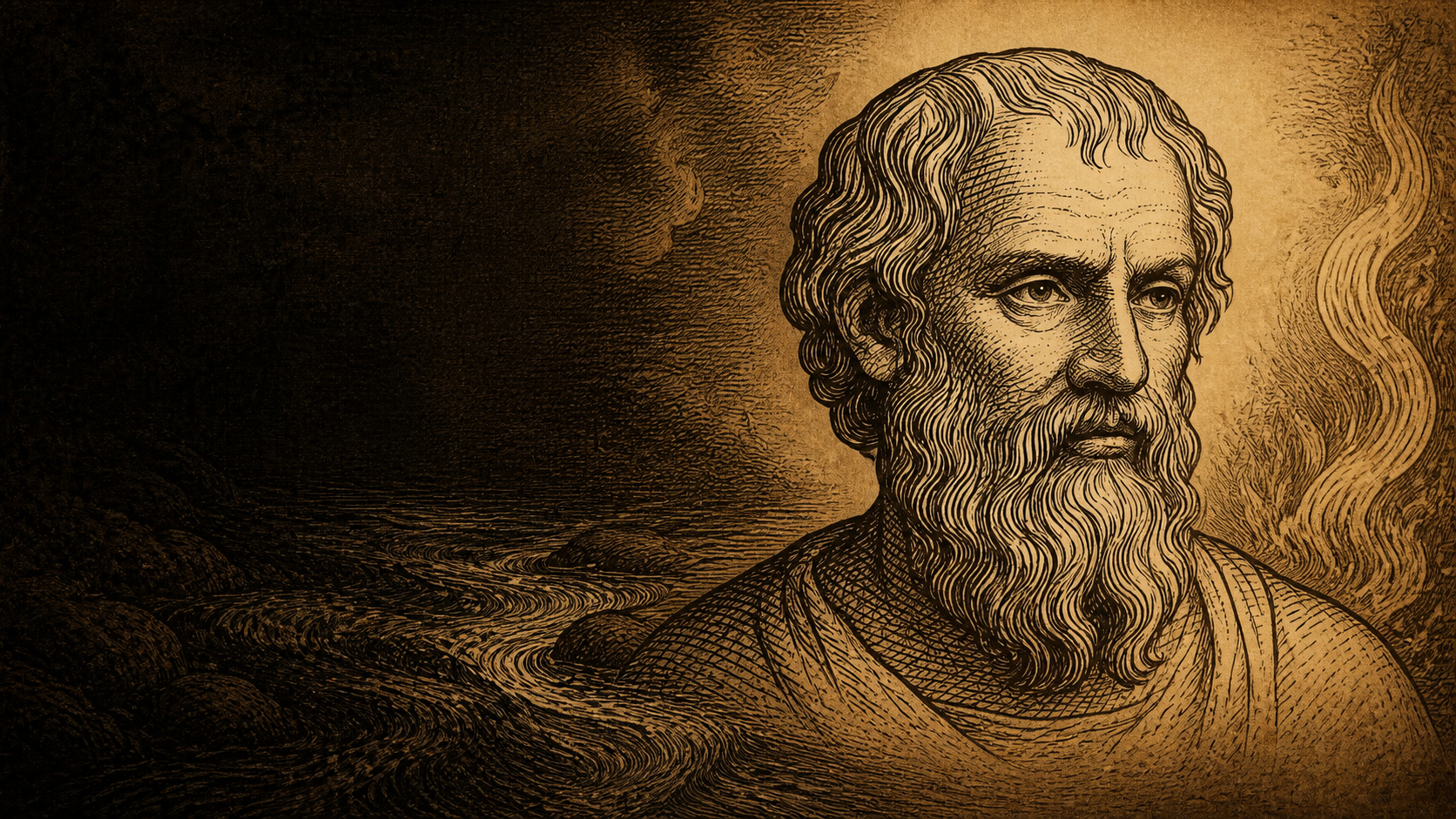
Who was Heraclitus?
LOCAL ARCHIVE VOICE / PLAYING
PAUSE / RESUME EPISODE ALL PODCASTS → READ FULL TEXT → DOWNLOAD TEXT DOWNLOAD AUDIO SAVE MY PLACE COPY LINK READ RELATED WORK → READ A PRIMARY SOURCE → THINK WITH THIS → CONTINUE THIS IDEA →
THE NEXT MOVE BELONGS TO YOU
How do you want to continue?
I WANT TO READ Open the complete text in the carriage.
I WANT TO LISTEN Resume—or begin the narration again.
CONTINUE THE JOURNEY Carry this idea to another station.
RETURN TO THE PORTRAIT ×
RETURN TO THE PLATFORM ×
NOMOTO Transit is an interactive audiovisual journey and requires JavaScript. You can still read the articles , explore the research , or browse every work .
Michael Faraday - New Language for Nature You’re listening to “Scientific Giants Who Changed Our Understanding of the World We Live In.” Each episode stands beside one mind and follows a thread of curiosity until it ties to the world we inhabit. Today we descend into a basement where iron filings glitter like frost on black paper, where the air smells faintly of oil, hot shellac, and singed cotton, where a man in a plain coat is bending a piece of soft iron and listening—yes, listening—to what happens when a wire is wound and a current persuaded to run. The room is part workshop, part chapel, part classroom of the Royal Institution in London. The man is Michael Faraday, bookbinder’s son, apprentice turned experimenter, a servant who became the steward of a new language for nature. He will show that motion can be drawn from magnetism, that electricity can be summoned from change, that light and magnetism converse in the fabric of glass, that “lines of force” are not metaphors we draw on paper but structures out there in the world, and that a civilization can be electrified without first learning to boast about it.
Begin with hands, because that is what he had when books were still objects to be stitched and backed, not passports to a career. He was born in 1791 in Newington Butts, south of the river, to a family that could not afford to let genius go idle. At fourteen he went into the shop of George Riebau, a bookbinder and bookseller, binding volumes for customers and, when courtesy and curiosity gave him permission, reading the pages he sewed. He copied passages, made diagrams for himself, wrote questions in margins he had no right to mark, and learned the feel of a clean sentence the way a cabinetmaker learns the feel of an edge planed square. The shop taught him something schools rarely do: that the world comes into your head with your hands first, and that an instrument can be a teacher if you let it refuse to lie.
A neighbor put into his hands tickets to Humphry Davy’s public lectures at the Royal Institution. Davy was the most brilliant chemist in London and a showman besides, making flames dance green with copper salts, popping gas in soap bubbles over candlewicks and sending applause up through the tiers like a spark. Faraday sat in the gallery and took notes with the same care he gave to endpapers, then bound those notes and sent them to Davy with a letter that was bold without being insolent. The letter said, in effect: I am hungry; I am precise; give me a chance. Davy did, first with a few errands and then with a post as chemical assistant at the Royal Institution. It was not a straight elevation. On the Continent, when Davy set out with his new assistant on a tour of laboratories and salons in 1813–1814, Faraday was treated by some as a servant, scorned by Davy’s wife, required to mend apparatus and carry luggage. He did what a grounded ambition does: learned the instruments, learned the manners of rooms where money and curiosity exchange favors, learned languages enough to be useful, and learned, most enduringly, that an experiment will answer if the arrangement is fair.
Back in London he put glass and gas and wire under discipline. He liquefied gases—chlorine among them—that had been “permanent” by reputation until pressure and cold told another story. He studied chlorine itself until the greenish ghost gave up a part of its grammar; he isolated benzene from oils used for lighting and wrote down its properties without pretending to understand its shape. He improved steel. He drew the outlines of a science of electrolysis in which the same electricity that could shock a frog’s leg or ring a bell could pull metal out of a solution and plate it onto a spoon, or split water into hydrogen and oxygen. He disliked the tangle of names that had grown around these new crafts—vitriols and lyes and butter of antimony—and, with his friend the wordsmith William Whewell, he helped mint terms that did not flatter fashion: anode and cathode for the entering and leaving places, electrode for the conductor that touches the solution, ion for the thing that travels under an electric push. He then proved two laws that turned a cluster of tricks into an economy: the amount of chemical change at an electrode is proportional to the quantity of electricity that passes; and equivalent amounts of different substances are liberated by equal quantities of electricity. In other words, electricity is not a spirit that appears where it wills; it is a ledger entry you can trust.
And then there was the smell of ozone, a smell like metal seen with the nose, the signature of sparks and brush discharges in rooms where wires have been persuaded into loops. In 1820, in Copenhagen, Hans Christian Ørsted had found that a current-carrying wire will deflect a compass needle. Ampère in Paris turned that rumor into mathematics and into coils that pulled with a steadiness magnets love. Faraday read these reports and felt the itch that pushes a mind from reading to building. What Ørsted had done suggested a marriage: if electricity could produce magnetism, might magnetism be persuaded to produce motion? In 1821, he gave the world an answer that would soon be household. He poured mercury into a dish, set a fixed magnet upright in the pool, and lowered a current-carrying wire so it hung freely over the magnet. When he completed the circuit, the wire began to circle the magnet, tracing a dance around an invisible axis. Reverse the roles—hang the magnet, let a current run around it—and the magnet turns. A line of force had become a wheel. The first electric motor began as a toy on a bench, and it is a measure of his temperament that he immediately treated it not as a gadget but as an argument: the forces around a current and a magnet are not mere attractions along lines; they are curls that can be harnessed. Motion is latent in the geometry.
He then asked an opposite question, the question from which an age would be powered: if current can make magnetism and magnetism can make motion, can motion, through magnetism, make current? It sounds like a riddle now because we have allowed it to become ordinary. In the summer and autumn of 1831 he built the answer carefully enough that strangers would be able to repeat it. He wound two coils of wire on opposite sides of a soft iron ring—primary and secondary, though he did not yet use those words—and put a galvanometer on the secondary to watch for any tremor of electricity. When he connected a battery to the primary, the galvanometer kicked. When he broke the circuit, it kicked again in the other direction. While the current was steady, the needle calmed. He pushed a bar magnet into a coil and saw the needle swing; he pulled it back and saw the swing reverse. He spun a copper disk between the poles of a horseshoe magnet and drew current from a brush at the rim. Change was the engine. Faraday’s law—he would not have branded it so—falls out of those small performed sentences: the electromotive force induced in a circuit is proportional to the rate of change of magnetic flux through the circuit. Or the way he would more happily say it: rearrange the situation, and nature prints an answer when she must. From these arrangements came the transformer in embryo, the alternator in possibility, the dynamo in fact. An entire economy moved, slowly at first and then with hungry speed, from chemical piles and small tricks to great machines that could pull current from a waterfall and carry it along wires to lamps and motors far away.
He drew what he had learned the way a poet draws breath—lines on paper to stand for the lines of iron filings that stood up and curved when a magnet lay beneath them. Those “lines of force” were not pictures to him. They were a way of thinking that let a boy in the gallery feel the shape of a field with his eyes. He sprinkled filings on cards, tapped gently, and watched them arrange themselves along curves that emerged from a magnet’s pole and returned to the other. He slid a piece of soft iron into the space and watched how the pattern bent; he interposed glass or a block of bismuth and saw how the lines hesitated or were repelled. He hung small needles in drops of gum so they could rotate with almost no friction and used them to test whether the space in front of him was empty of influence or saturated with direction. He was training the culture to see the invisible in ways it could reproduce without trusting a mystic. That is what a field is at first: a decency of pattern imposed on a muddle.
He also trained his own mind to stop pretending that a field is a set of arrows we draw after the fact. The field is the primary thing. Matter is the way a field knots itself. He did not write that slogan; he lived its consequences. Where others were content to speak of action-at-a-distance—to let a force reach across empty space like a ghost’s arm—he preferred to imagine something in the space taking the strain, even if he could not yet write its equations. The faith, if it is a faith, becomes a method when the experiments begin to crowd around it, and his crowded.
Two are so simple you can make them at a kitchen table with careful friends and a few cautions. The first is a room clad in metal foil. In 1836 he mounted sheets of tinfoil on a wooden frame to build a chamber and placed an electroscope inside. He electrified the outside of the enclosure and watched the instrument inside remain calm. The charge resided on the outside of a conductor; the inside was protected. A storm cannot reach you through a metal envelope. We now call this a Faraday cage and use it to keep radio noise out of instruments and lightning out of cars. The second is a beam of light forced to confess under a magnet’s influence. In 1845 he hung a glass rod between the poles of a powerful electromagnet, sent polarized light through the glass—light whose waves had been forced to vibrate in a single plane by passing through a prism—and saw the plane of polarization rotate when he turned on the magnet. The rotation changed with the strength of the magnetic field and the length of the glass path. He had tied optics to electromagnetism with a twist of light in matter. The Faraday effect flatters his name now; at the time it troubled a habit and delighted a few. Something that runs through glass when a battery is connected also touches light. Ideas that had lived in separate cabinet drawers—electricity, magnetism, light—belonged to the same wardrobe. He did not write the equations of that household. James Clerk Maxwell would. But Maxwell would later say, with a gratitude that reads like amazement, that he made his equations to express Faraday’s ideas.
He thought also with insulators—the materials that do not release charge easily. He found that when a charged body influences another across space, the space must be taken seriously, not ignored as empty. He introduced “specific inductive capacity,” what we would now call the dielectric constant, to measure how a material inserted between charged conductors changes the amount of charge needed to produce a given potential difference. Glass is not the same as air; sulpher is not the same as shellac. He is telling the culture that space has character, the way a cloth has weave and density. He is telling engineers that the emptiness between wires is not nothing; it is a part of the system that can be chosen and tuned. He is telling philosophers that their favorite nothing has properties that a child can test with foil and a jar.
His hands kept returning to magnets and to materials that behaved perversely when a magnet was brought near. He discovered diamagnetism, the tendency of many substances to be weakly repelled by magnetic fields, a tendency you can dramatically display by making a small piece of bismuth float in a field’s gradient or by suspending a frog between the poles of a high-field magnet until the tiny imbalances are enough to lift its water into lines. Faraday did not hoist amphibians; he tilted bits of matter and saw them take up positions that revealed an underlying arithmetic of susceptibility. He built a vocabulary that let later physicists make a table and then write their own letters on top of the table: paramagnetic for things that are somewhat attracted (iron, nickel), diamagnetic for things that are slightly pushed away (bismuth, copper), ferromagnetic for the stubborn that can be permanently magnetized. He did not try to turn the table into a dogma. He used it as a workbench.
He wrote in notebooks with the care of a clerk who knows that his own memory will not be equal to tomorrow’s needs. He did not pretend to be a mathematician. He could manipulate numbers as well as any careful experimenter, but he distrusted algebra when it wandered unchaperoned. He drew constantly, and he wrote “I am not satisfied” more often than he wrote “I am convinced.” The honesty can read like pedagogy; it was a posture of survival. He had seasons when his mind failed him, when the years of exposure to mercury vapor and solvents and the sheer strain of being the instrument that asked and answered made his recall falter and his confidence go gray. He stepped back, defended the lectures he loved as if they were a kind of steadiness the mind could sit in, and waited for the busyness that felt like health to return. It did. He went on again, older and more tender but still clear.
He would not patent. He refused money for ideas that would have made him rich. He declined a knighthood. He declined the presidency of the Royal Society, not because he despised it but because he knew what work he could do and what pomp would cost. He accepted a modest pension and later lived in a grace-and-favor house at Hampton Court thanks to a queen who liked to be in rooms with instruments and to hear the sound Faraday’s voice made when he explained the world to people who could change it. He kept his Sandemanian faith private and steady, as much practice as creed, a discipline that made him wary of anger and wary of using other people’s credulity to pay his bills. He would consult for the Admiralty on the magnetization of iron ships and the design of lighthouses; he refused to design weapons. He liked to make useful things but disliked being used.
He never stopped teaching. Friday evening discourses at the Royal Institution became a kind of civic ritual; Christmas Lectures a sworn promise to the young that wonder could be won honestly and shared cheaply. He could make a candle into a semester. The little volume published from those lectures, The Chemical History of a Candle, is a quiet manifesto: begin with a familiar thing, take it seriously, ask it questions you are willing to answer in public, and do not rest until the invisible that governs it has become visible enough for a child to draw. A candle burns because wax vaporizes and reacts with oxygen; the flame’s shape is a product of convection and the fuel’s rate of rise; the luminosity depends on particles of soot being heated to incandescence. The room fills with carbonic acid. Water condenses on a cold spoon. In those small sentences a child can smell the structure of the chemical world without being asked to worship a word.
He read as carefully as he spoke. When he was not in the laboratory, he walked quickly, thinking with his head down the way many men do when the day’s next step in an argument is more urgent than what the cobbles do to the soles of shoes. He could be abrupt. He could be sweet. He wrote thank-you notes that were as exact as his captions and refusals that were kinder than most invitations. He did not flatter easily. He made himself into an instrument by refusing noise.
If you want to feel the moment when Faraday’s private language—those lines of force—becomes a public language other minds can calculate with, step into a room on another island in another decade. It is the 1850s in Scotland. James Clerk Maxwell stands over pages so crowded with symbols that even mathematicians squint the first time they see them. He is trying to write equations that preserve the dignity of Faraday’s curves. He wants a formula that does what an iron filing does when it turns in response to a nearby magnet. He writes four relations and one extra term—displacement current—that has the audacity to put changing electric fields on a level with ordinary currents. The mathematics says that electric and magnetic fields can travel through space as waves at a speed determined by the electrical and magnetic properties of that space. Maxwell calculates the speed and stares. It matches the measured speed of light. The connection Faraday had found in glass with a twist and a magnet turns into an identity: light is an electromagnetic wave. The nineteenth century’s fondness for unity—heat and motion, electricity and chemistry—gets its grandest exemplar. The twentieth century’s engineers will build radios and radar from that unity. The twentieth century’s theorists will build more. Faraday would have puzzled over the curly symbols. He would have understood the argument because he had rehearsed its tone with filings, magnets, and a beam of polarized light rotating in a field.
The practical world moved even faster because a lever that moves a city did not need a metaphor to do its work. Wire and iron and copper disks freed from literal friction by careful bearings make the world go around in ways that a book could never dream quickly enough. Joseph Henry on the other side of the Atlantic discovered induction independently and built electromagnets that could lift weights men had used words to lift before; Samuel Morse made dot and dash an alphabet for wires that taught continents to answer back; Zénobe Gramme put the dynamo on a bench and then a factory floor; Siemens and Edison and Tesla and Westinghouse turned field and flux into cities that stay lit when rain makes a morning gray. The giant machines are spectacular, but Faraday would have smiled most at the small ones that hide in a thousand rooms: transformers that make voltage safe for a kitchen; motors that spin a fan so a child sleeps; a bell that rings because a coil is wound and a bit of iron can be moved by a momentary field. Induction is not a large apparatus; it is a sentence.
He did not equip only engineers and physicists. He gave courts new instincts: do not take a testimony; test a claim with apparatus. He gave journalists new habits: do not marvel at a trick; ask how it was done and by what general rule. He gave preachers a new humility and a new metaphor; he would not have loved the metaphor, but he could not have stopped it from escaping into sermons: a field that pervades space is a kinder picture of influence than an angry arm. He gave politicians a way of speaking about infrastructure that sounds like prudence rather than pomp: a supply chain for copper and coal and iron is not a luxury; without it, a city darkens and a hospital dies. He gave schoolteachers a license to insist that demonstration is not a parlor game; it is the way the mind learns decency.
The Royal Institution spent his life learning that decency with him. He made its basement a place where poor boys could see that thought has tools and can be learned; he made its theater a room where rich men could see that money is not the same as understanding; he made its laboratory a shop where instruments were made and repaired in-house because truth cannot afford a queue; he made its library a ledger that people returned books to because stealing a method is worse than stealing a object. He was a difficult colleague only to those who thought that ranking is the same as value. He did not taunt. He did not position. He did not rest.
The times were harsh to minds, and his was not spared. Periodic blurs stole his confidence in the 1830s; he worked through them as a man works through a winter, walking when the weather allows and keeping the lamp trimmed when the wind permits flame. He had loyal help—assistants whose names rarely make it onto monuments and a wife, Sarah Barnard, whom he married in 1821 and with whom he found a steadiness that made the daily humiliations of London tolerable. He did not have children. He had students who, decades later, would write about his hands moving in the light of a lamp as if memory itself were a kind of soft iron being bent by a field it had learned to trust.
He died in 1867. The culture grieved as it grieves an uncle who refused to sit at the head of the table but paid for the meal. He was buried in Highgate under a stone that a child could read. In Westminster Abbey a tablet bears his name so the powerful could be seen honoring what they do not master. The honors are not the work. The work is light you can read by, the hum of a mild motor under your own breath at night, the calm inside a car as lightning hits a road nearby and you feel nothing, the taste of an idea when a child sprinkles filings and sees a pattern.
If you want to carry him past this hour, open a drawer in your house that has a tool with wire in it and imagine laying it on the bench where he found coils and rings and disks. He would not disdain a kitchen mixer or a fan or the motor in a hard drive. He would show you the part that moves. He would ask you whether you know which way the current runs, whether you know how to make a brush against the rim of a disk whisper instead of scrape, whether you know how to make a field by change rather than by pipe and battering. He would approve if you asked an honest question he could answer with an arrangement and a line. He would not, I think, care that your phone’s face is a thousand times everything he could have wanted in an instrument and more. He would care whether you have learned to use it without superstition.
He taught two lessons that I wish would live in every room where the future is being built. The first is that the best language is the one that makes action possible across mistrust. His lines of force look like art now because they have been superseded by mathematics, but in their day they allowed craftsmen and princes to point at the same card and agree on where the curve lay. The second is that knowledge kept in private is a sin against the city. He did not use that word. He used “duty” and “service” and “obligation” with a slow insistence that made even the eager generous. He gave up rich patents that might have paid for palaces. He spent his energy on institutions that, while he lived, fed and taught and kept clean the minds of people who could not have found their way to them in any other age. He believed that truth in small rooms is a public good in a way that sermons are not. He practiced that belief with coils and glass and filings. We live inside it.
So we leave him tonight in the light he helped make ordinary, a man standing over a card dusted with iron, tapping it with a fingernail until the dust takes the shape of confidence. The room is warmer than when he began. The dish of mercury has been covered because he learned to fear its breath. The magnet is nicked and faithful. A wire makes a circle that could be drawn on any child’s slate. The instrument next to it hums with a patience that outlasts names. Now and then a visitor from upstairs puts on a hat and says, “You make it look simple.” He smiles—or doesn’t—and answers, “It is simple, once you stop lying.”
You have been listening to “Scientific Giants Who Changed Our Understanding of the World We Live In.” Today we stood in a basement, a theater, and a nation of wires, and watched Michael Faraday turn curiosity into instruments and instruments into a grammar that tied magnet to motion, motion to current, and current to light. In our next episode we will climb from coils to creatures, traveling to a quiet house in Kent where a man surrounded by barnacles and notebooks will take a small bag of facts from islands and pigeon lofts and turn it into a theory of how life makes and unmakes its forms—Charles Darwin, who will teach us to see selection writing in slow ink across the face of the Earth.
Return to Transit