NOMOTO MEDIA Read, listen and watch Articles, podcasts, films, stories, books, music and research.
CHAPTER 00 / THE WET SEAT
One passenger is missing.
The seat is wet. It has not rained. Someone says the passenger was carrying an empty birdcage.
Browse all content Explore the subway
READ ARTICLES
EXPLORE RESEARCH
SEARCH ALL WORK
BULLSHIT CENTRIFUGE
A dreamlike journey through the human condition: moral philosophy from Thales to Arendt and Camus, psychology, science, film, and AI as a new test of old human questions. There is no required route.
Nomoto Media system map
Power, Thought, Art, and Memory cross at shared stations. Each interchange connects films, voices, and texts through a common question.
AI: An Uncertain Future AI articles Psychology Philosophy Scientific Giants Research Short Stories Books Films Filmmaking Giants Theatre Classical Music Music Addiction & Recovery Articles All Content The Mapmaker American Presidency How Empires Rise and Fall CLOSED LINE / NEW YORK CLOSED LINE / PARIS CLOSED LINE / MOSCOW
DEPARTURE / THE SYSTEM IS WAKING ENTER TRANSIT THE MAP WILL OPEN WHEN READY
POWER LINE THE WATCHING ROOM BETWEEN STATIONS
← Back to map
LOCAL YEAR 2026 SHIFT YEAR ↻ N STATION TOUCH SIGN
NOMOTO MEDIA
Title
Description
← PREVIOUS STORY 01 / 05 NEXT → RANDOM STORY ↻ ALL STORIES
THE POSTER IS MOVING
×
A PASSENGER SAYS
READ IN THE CARRIAGE →
LISTEN IN THE CARRIAGE →
SHIFT YEAR AGAIN ↻
FOLLOW THE TRANSFER →
CONTINUE THE JOURNEY →
WORDS BESIDE THE FILM / DRAG TO MOVE
READ THIS PASSAGE →
GIVE ME ANOTHER QUOTE ↻
LOOK AGAIN THE QUESTION FOUND OBJECT
×
EVIDENCE / UNFILED
A detail refuses to disappear.
KEEP THIS CLUE
01 FILM ARCHIVE
FILM / RELATED WORK FOLLOW THE SIGNAL READ IN THE CARRIAGE → LISTEN IN THE CARRIAGE → THINK WITH THIS → ALL PODCAST EPISODES → TAKE THE NEXT TRAIN → ASK THE CONDUCTOR →
PLAY FILM DOWNLOAD SHORT NEXT FILM → HIDE QUOTE FILM CONTROLS ← Back to journey
ORIGINAL NOMOTO SECTION ARTICLES 220 works · original categories and publication pages ORIGINAL NOMOTO SECTION COLLECTIONS Connected bodies of work ORIGINAL NOMOTO SECTION BOOKS Long-form work and complete manuscripts ORIGINAL NOMOTO SECTION SHORT STORIES Fiction · memory · absurdity · human consequence ORIGINAL NOMOTO SECTION VIDEO Films and moving-image work ORIGINAL NOMOTO SECTION MUSIC Original sound and audiovisual work ORIGINAL NOMOTO SECTION RESEARCH Evidence · prediction · power · consequence ORIGINAL NOMOTO SECTION ABOUT NOMOTO The work, author, and contact route 02 / PHILOSOPHY THE COMPASSIONATE STOIC Enter the inner chamber 03 / HUMAN CONDITION FACES REMEMBER All witness fragments · one film 04 / UNBUILT THE CITY BORROWS OUR BODY Travel forward 09 / NOMOTO MEDIA LONELY ROBOT NOMOTO MEDIA archive · music/video experiment 12 / NATURAL HISTORY GREEN RIVER FOSSIL COMPANY Quarry · preparation · geological design 13 / PHILOSOPHY MARCUS AURELIUS / THE INNER CITADEL Film → thinker → text → narration 15 / LABOR THE ASCENT AFTER THE SHIFT Film → essay → local narration 17 / MEMORY THE MEASURE THAT OUTLIVED THE MAKER Film → Little Book 18 / FUTURE THE LAST TRAIN LEAVES EARTH Film → Newton dramatic script 19 / AI ROBOT LOVE / RUNNING Film → friendship and attachment 20 / CARE THE REACH Film → A Little Book of No Consequence 05 / FICTION / SHORT STORY THE WATCHER READ IN THE CARRIAGE 06 / FICTION / SHORT STORY THE LAST MANUAL GENERATION “THE INVITATION ARRIVED ON PAPER.” PHILOSOPHY 01 WHO WAS HERACLITUS? Original script · existing audio PHILOSOPHY 02 WHO WAS SOCRATES? Original script · existing audio PHILOSOPHY 03 WHO WAS PLATO? Original script · existing audio PHILOSOPHY / THEATRE Seneca — Stoic tragedy and rhetoric Original script · existing audio PHILOSOPHY 05 WHO WAS RENÉ DESCARTES? Original script · existing audio PHILOSOPHY 06 WHO WAS JOHN LOCKE? Original script · existing audio PHILOSOPHY 07 WHO WAS DAVID HUME? Original script · existing audio PHILOSOPHY 08 WHO WAS IMMANUEL KANT? Original script · existing audio PHILOSOPHY 09 WHO WAS JOHN STUART MILL? Original script · existing audio PHILOSOPHY 10 WHO WAS KARL MARX? Original script · existing audio PHILOSOPHY 11 WHO WAS FRIEDRICH NIETZSCHE? Original script · existing audio PHILOSOPHY 12 WHO WAS MARTIN HEIDEGGER? Original script · existing audio PHILOSOPHY 13 WHO WAS JEAN-PAUL SARTRE? Original script · existing audio PHILOSOPHY 14 WHO WAS HANNAH ARENDT? Original script · existing audio PHILOSOPHY 15 WHO WAS SIMONE DE BEAUVOIR? Original script · existing audio PHILOSOPHY 16 WHO WAS ALBERT CAMUS? Original script · existing audio PHILOSOPHY 17 WHO WAS JOHN RAWLS? Original script · existing audio PHILOSOPHY 18 WHO WAS MICHEL FOUCAULT? Original script · existing audio 08 / PSYCHOLOGY WHO WAS JUNG? Read · listen · enter the shadow 09 / SCIENCE WHO WAS NEWTON? The complete original episode 09A / ORIGINAL DRAMA / STAGE OR TELEVISION NEWTON — FOUR EPISODES Complete 152-page script · read or download 10 / SCIENCE WHO WAS DARWIN? Variation · time · consequence 11 / SCIENCE BREAD FROM AIR / POISON FROM SCIENCE Follow discovery into consequence 12 / PSYCHOLOGY WHO WAS KAREN HORNEY? Against Freud · toward culture 13 / PSYCHOLOGY THE LISTENING REVOLUTION What changes when someone is heard? 15 / POWER THE WATCHING ROOM Read in the carriage 16 / COMPLETE PUBLICATION ALL 464 PUBLISHED WORKS Original sections · categories · canonical links 01 / FICTION / NARRATED SOME KIND OF LOVE LISTEN · READ · CONTINUE 02 / FICTION / NARRATED THE MIRROR LISTEN · READ · CONTINUE 03 / FICTION / NARRATED THE WATCHER LISTEN · READ · CONTINUE 04 / FICTION / NARRATED THE LAST MANUAL GENERATION LISTEN · READ · CONTINUE 05 / FICTION / COMPLETE TEXT THE ASTEROID THE ASTEROID WAS SUPPOSED TO KILL US ON THURSDAY. 20 / A LITTLE BOOK OF NO CONSEQUENCE THE BOULDER HAS EXCELLENT ATTENDANCE Read · listen · return to the hill 20B / COMPLETE BOOK LINE A LITTLE BOOK OF NO CONSEQUENCE PROLOGUE · SEVEN PARTS · COMPLETE MANUSCRIPT DOWNLOAD 23 / MEMORY LINE / 2020–2025 THIRTY OLDER WORKS RETURN TO SERVICE Democracy · economy · AI · care · war · philosophy COMPLETE ARTICLE ARCHIVE 464 ORIGINAL WORKS Ordered by original publication date 2026 / FRONT PAGE TETRIS Original text OPEN BOOKS PHILOSOPHY & HISTORICAL PSYCHOLOGY Six verified public-domain editions · read or download 17 PUBLISHED EPISODES PSYCHOLOGY All published episodes · cover art · audio 30 PUBLISHED EPISODES CLASSICAL MUSIC All published episodes · cover art · audio 39 PUBLISHED EPISODES SCIENTIFIC GIANTS All published episodes · cover art · audio 19 PUBLISHED EPISODES AI & SOCIETY All published episodes · cover art · audio 31 PUBLISHED EPISODES FILMMAKING GIANTS All published episodes · cover art · audio 34 PUBLISHED EPISODES THEATRE All published episodes · cover art · audio 62 PUBLISHED EPISODES AMERICAN PRESIDENCY All published episodes · cover art · audio 18 PUBLISHED EPISODES ADDICTION & RECOVERY All published episodes · cover art · audio 29 PUBLISHED EPISODES CIVILISATIONS RISE AND FALL War: How Empires Rise and Fall · cover art · audio 31 / FILMMAKING GIANTS OLIVER STONE The provocateur of American politics · 11 min 32 / FILMMAKING GIANTS LUIS BUÑUEL The surrealist provocateur · 19 min 33 / FILMMAKING GIANTS QUENTIN TARANTINO The pop-culture alchemist · 23 min 34 / FILMMAKING GIANTS ANDREI TARKOVSKY The sculptor of time · 18 min 35 / FILMMAKING GIANTS AKIRA KUROSAWA The bridge between East and West · 17 min 36 / SCIENTIFIC GIANTS ANTOINE LAVOISIER Matter · measure · revolution · 27 min 37 / SCIENTIFIC GIANTS MICHAEL FARADAY A new language for nature · 23 min 38 / SCIENTIFIC GIANTS GREGOR MENDEL The monk who discovered heredity · 22 min
THE SHELVES CONTINUE BEYOND THE WALL · NEW CARDS APPEAR AS THE JOURNEY GROWS
ONE PASSENGER IS MISSING / NO WRONG ANSWER
SOUND ON
Centrifuge
Read, listen and watch
07 CONTINUE MY JOURNEY Return to the marked place
Return to opening page Read this passage → Another quote ↻
← Back to map
NOMOTO MEDIA
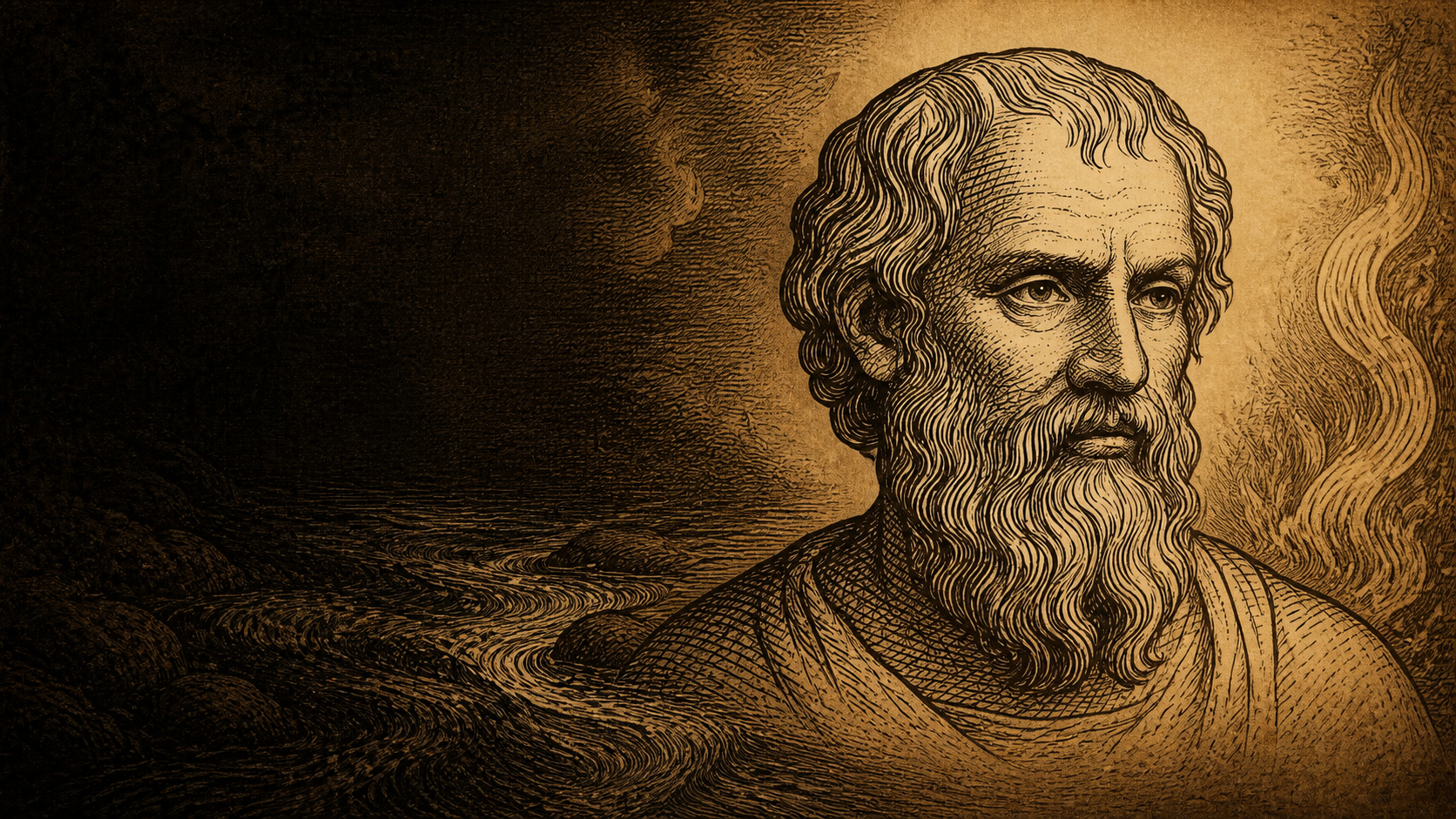
Who was Heraclitus?
LOCAL ARCHIVE VOICE / PLAYING
PAUSE / RESUME EPISODE ALL PODCASTS → READ FULL TEXT → DOWNLOAD TEXT DOWNLOAD AUDIO SAVE MY PLACE COPY LINK READ RELATED WORK → READ A PRIMARY SOURCE → THINK WITH THIS → CONTINUE THIS IDEA →
THE NEXT MOVE BELONGS TO YOU
How do you want to continue?
I WANT TO READ Open the complete text in the carriage.
I WANT TO LISTEN Resume—or begin the narration again.
CONTINUE THE JOURNEY Carry this idea to another station.
RETURN TO THE PORTRAIT ×
RETURN TO THE PLATFORM ×
NOMOTO Transit is an interactive audiovisual journey and requires JavaScript. You can still read the articles , explore the research , or browse every work .
Oliver Stone – The Provocateur of American Politics Oliver Stone – The Provocateur of American Politics
The jungle presses in on all sides. Rain falls in sheets, the ground is mud, the night filled with sudden flares of gunfire. A nineteen-year-old American soldier crouches in the muck, his uniform soaked, his mind reeling from fear. Later he will remember this not only as a nightmare but as a furnace. Later he will take these sights and sounds, the cries of wounded men, the blur of morality, and pour them into cinema. That soldier is Oliver Stone. Vietnam marked him with scars visible and invisible. It would become both his obsession and his weapon. For Stone, film was never escape. It was confrontation. He believed movies could wound, could heal, could demand that a nation look at truths it would rather bury.
Stone was born in 1946 in New York City, the only child of Louis Stone, a Wall Street broker, and Jacqueline, a Frenchwoman. His early life was privileged: summers at country clubs, the aura of affluence. But beneath the comfort ran fracture. His parents’ marriage fell apart, and the divorce shattered him. Later he described it as the collapse of his world, the seed of his mistrust of authority and institutions. At Yale he studied briefly before dropping out, restless, searching. He taught English in South Vietnam in 1965, a strange foreshadowing of what was to come, then enlisted in the U.S. Army in 1967. He saw combat with the 25th Infantry Division, wounded twice, awarded the Bronze Star and Purple Heart. The boy from Wall Street privilege had gone into the jungle and returned someone else.
When he came back, America was in turmoil. The war divided generations, the counterculture raged, and cinema itself was about to change. Stone studied film at NYU, under teachers like Martin Scorsese, who encouraged his bluntness and intensity. He began with shorts, then moved into screenwriting. His scripts were raw, often excessive, but they had force. Midnight Express (1978), about an American jailed in Turkey for drug smuggling, was shocking in its violence, unforgettable in its sense of entrapment. It won him an Oscar. Soon after came Scarface (1983), directed by Brian De Palma from Stone’s script, turning Al Pacino into Tony Montana, the Cuban gangster who builds an empire on cocaine and paranoia. Audiences were divided, critics appalled, but the film became iconic. Its lurid dialogue, excess, and operatic downfall embodied both the American Dream and its corruption. Stone had a knack for stories where systems devour individuals and where individuals corrupt themselves with power.
But writing was not enough. He wanted to direct, to seize control of images and sounds. He made smaller features — Seizure (1974), The Hand (1981) — that hinted at his obsessions with control, violence, and paranoia. They did not land. For years Stone seemed destined to be a troubled talent in the margins. Then came the script that would save him and nearly kill him: Platoon.
Stone had tried for a decade to get it made. Studios recoiled: too grim, too political, too unflattering to America’s myth of itself. But by the mid-1980s, with Vietnam films like Coming Home and The Deer Hunter paving the way, the time was right. Shot in the Philippines with young actors forced through military training, Platoon depicted war as moral collapse. Charlie Sheen’s soldier is pulled between two sergeants — Elias, played by Willem Dafoe, compassionate but weary, and Barnes, played by Tom Berenger, brutal and unyielding. The film does not glorify combat; it immerses the viewer in confusion, mud, fear, and betrayal. Stone poured his own nightmares into the story. When it opened in 1986, audiences were stunned. It won the Academy Award for Best Picture, and Stone won Best Director. He had taken his trauma and turned it into a reckoning for a nation.
He followed swiftly with Wall Street (1987). Where Platoon dissected war, Wall Street dissected capitalism. Michael Douglas as Gordon Gekko embodied greed in suspenders and slicked hair. His mantra, “Greed is good,” intended by Stone as condemnation, was embraced by traders as a battle cry. The film captured the ethos of the Reagan era, the frenzy of money and power. Stone knew this world through his father, a stockbroker whose disillusionment after the crash colored Stone’s own cynicism. Wall Street proved Stone could move from battlefield to boardroom without losing intensity.
Then came Born on the Fourth of July (1989), adapted from Ron Kovic’s memoir. Tom Cruise transformed himself to play the patriotic boy turned paralyzed veteran turned antiwar activist. For Cruise, it was a career-defining risk; for Stone, it was another exorcism. He staged not just battles but hospital wards, protests, the agony of disillusionment. The film earned Stone his second directing Oscar. In three films — Platoon, Wall Street, Born on the Fourth of July — he had mapped America’s late 20th century crises: war, greed, and betrayal.
But Stone’s ambition was bottomless. In 1991 he made JFK, an epic fever dream of conspiracy. Kevin Costner’s Jim Garrison investigates the assassination of Kennedy, and Stone intercuts archival footage with dramatization, black-and-white with color, newsreel with hallucination. The editing is relentless, designed to overwhelm. The film suggests a vast cover-up, implicating the CIA, the military-industrial complex, shadowy networks. Critics accused Stone of distortion, of inventing. But JFK did what no congressional report had: it reignited national debate. It even led to the release of sealed government documents. Stone’s belief that cinema could be political act was vindicated.
The early 1990s cemented Stone as both artist and lightning rod. The Doors (1991) indulged his fascination with excess, telling Jim Morrison’s story as psychedelic opera. Heaven & Earth (1993) looked at Vietnam through the eyes of a Vietnamese woman, expanding his war saga into cultural encounter. But it was Natural Born Killers (1994) that made headlines. Based on a story by Quentin Tarantino, Stone turned it into a hallucinatory satire of media, violence, and celebrity culture. Woody Harrelson and Juliette Lewis play Mickey and Mallory, lovers on a killing spree turned folk heroes by television. The film is edited like a kaleidoscope: shifting film stocks, cartoon inserts, relentless sound. Stone wanted to indict a culture that turned killers into stars. Critics accused him of doing the opposite. The film was blamed for inspiring real crimes. It remains one of the most divisive films of the 1990s, a testament to Stone’s willingness to provoke at any cost.
His next major project, Nixon (1995), sought to humanize a reviled president. Anthony Hopkins gave a performance of paranoia and pathos, portraying Nixon as tragic, haunted by demons. The film was long, ambitious, and underappreciated at release. But it showed Stone’s fascination with power as tragedy, leaders undone by both circumstance and flaw. Later works — Any Given Sunday (1999), about football as modern gladiator combat, and Alexander (2004), an epic that stumbled under its own weight — revealed his range and his excesses. Stone’s films could soar, and they could collapse. He never played safe.
As the years passed, Stone turned increasingly to documentary. He filmed Fidel Castro, Hugo Chávez, and Vladimir Putin, drawing criticism for being too sympathetic. Yet his intent was consistent: to question American narratives, to give voice to the figures painted as enemies. He remained driven by suspicion of authority, by a conviction that truth lies hidden beneath official stories. In 2016, Snowden dramatized the whistleblower’s revelations about government surveillance, continuing Stone’s decades-long critique of secrecy and power.
Stone’s style is unmistakable. He cuts fast, layers sound, assaults with imagery. His films are not subtle; they are symphonies of outrage. He blends realism with surreal flourishes, often tilting toward excess. To some, that makes his work undisciplined; to others, it makes it urgent. He forces you to feel, not just to think. Watching a Stone film is to be implicated, unsettled, accused.
Critics have always been divided. Some hail him as one of the few American directors willing to use Hollywood spectacle to question America itself. Others dismiss him as conspiratorial, melodramatic. But even his detractors acknowledge his impact. He pushed topics — Vietnam, greed, assassination, surveillance — into mainstream cinema with a ferocity few dared. He is less an aesthete than a polemicist, less concerned with polish than with punch. In that, he belongs to a lineage of artists for whom provocation is principle.
What makes Oliver Stone a giant is not consistency but audacity. He embodies the belief that movies matter, that they can shape debate, awaken conscience, disturb comfort. He risked ridicule, bans, blame, and still made films that spoke to the wounds of his time. His Vietnam trilogy — Platoon, Born on the Fourth of July, Heaven & Earth — remains one of the most searing artistic reckonings with that war. His political thrillers, from JFK to Snowden, remind us how fragile truth is. His satires and portraits of excess mirror America’s own contradictions.
In later years, Stone has become almost a relic of another era, when directors could command massive budgets for political cinema. Hollywood no longer funds such risks. Yet his legacy is secure. Younger filmmakers cite him as proof that anger can fuel art, that cinema can confront as well as entertain. His films are studied, debated, revisited, not for their restraint but for their refusal to be restrained.
Oliver Stone is the filmmaker as warrior, as agitator, as provocateur. He is not subtle, not always right, not always successful. But he is essential. He reminds us that art can be dangerous, that truth is contested, that cinema can be a battlefield. He fought his wars on screen, and through them, he made America look at itself in the mirror, whether it wanted to or not.
Produced by NOMOTO MEDIA — Music by NOMOTO MEDIA.
Return to Transit