Robert Wilson – Slow time, visual theatre
Avignon, 1976. Late on a July evening in the cobbled courtyard of the Théâtre Municipal, hundreds of festival-goers sit on wooden benches beneath a darkening sky. On stage, a strange and hypnotic tableau unfolds. A line of figures in unison slow-motion crosses from left to right, their movements deliberate and dreamlike. A young woman in a white dress steps forward, raises her arm at an impossibly languid pace, and points toward a bright halo of light. From the orchestra pit, an electric organ sustains a pulsating chord that seems to suspend time itself. In the front row, a man wipes sweat from his brow; it’s been four hours, and yet the performance of Einstein on the Beach is still in full flow, no intermission in sight. Some audience members quietly slip out for a break, then wander back in—a courtesy the director has encouraged. Up in the lighting booth stands Robert Wilson, tall and still at age thirty-four, his eyes taking in every detail. He wears all black, silver hair pulled into a tight ponytail, the very picture of calm control. As a gentle chorus of “do-re-mi” syllables echoes onstage in an endless loop, Wilson allows a rare, slight smile. This is his world: a theatre where time stretches, images speak louder than words, and the spectators’ sense of reality is slowly, inexorably being transformed.
He was not always at home in the world of theatre. Robert Wilson was born in 1941 in Waco, Texas, into a conservative Southern family where life followed a steady, traditional rhythm. As a boy, he felt out of sync with that world. He was painfully shy, struggled with a stutter that made each spoken sentence an ordeal. At school, when he opened his mouth and the words tangled, classmates would sometimes snicker. Wilson often wished he could communicate without having to speak at all. Salvation came from an unlikely place: a local dance teacher named Bird Hoffman. She taught the anxious teenager to slow down and express himself through movement. In Hoffman’s studio, he learned to glide, to turn each motion into something meaningful. With each fluid gesture his stutter loosened its grip. Years later, Wilson would credit this experience—moving in slow, careful rhythms—as the seed of his theatrical style. It was also in Texas that he first developed an eye for visual detail. He loved drawing, crafting objects, and spent long hours alone sketching the shapes of trees and buildings, as if stories could live in shapes and colors rather than in spoken tales.
In the early 1960s, Wilson left the expectations of Waco behind and headed to New York City. He was drawn first to architecture and design—fields where structure and space speak volumes. He studied at Pratt Institute in Brooklyn, learning how light, form, and geometry could affect emotion. At night, he wandered Manhattan’s art galleries and dance performances, finding himself mesmerized by the choreography of Merce Cunningham and the strange, silent films of experimental artists. Traditional plays with their neat plots and chatter interested him less; he dreamed instead of creating experiences that felt like moving paintings or living sculptures.
New York in the late ‘60s crackled with experimentation, and Wilson plunged in. In a loft on the Lower East Side, he gathered a ragtag group of artists, dancers, and performers and founded an experimental collective he whimsically named the Byrd Hoffman School of Byrds—an homage to the dance teacher who had changed his life. They weren’t a school in any formal sense; rather, they were explorers of the unknown, “byrds” learning to fly beyond the confines of conventional theatre. Their rehearsals were like playful laboratories. Wilson encouraged performers to explore extreme slow-motion movement, to improvise without words, to hold a single pose for minutes on end. They practiced being as precise as machines one moment and as spontaneous as children the next. In these early years Wilson also worked with children who had mental and physical disabilities, believing that their different ways of perceiving the world could unlock new creative possibilities. One of these was a deaf teenager named Raymond Andrews who scarcely communicated in ordinary life—but in Wilson’s workshop, through gesture and visual storytelling, Raymond’s inner world blossomed. The collaboration between the silent boy and the soft-spoken Texan would soon lead to a breakthrough production.
That breakthrough came in 1970 with a wordless play titled Deafman Glance. It was unlike anything audiences had seen. Seven hours long and completely silent, it unfolded as a series of enigmatic images, like a dream made visible. One scene drifted into the next: a boy calmly pours a bucket of white paint onto a table; a woman in a long dress crosses the stage in glacial slow-motion, tears streaming down her face; a fish is gutted with ceremonious care under dim blue light. Spectators in New York were baffled or entranced—often both. Some surrendered to the strange logic of the piece, letting go of the need to “understand” and simply experiencing it. Others grew restless, sneaking glances at their watches or leaving early. But Wilson didn’t mind if people came and went. To him, viewing theatre could be like strolling through an art gallery: you observe one painting at length, you pass quickly by another, you might even step out for a coffee and return refreshed to discover a detail you missed. Deafman Glance, which Wilson had created in collaboration with Raymond (the deaf “glance” of the title referred to Raymond’s silent way of seeing the world), eventually traveled to Europe. In Paris, it caused a sensation among the avant-garde. The Surrealist writer Louis Aragon, nearly blind by that time, attended a performance and proclaimed that Wilson was a visionary, calling Deafman Glance “the greatest theatrical experience of my life.” A wordless, seven-hour American epic had conquered the City of Lights. At age 29, Robert Wilson suddenly found himself vaulted into the forefront of postmodern theatre.
With success came larger canvases to paint on. Wilson’s ambitions swelled in the early 1970s. In Iran, at a desert arts festival in 1972, he staged KA MOUNTAIN AND GUARDenia TERRACE, a monumental piece that ran continuously for seven days and nights on a mountainside. It was as if time itself was his stage. Actors performed episodes of a mythical family saga at different spots up and down the mountain, while the audience—free to roam, to sleep in tents, to wake at dawn and find a new scene still unfolding—tried to make sense of the sprawling magic. One traveler recalled climbing by torchlight to a ridge at 3 AM to find a solitary performer in a white robe performing a slow dance against the stars. There was no linear story, no beginning or end—just a “mystical continuum,” as Wilson described it. Spectators alternated between confusion, boredom, and moments of unexpected awe. To some, it was a pretentious marathon. To others, it felt like a pilgrimage to an alternate reality shaped by ritual and stillness.
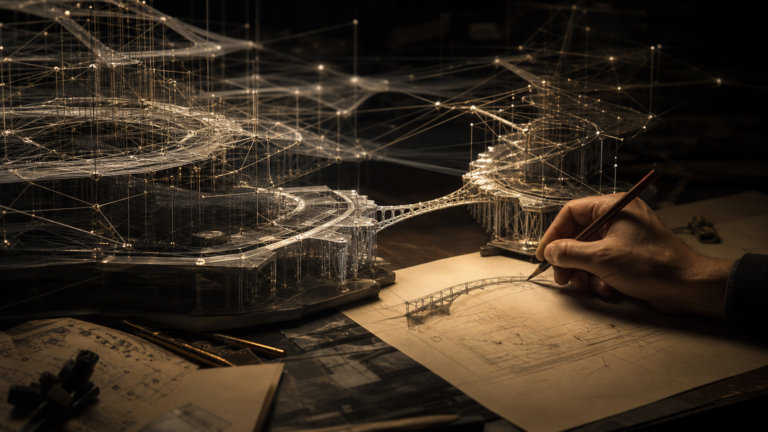
Though such extreme projects made headlines, Wilson’s most famous work was yet to come, and it would require not just his visual imagination but also an ally in music. In 1975, Wilson began collaborating with an up-and-coming composer named Philip Glass. Together, they conceived an opera that broke every rule of opera. It had no plot, no hero, and almost no sung lyrics—only repetitive, mesmeric music and a series of stylized images drawn from the life and ideas of the physicist Albert Einstein. Wilson filled page after page of storyboards with sketches of what the audience would see: a train endlessly emerging on stage, a courtroom with silent figures twitching in slow motion, a spaceship launching into a field of stars. Glass composed pulsating musical patterns that mirrored the relentless logic of time and mathematics. The piece, titled Einstein on the Beach, premiered at the Avignon Festival in 1976 in the very courtyard we find ourselves in now.
On that premiere night in Avignon, as the performers move with trance-like focus, something extraordinary happens among the audience. Many sit fidgeting, unaccustomed to the marathon length and the absence of a conventional story to latch onto. Yet as hour follows hour, a subtle change settles in. A businessman who at first checked his program repeatedly eventually stops worrying about when it will end and instead lets the waves of music wash over him. A young woman who had been puzzled by the random-seeming numbers being chanted on stage (“one-two-three-four, one-two-three-four-five-six…” repeated like an incantation) finds herself murmuring along, her mind oddly clear and peaceful. By the time a circle of dancers begins slowly shifting in a beam of orange light to signal the final act, the Avignon audience has been freed from the ordinary pace of clock-time. They applaud not at obvious climaxes—there are none—but at moments when a beautiful image or a shift in harmony strikes their heart. When the five-hour journey finally concludes, some audience members are in tears, though they couldn’t say exactly why. Glass’s last note fades. On stage, the performers, who have maintained superhuman concentration, stand breathing heavily yet calmly; they form a line and bow. Robert Wilson steps briefly into view, offering a modest nod. The spectators know they have witnessed something radical and new. It is as if Einstein’s own theories about time and space bending have been enacted on a theatre stage. Later, some critics will rave that Einstein on the Beach has redefined what opera and theatre can be; others will splutter that it’s an endurance test or an elaborate prank. Wilson, for his part, will simply continue onward, unfazed, pursuing his singular vision.
After Einstein, Wilson’s reputation as a “master of slow time and visual theatre” is cemented. He spends the following decades creating works all over the world—innovative stagings of classic operas and plays, original pieces with titles as strange as their content (Death Destruction & Detroit, The Black Rider, The Civil Wars). He collaborates with musicians like Tom Waits and writers like Heiner Müller, always infusing their words and music with his distinctive imagery. A Wilson production might feature actors speaking in an unusually flat, rhythmic cadence or moving with ballet-like precision through light and shadow. His rehearsals are famously meticulous: he will adjust an actor’s head tilt by a few degrees to catch the light exactly, or spend an hour to get a blue projection screen to be just the right shade of blue. He sketches every scene beforehand in what he calls a “visual book”—hundreds of drawings that guide his lighting, set, and movement design. Yet within these controlled compositions, he leaves room for audiences to interpret freely. “I’m not interested in meaning that can be summed up,” he often says. “I’m interested in the ineffable.” Like a painting, his work invites you to feel something before you understand it intellectually.
Of course, not everyone in the theatre world welcomes this approach. Traditionalists sometimes argue that Wilson sacrifices story and acting for the sake of pretty stage pictures. Some early critics in America grumble that his shows are cold, overly long, or simply baffling. But even skeptics grant him this: no one forgets a Robert Wilson image once they’ve seen it. A childlike giant on stilts slowly crossing the stage with a net full of fluttering moths; a line of performers each bathed in a different colored spotlight, like a human rainbow; the quiet tableau of a woman and a deer bowing to each other in a snowstorm of white confetti. These moments imprint on the viewer’s mind. They often arrive without explanation, open to personal meaning. Audience members might disagree on what a Wilson piece “means,” but during the show itself, a kind of collective dream takes hold in the theatre. In that dream space, people often discover parts of themselves—or of existence—that lie beyond words.
As Wilson’s career progresses, mainstream recognition also grows. Once the enfant terrible of the avant-garde, he becomes something of a grand master. By the 1990s, institutions that once might have shunned such experimental work now embrace him. He establishes a creative laboratory called the Watermill Center in Long Island, where young artists from around the globe come to train in his methods and create interdisciplinary performances. Yet Wilson remains, at heart, that shy Texan boy who speaks most eloquently through visual art and movement. In interviews, he still speaks slowly, carefully, as if sculpting each sentence. He often mentions silence as “the most beautiful part of theatre.” He credits dancers and musicians as his models more than playwrights or novelists.
Back in the Avignon courtyard, night has fully fallen. The 1976 premiere has ended, but let us imagine, for a moment, that time can loop—fittingly, in Wilson’s universe it often does. The stage is dark now, save for a single spotlight where a solitary figure stands: the character evoking Albert Einstein, identifiable by his frizzy white hair and violin in hand. In reality, the actor has been motionless in this pose for several minutes, as the last delicate notes of a solo violin drift into the summer air. This final image lingers: Einstein, a symbol of time and genius, silently playing his violin. The audience holds its breath, suspended with him. Robert Wilson watches from the booth, his face illuminated softly by the glow of the stage. In this charged stillness, one can sense Wilson’s philosophy made manifest: Time in the theatre is not a thing to be rushed or filled; it is a material to be shaped, stretched, and savored. What matters now is not resolving a story—there was no conventional story to resolve—but rather the feeling that has settled over everyone present. It’s a mixture of wonder, patience, and maybe a touch of vulnerability. In slowing down the world on stage, Wilson has slowed down the beating of everyday life for his audience too. They have lived five hours in his alternate reality and emerged perhaps seeing differently.
When at last the lights go out and applause erupts, people find themselves strangely energized, despite the late hour. Some feel as if they’ve meditated. Others are buzzing with questions to ask their friends: “What did the bit with the spaceship mean?” “Can you believe we sat through all of that?” “Did you notice how the sunlight became moonlight on the backdrop gradually?” They have experienced something together that can’t be neatly summarized, and that in itself is exhilarating.
Robert Wilson steps out into the warm night air, exhausted but content. He speaks quietly with Philip Glass, the two congratulating each other on the feat they’ve pulled off. Glass admits he lost himself in the images a few times while conducting the music. Wilson nods—he too felt that transcendence, even as he orchestrated it. The church bells of Avignon ring midnight. As the crowd disperses into the medieval streets, Wilson lingers a moment, looking up at the stars. It strikes him that theatre, at its best, is like those stars: ancient lights reaching our eyes across vast distances, provoking awe and contemplation without a single word. Tonight, he dared to let his audience drift among those stars.
For decades to come, Robert Wilson will continue to invite audiences into his unique cosmos of slow time and visual poetry. Many will step into his productions uncertain and emerge moved in ways they didn’t expect. His work will remind the world that theatre is not just literature spoken on a stage—it can also be pure experience, a canvas of light, motion, and sound that hits us directly in the subconscious. In an age when life only accelerates, Wilson’s art insists on another rhythm: one of pause, of visual listening, of dreamlike reflection. And so, the legacy of that night in Avignon, 1976, lives on. Long after the festival, people recall how Einstein on the Beach made them feel outside of time. Long after his actors have taken off their makeup and gone home, Robert Wilson’s images and the ghost of his slow, steady heartbeat of a theatre stay with us. In our memory, a violin plays on, a figure in white moves across a stage as if walking on the ocean floor, and we, the audience, are left to ponder not what it all “meant,” but how it taught us to see time and beauty anew.
Return to Transit