Santiago Ramón y Cajal – The Forest of Neurons
You’re listening to “Scientific Giants Who Changed the World.” Each episode stands beside one mind and follows a thread of curiosity until it ties to the world we inhabit. Today we meet a man who proved that seeing can be an act of revolution. He worked not with giant machines, not with armies of technicians, but with microscopes, stains, and the kind of patience that borders on obsession. He drew what he saw with such clarity that the entire understanding of the brain changed. His name is Santiago Ramón y Cajal, and if you want one phrase to carry him, it is this: he turned the nervous system from a fog into a forest.
Cajal was born in 1852 in Spain, in a world that did not yet have neuroscience as a discipline. The brain was still mysterious, and much of what was believed about it was shaped by limited tools and inherited assumptions. Cajal’s own early life was turbulent. He was restless, rebellious, and attracted to art as much as to science. He loved drawing. He loved photography. He had an eye for composition and a hunger to make images that revealed structure. Those artistic instincts would eventually become one of the most powerful instruments in biological history.
His father, an anatomist, pushed him toward medicine. Cajal resisted at first. But over time he found that anatomy—especially under the microscope—offered a kind of truth that could satisfy both his artistic and analytical mind. Tissue, when properly prepared and stained, was not just matter. It was architecture.
In the late nineteenth century, the major question about the nervous system was deceptively simple: what is it made of? Today we take it for granted that the brain is composed of neurons, individual cells that communicate across synapses. But in Cajal’s early career, this was not settled. There was a dominant theory known as the reticular theory, championed by powerful figures such as Camillo Golgi. According to reticular theory, the nervous system was one continuous network—a kind of fused web. Not individual units, but a single, interconnected mesh. The brain, in this view, was less like a forest and more like a spiderweb with no distinct threads.
Why did this theory dominate? Partly because the nervous system is dense, and under early microscopes it was difficult to resolve boundaries. Partly because staining methods were limited. The nervous tissue looked like a continuous tangle, so it was natural to assume continuity.
Then a technological miracle appeared: Golgi’s staining method, sometimes called the “black reaction.” It used silver chromate to stain a small number of neurons completely, turning them dark against a pale background. Instead of a uniform blur, you could see individual cells in dramatic isolation. It was one of those rare methods that makes the invisible suddenly legible.
Golgi invented the stain. Cajal mastered it.
Cajal adopted the Golgi method and then improved the preparation techniques, refining fixation, slicing, and staining to produce clearer results. He applied it to nervous systems at different developmental stages, in different species, in different regions. He did not accept one glimpse as proof; he demanded repeated clarity across contexts. This was the core of his style: relentless verification through seeing.
What he saw contradicted the reticular theory. Again and again, he saw neurons as separate cells. Their branches came close, sometimes extremely close, but they did not merge into one continuous mass. The nervous system was not a fused net. It was a community of individual elements.
This was the neuron doctrine: the idea that neurons are discrete units, the fundamental cells of the nervous system. Each neuron has a cell body, dendrites that receive signals, and an axon that sends signals outward. Communication happens through contact, not continuity.
In Cajal’s time, the synapse had not yet been directly confirmed by electron microscopy—it would come later—but Cajal’s interpretation anticipated it. He reasoned that if neurons were separate, then communication must happen at points of close contact. He turned that contact into a conceptual space: the idea that information passes across gaps.
He also developed another crucial concept: the law of dynamic polarization. In simple terms, he proposed that signals move through neurons in a directional flow—received by dendrites, passed through the cell body, and transmitted along the axon. This provided a functional logic to neuronal structure. The neuron was not just a shape; it was a directional instrument.
Cajal did not merely state these ideas. He drew them. His drawings are not decorative. They are acts of interpretation and proof. In them you can see dendritic trees spreading like branches. You can see axons extending like long paths. You can see layers of the retina and cortex organized into circuits. Cajal made the brain visible in a way that could be shared with others. He did not keep vision private. He published it as image and argument.
This is important, because science often advances not only by discovering facts but by creating a new way of seeing. Once you accept neurons as individual cells, you can ask new questions. How do they connect? How do circuits form? How does development shape connectivity? How does damage disrupt pathways? Once you accept synaptic contact, you can imagine chemical transmission, plasticity, learning. The entire future of neuroscience becomes possible when the basic unit is defined.
The conflict with Golgi is one of history’s sharp ironies. Golgi’s stain made the neuron visible, but Golgi himself clung to reticular theory. Cajal used Golgi’s own method to overturn Golgi’s interpretation. In 1906, both men shared the Nobel Prize in Physiology or Medicine for their work on the structure of the nervous system. The prize recognized the stain and the insight, the tool and the doctrine. But the tension remained. It was as if two incompatible visions were forced to stand on the same stage.
Cajal’s influence went beyond the neuron doctrine. He mapped neural pathways. He studied brain development and proposed that axons grow toward their targets, guided by cues—a concept that foreshadowed modern developmental neurobiology. He described growth cones, the exploratory tips of growing axons. He worked on the retina and the cerebellum, revealing their layered logic. He examined the spinal cord and cerebral cortex, turning mysterious tissue into structured systems.
He also lived through political and social turbulence in Spain, and he struggled with limited resources compared to wealthier scientific centers. Yet his work achieved a universality that broke through borders. He proved that profound science can be done with modest equipment if the mind behind it is rigorous and the eye is trained.
Cajal’s personality mattered too. He was disciplined but also imaginative. He understood that interpretation is unavoidable, but he insisted that interpretation be constrained by repeated observation. He did not settle for the first satisfying explanation. He returned to the microscope until the tissue had no more ambiguity to offer.
So how should we remember Santiago Ramón y Cajal?
We should remember him as the man who drew the brain into modern existence. He helped establish the neuron as the basic unit of nervous function, turning the brain from a continuous mystery into a system of discrete cells connected in networks. He gave neuroscience its alphabet. Without that alphabet, everything that follows—synaptic chemistry, neural circuits, brain imaging, learning models—would be written in a language no one could read.
We should also remember him as proof that art and science are not opposites. His drawings were not separate from his science; they were central to it. He used artistic skill to capture structure faithfully, and then he used that captured structure to build theory. He is one of the great reminders that precision can be beautiful and beauty can be a form of precision.
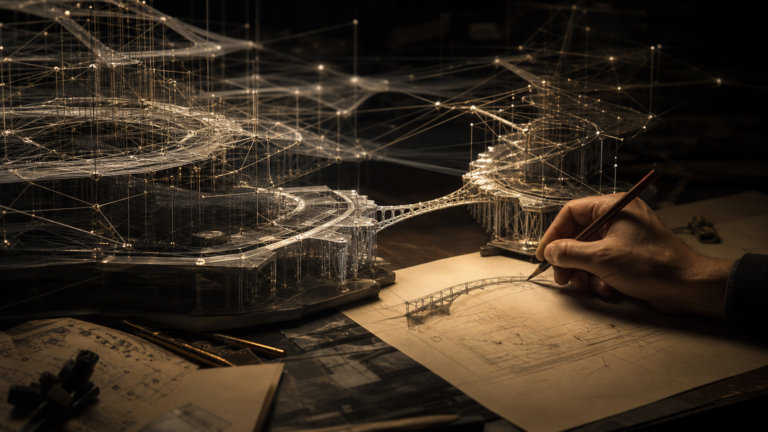
If you want a final image, picture Cajal at his desk late at night, a microscope beside him, paper and ink ready. Picture him peering into a stained slice of nervous tissue where a few neurons glow black in a pale world. Picture him tracing branches carefully, not inventing them, but translating them—turning the private sight in the lens into a public map of the mind. In that translation, the brain became a forest rather than a fog.
You have been listening to “Scientific Giants Who Changed the World.” Today we followed Santiago Ramón y Cajal from restless youth to microscopic discipline, from Golgi’s stain to the neuron doctrine, from reticular mystery to cellular clarity. In our next episode, we will meet Wilder Penfield, who, during awake brain surgeries, touched the cortex with electrical stimulation and heard patients relive memories—turning the brain into a mapped landscape that could be explored in real time.
Until then, thank you for your attention and your time. This episode was written as a continuous story for the ear, because Cajal’s legacy is not just a fact about neurons. It is a lesson about seeing: that if you look long enough, carefully enough, and honestly enough, the living world will reveal its structure—and sometimes that structure changes everything.
Return to Transit