Sextus Empiricus
In a world overflowing with noise, shallow takes, and information that evaporates the moment you hear it, NOMOTO MEDIA exists for one purpose: to give you depth. Whether the subject is philosophy, psychology, history, science, artificial intelligence, literature, or the shape of the future, every series we publish is built on one idea — that thinking clearly is a form of survival.
You’re listening to a NOMOTO MEDIA production. Our catalog spans dozens of long-form, story-driven shows: from Western Moral Philosophy for Beginners to Pioneers of Psychology & Psychiatry, from AI – An Uncertain Future to The Classical Music Giants. Each series is crafted to give you more than facts — it gives you the context, the conflict, and the human meaning behind the ideas that shaped our world.
If you enjoy this program, explore the rest of our library. Every show is designed to stand alone, but together they form a larger project: a guided tour of the forces — intellectual, emotional, political, technological — that built the world we live in and the world we’re about to enter.
Visit the NOMOTO MEDIA channel to discover new series, follow your favorites, and support the work that allows us to create long-form, high-fidelity educational storytelling. And please leave comments if you enjoy our shows.
Now, let’s begin..
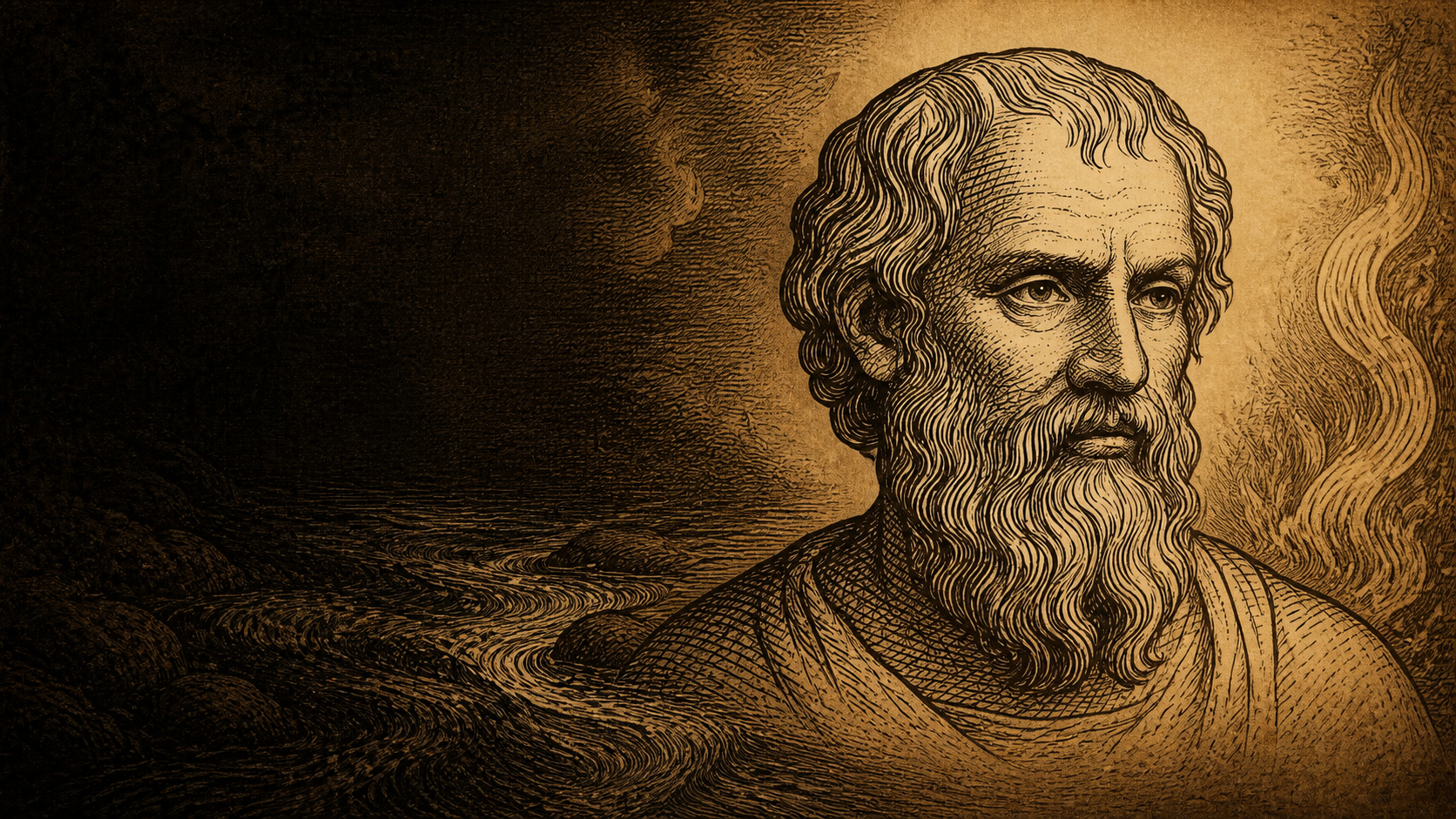
In a quiet corner of the Roman Empire sometime in the late second or early third century of our era, a physician sits at a wooden table, scratching notes onto a wax tablet by lamplight. Around him the house is dark; outside, the city is sleeping. On the shelves behind him are scrolls by Plato, Aristotle, Epicurus, Chrysippus, Hippocrates. He has read them all, argued with them in his mind, and found in each something impressive and something unproven. Tonight he is trying to do something different. Not to build yet another doctrine about the soul or the gods or the best life, but to catalogue the ways in which any such doctrine can be unsettled. His name is Sextus Empiricus, and though he writes in an age of worn-out certainties and competing cults, what he sets down will become one of the most powerful handbooks of doubt ever composed.
We know almost nothing about Sextus’ personal life in the way we know about Socrates or Seneca. He left no anecdotes about himself, no self-dramatizing death. What we have are his works: dense, sometimes repetitive, but astonishingly systematic. He was almost certainly a doctor by profession, probably of the Empiric school of medicine, which distrusted grand theories about hidden causes and relied instead on observation, experience, and analogy. That attitude—suspicion toward unseen explanatory entities, and respect for what can actually be observed—shapes his philosophy.
He writes in Greek, in a world politically dominated by Rome but intellectually still nourished by the old Hellenic traditions. Stoics, Epicureans, Platonists, and Aristotelians are all jostling in the marketplace of ideas, each claiming to have finally laid hold of the truth about reality and the good life. Sextus listens to them all like a diagnostician listening to patients, hearing not just their claims but their symptoms: the strain in their efforts to refute rivals, the evasions when confronted with counterexamples, the subtle dogmatism even in those who profess modesty.
Behind him, in the history of skepticism, stands Pyrrho of Elis, the figure you have just explored: the man who refused to affirm or deny anything about the nature of things, who sought tranquility through suspension of judgment. But between Pyrrho and Sextus lie centuries of development. Pyrrho himself wrote nothing. His attitude was transmitted orally, filtered through disciples, mixed with Academic skepticism in Plato’s Academy, then partially lost and rediscovered. Sextus is the one who gathers these scattered strands, purifies some, elaborates others, and presents a complete picture of what it means to live as a skeptic in a world rich with philosophical systems.
He calls his stance “Pyrrhonian” to distinguish it from the “Academics,” the skeptics in the Platonic line who had tended to drift toward a more dogmatic position: asserting, for example, that nothing can be known, or that only probabilities are available. For Sextus, even those claims go too far. A true skeptic, he insists, does not assert that knowledge is impossible. To say “nothing can be known” is itself to claim to know at least one truth about reality, which contradicts itself. The skeptic is more radical and more modest at once: he simply withholds assent on all questions that go beyond what is immediately evident.
The word he uses again and again is “investigative”: the skeptic is one who inquires. Skepticism is not a doctrine but a practice of searching that never hardens into final answers. Sextus describes the origin of skepticism in an almost clinical way. Some people, confronted with the disagreements among philosophers, feel driven to find out which side is right. They investigate with seriousness. Some eventually convince themselves they have found the truth: these become dogmatists. Others conclude that the truth cannot be grasped at all: these become negative dogmatists, asserting that knowledge is impossible. A third group, after long searching, find that arguments on both sides of every major issue seem equally strong, and so they suspend judgment. It is this third response that Sextus calls skepticism in the Pyrrhonian sense.
The central experience here is what he calls “equipollence”: the equal weight of opposing arguments. When faced with a claim—for example, that the gods exist and care for human affairs—the skeptic examines the reasons given for it and the reasons given against it. If the reasons seem evenly balanced, the mind is drawn neither to assent nor to rejection. Out of this standstill, Sextus says, comes a surprising result: ataraxia, tranquility. When we no longer feel compelled to defend a particular view of the hidden structure of things, a certain tension in the soul relaxes.
Sextus is keenly aware that this sounds paradoxical. Most people imagine that doubt produces anxiety and that certainty brings peace. But in his experience, it is the dogmatists who are tormented, constantly worried that some new argument will topple their system, always compelled to reconcile contradictions, forever anxious to convert others and silence critics. The skeptic, by contrast, having relinquished the need for theoretical security, can live more lightly. He still feels ordinary pains and pleasures, he still flinches at sudden noises and grieves when friends die, but he is freed from the extra layer of suffering that comes from believing that the universe must be a certain way and that his well-being depends on that belief.
To help others reach this standstill, Sextus develops a set of strategies he calls “modes” or “tropes” of skepticism. The most famous set, going back to an earlier skeptic named Aenesidemus, consists of ten modes. These are not logical tricks for their own sake; they are methods for revealing the relativity and variability of our judgments.
The first mode points to the differences among animals. Honey is sweet to humans, but perhaps bitter to some other creature; a plant that nourishes one species is poison to another. If the same thing appears completely different to different kinds of perceivers, how can we confidently say what it is “in itself”? The second mode notes differences among individual humans. What one finds hot another finds mild; what one finds beautiful another finds ugly. The third mode reminds us that even within the same person, the senses conflict: what looks smooth to the eye may feel rough to the touch; what smells pleasant might taste foul.
Other modes focus on conditions: the fourth points to how our perceptions depend on bodily states—health, sickness, fatigue, intoxication. The fifth stresses the role of positions and distances: a tower looks small from far away and large up close, round from one angle and square from another. The sixth highlights mixtures: we never encounter objects in isolation, but always through media—air, water, glass—that alter how they appear. The seventh appeals to the effects of quantity and constitution; the eighth to relativity in general; the ninth to how habitual associations shape our impressions; the tenth to the diversity of customs, laws, and beliefs across cultures.
Sextus likes to dwell on these examples. Imagine, he says, a simple piece of bread. To a healthy person it appears pleasant, nourishing. To someone feverish, it appears dry, tasteless, even repulsive. To a person with celiac disease, though he does not use the term, the same bread would be a source of pain and damage. What, then, is the bread by nature? If we say it is truly nourishing, we seem to ignore the sick person’s experience. If we say it is truly repulsive, we ignore the healthy one’s. If we try to split the difference—“it is both nourishing and harmful”—we are still speaking from within a human frame. The skeptic concludes that the only honest thing to say is: it appears nourishing to this person in these circumstances, harmful to that person in those circumstances. Anything more leaps beyond what is given.
Taken together, these modes do not prove that there is no truth. They show that our access to truth is thoroughly entangled with our particular standpoint as embodied, encultured beings. Each time we are tempted to say “things are like this,” the skeptic can ask: for whom? under what conditions? compared to what? The point is not to annihilate confidence in all practical matters but to undercut the leap from “this is how it appears to me” to “this is how it is in itself.”
Sextus extends this strategy beyond sense perception into the realm of reason. For every argument, he says, there is a counterargument. For every principle someone proposes as self-evident, another philosopher denies it or proposes a rival principle. Attempts to justify our basic standards of reasoning—such as the law of non-contradiction or causal inference—either fall into circularity (using the principle to justify itself) or into infinite regress (each justification needing another). The skeptic does not say that therefore there is no reasoning; he reasons constantly. But he refuses to grant any principle the invulnerable status dogmatists crave.
To see what he means, consider the simple causal claim that fire burns. The dogmatist says: I know fire has the power to burn by its nature. Sextus replies: what you have, in fact, is a long series of observations that when certain appearances—flames, heat, crackling—are present, certain other appearances—pain, blackened flesh—tend to follow. You infer a hidden power that binds them, but that power is never observed directly. It is a hypothesis built on habit. A skeptic will act as if fire burns—he will not stick his hand into it—but he will not add the belief that he has glimpsed the inner necessity tying cause to effect.
From this arsenal of modes, Sextus develops what he calls a “therapy of the soul.” Dogmatists suffer from what we might now call cognitive rigidity: the compulsion to see the world through a fixed set of categories and to experience any challenge to those categories as a threat. The skeptic offers a cure: a way of loosening those rigidities by constantly bringing to mind the contingency and contestability of our beliefs. The aim is not to turn people into paralyzed doubters but to liberate them from the oppressive sense that their worth and safety depend on the correctness of their theories.
One might expect such a philosophy to lead to inaction, but Sextus is careful to explain how the skeptic lives and acts. Like the later Pyrrhonists he inherits, he distinguishes between what is evident and what is non-evident. The skeptic suspends judgment about the latter—the true nature of the gods, the ultimate composition of matter, the absolute basis of morality. But he accepts, at least provisionally, the everyday appearances that guide ordinary life. He follows four “rules of life”: the guidance of nature, the compulsions of feelings, the traditions of law and custom, and the teaching of arts and crafts.
By “guidance of nature,” Sextus means our basic sensory and bodily tendencies: we are hungry, we eat; we are cold, we seek warmth. By “compulsions of feelings,” he means the spontaneous attractions and aversions that move us: we recoil from pain, seek relief, feel affection for some and hostility toward others. By “traditions of law and custom,” he points to the social habits and legal frameworks into which we are born: we speak our native language, celebrate local festivals, obey traffic rules without needing metaphysical proofs of their validity. By “teaching of arts,” he includes the practical disciplines—medicine, navigation, farming, music—whose procedures are justified not by ultimate theories but by their success in achieving limited goals.
Sextus insists that the skeptic’s life, outwardly, is almost indistinguishable from that of an ordinary person. The difference is internal: a certain lightness with which he wears his roles and a certain refusal to absolutize his preferences. Imagine the skeptic-physician, perhaps Sextus himself, standing at the bedside of a feverish patient. He examines the pulse, notes the temperature, listens to the cough. He recalls that in similar cases certain mixtures and regimens have seemed to help. He prescribes them. He does not, however, make his peace of mind depend on the belief that his medical theory corresponds to the hidden structure of nature. If the treatment fails, he revises it without feeling that a sacred worldview has been shattered.
Ethically, this produces a distinctive tone. A dogmatic Stoic, for example, believes that virtue is the only true good, that the cosmos is governed by a providential logos, and that everything that happens is part of a rational order. From this, he draws the conclusion that one must accept whatever befalls without complaint. A dogmatic Epicurean believes that pleasure understood as freedom from pain is the highest good, that the gods are indifferent, and that death is annihilation. From this, he concludes that one should pursue a life of moderate, sustainable pleasures and banish fear of death. Sextus looks at both and says: your confident metaphysical claims go beyond what you can show. Perhaps the cosmos is providential; perhaps it is not. Perhaps the soul survives; perhaps it does not. He will not stake his peace of mind on any of these contested pictures.
At the same time, he does not deny that certain ways of living seem, in practice, to yield more tranquility than others. A life of constant rivalry, addiction to luxury, and cruel ambition appears, as far as experience shows, to be more agitated and miserable than one of moderate habits and kindness. The skeptic may therefore adopt something like the Epicurean or Stoic way in practice, but he does so not as someone who believes he has the metaphysical key, only as someone who notices what seems, so far, to work. If tomorrow experience points another way, he is prepared to adjust.
To appreciate just how carefully Sextus draws the line between practice and belief, it helps to look at how he handles moral language itself. When a skeptic says, “That action is unjust,” Sextus explains, he is not making a claim about an objective property inhering in the action. He is expressing how the action appears to him in light of his upbringing, his feelings, and the customs he shares with others. He may still oppose the action, argue against it, even risk his life resisting it. What he will not do is add the further claim that anyone who disagrees must be blind to a moral reality as clear as the sun.
Sextus’ skepticism thus cuts deeper than a simple shrug at all moral questions. It forces us to examine how much of our moral discourse rests on claims about human nature, cosmic order, divine commands, or rational essences that we cannot demonstrate. When we say “justice requires this” or “it is objectively wrong to do that,” we often smuggle in background theories. The skeptic asks us to bring those background commitments into the light and see whether they truly have more support than their rivals. Often the answer is: they do not.
From one angle, this is threatening. If we cannot justify our deepest moral convictions in an unassailable way, does that not undermine their authority? But Sextus suggests a different response. Perhaps moral life does not need the kind of foundation we imagine. Perhaps it is enough that some ways of treating one another seem, by long experience and shared feeling, to be better than others. Killing innocents appears, to almost all of us, as something horrific. Caring for children, keeping promises, showing mercy to the vulnerable appear, for the most part, as admirable. The skeptic will gladly follow these appearances without claiming that they rest on an unshakeable metaphysical base.
The danger, of course, is complacency: if one culture’s cruelty sits side by side with another’s gentleness as mere “appearances,” what right do we have to criticize? Sextus does not squarely resolve this tension. He does, however, insist that skepticism is not compatible with ferocity. The tranquility he prizes is incompatible with the inner turmoil of hatred and rage; the suspension of judgment about ultimate matters tends to soften sharp divisions between “us” and “them.” A mind that knows its own fallibility is less likely to dehumanize opponents absolutely.
The works in which Sextus develops all this—above all the Outlines of Pyrrhonism and the sprawling Against the Mathematicians—are not easy reading. He walks patiently through the claims of grammarians, rhetoricians, geometers, astronomers, ethicists, theologians, physicians, and more, showing in each case how their arguments can be matched by equally forceful counterarguments. He does not do this out of malice toward learning. Despite the title, “mathematicians” here means anyone devoted to a special technê, a structured discipline. Sextus’ own medical training puts him in their company. His criticism is aimed not at practice itself, but at the urge to turn every practice into a worldview.
For a modern reader, there is something almost scientific in Sextus’ refusal to reify theories. A good scientist knows that any model—of disease, of climate, of the atom—is provisional, subject to revision or replacement in light of new evidence. The difference is that the scientist hopes the models are gradually converging on an underlying reality, while Sextus declines to say whether such convergence is happening. He is content to say: “So far, this way of speaking and acting has not been overturned; we use it. Beyond that, I do not know.”
Historically, Sextus’ writings had a long afterlife. For centuries after his death, they circulated among scholars but did not greatly disturb the major dogmatic schools. Then, in the Renaissance and early modern period, Latin translations of his work reached European thinkers. The effect was explosive. Here was a complete arsenal of arguments showing that for every philosophical claim there was a plausible counterclaim, for every theological proof a counterproof, for every scientific theory a rival. Montaigne turned to Sextus as an ally in mocking the pretensions of his age, writing “What do I know?” over and over. Descartes felt the weight of skeptical arguments so strongly that he framed his entire Meditations as an attempt to find a point of certainty that Sextus could not touch.
In the sphere of moral and political philosophy, Sextus’ influence was subtler but real. Arguments from cultural diversity, from the unreliability of sense and testimony, from the fallibility of reason—all of these would become standard parts of the modern conversation about tolerance, pluralism, and the limits of moral knowledge. Whenever a thinker says, “We must be cautious in claiming to know what justice demands, because history shows sincere, intelligent people defending opposite positions,” there is a Pyrrhonian flavor in the air.
At the same time, there is a tension between Sextus’ therapeutic aims and the uses later generations made of his work. Some early modern thinkers, encountering his arsenal of doubts, felt not tranquility but vertigo. If nothing can be securely known, they worried, perhaps reason itself collapses, leaving only revelation or brute will. Others used skeptical arguments selectively, to undermine the positions of their enemies while leaving their own commitments untouched. Sextus would likely have regarded both reactions as signs that his therapy had not yet fully done its work. For him, skepticism is not a weapon to be turned outward only; it must also be applied inward, to one’s own dearest assumptions.
Yet Sextus himself is not an advocate of despair. His skeptical “therapy” is aimed at healing what he sees as a specific disease: the restless search for metaphysical security. People come to philosophy, he says, wanting to know the truth about things and hoping that knowing will make them happy. When they find only conflict and contradiction, they are tempted either to cling dogmatically to one side or to fall into despondency. The skeptic shows them a third possibility: to accept the conflict, to keep investigating without ever seizing upon a final theory, and to discover that living with open questions can itself be peaceful.
For you, guiding listeners through the story of Western moral philosophy, Sextus is both a continuation and an intensification of Pyrrho. Where Pyrrho appears as a somewhat enigmatic figure, walking through storms with an almost mystical equanimity, Sextus is the methodical organizer who turns that attitude into a set of argumentative tools. Pyrrho lives skepticism; Sextus explains how to do it.
Imagine him again at his table, late at night. A student has asked him, perhaps, whether the gods care about human justice. He does not answer yes or no. Instead, he begins to list the arguments on each side. On one hand, the apparent order in the world, the testimonies of poets and prophets, the way conscience seems to echo some higher law. On the other, the prosperity of scoundrels, the suffering of the innocent, the diversity of religious beliefs, the silence that meets many prayers. He writes, weighs, rewrites. By the end, the student may feel the question has not been answered. But if the exercise has been successful, the student may also feel less frantic about not knowing.
Sextus does not tell us that skepticism is the only honest stance. He reports, almost like a case study, that when he practiced these methods, tranquility followed “as a shadow follows a body.” The phrase is characteristic: he refuses even to guarantee that skepticism will always produce peace. It appears, in his experience and the experience of others, to have that effect. That is all he will commit to. The shadow could, in theory, sometime fail to appear.
There is a kind of integrity in this refusal to promise more than one can deliver. In a world still full of competing moral and religious programs, each claiming to offer the key to happiness, Sextus stands as a reminder that certainty is not a prerequisite for living, and that modesty about what we can know may itself be a moral virtue. He will not flatter us with assurances that a particular creed or theory will solve all our anxieties. He offers, instead, an invitation to look more honestly at the fragility of our beliefs and to see whether letting go of the craving for absolute security might relieve some of our suffering.
For some listeners, this will be unsatisfying. They will want, and perhaps need, a firmer anchor. For others, Sextus will feel like an ally: someone who articulates the unease they already feel when confronted with confident pronouncements about the soul, the cosmos, or the one true moral law. In either case, he marks a major strand in the unfolding story of Western thought: the strand that insists we take doubt seriously not to glorify paralysis, but to temper our arrogance and, perhaps, to make us gentler with one another.
If you place Sextus alongside the more constructive moral thinkers in your series—Plato designing his just city, Aristotle analyzing virtues, the Stoics preaching inner freedom, the Christian theologians grounding duty in divine will—his role becomes clear. He is the one who stands at the edge of each system, asking, softly but relentlessly, “How do you know?” He is not an enemy of justice or goodness; he is a skeptic about our claims to possess them in final, articulated form. In an era like ours, where competing moral visions clash with renewed ferocity and each side tends to speak in tones of certainty, the old doctor’s voice, filtering across nearly two millennia, still has something to teach.
Picture him one last time, closing his scroll, extinguishing the lamp, stepping out into the dark street. The stars above are partly veiled by clouds; the shapes of buildings are half-seen. He does not pretend to know whether the universe has a hidden purpose or not, whether some c
osmic mind governs events or whether everything is the play of chance. He knows that it appears one way to some, another way to others. Tomorrow patients will come to him with pains, and he will do what he can. Friends will ask his opinion on public questions, and he will speak as seems best then. Inside, however, he will keep space open—a quiet acknowledgment that beneath the surface of appearances, the truth, if there is a truth, has not been handed to him. In that open space, he finds, more often than not, something like peace.
Return to Transit