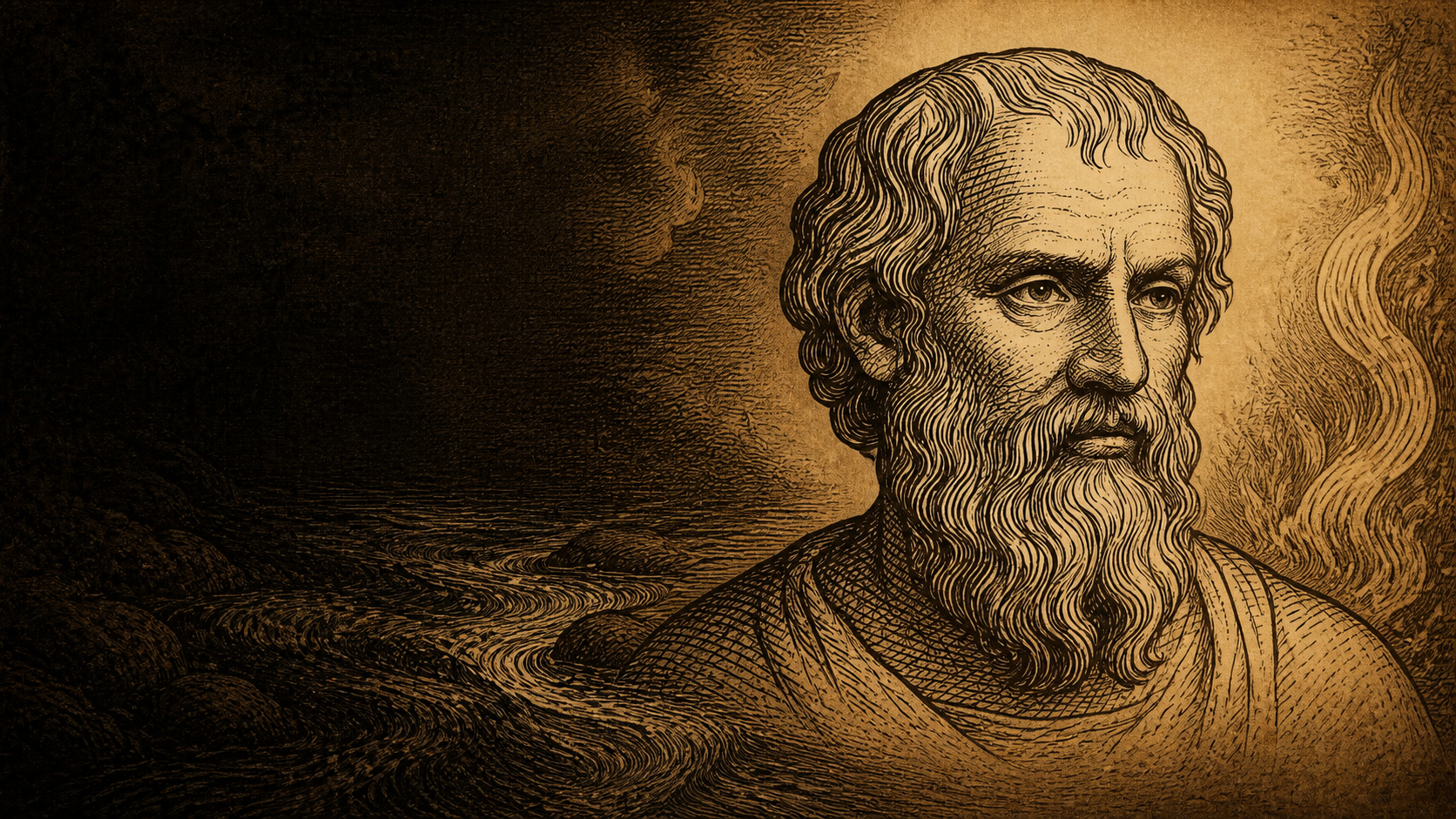
Sophocles – Classical form & fatalism
Theatre for Beginners is your honest doorway into the stage where civilizations learned to think out loud. In each episode, one writer and one living question: why does this still hit us in the chest? No jargon, no gatekeeping—just story, stakes, and the human choices that won’t sit quietly. You’ll meet the architects of drama and comedy from Athens to Edo to London: Aeschylus turning grief into law, Sophocles giving conscience a spine, Euripides dragging the sacred into the kitchen, Aristophanes laughing politics back to its senses, Zeami shaping silence, Shakespeare setting language on fire. You leave each episode with more than a plot; you leave with a tool—how to argue without cheating, how to spot a pretty lie, how to stand your ground without becoming stone. If you’ve ever felt theatre was for other people, this is for you: one clear voice, rich storytelling, scenes you can see in your mind, and the quiet conviction that old plays are not homework—they’re field guides for today.
This series lives inside the broader NOMOTO MEDIA catalog of eleven shows—your one-stop studio for starter-friendly, deeply researched journeys across ideas, history, and art. Alongside Theatre for Beginners you’ll find Western Moral Philosophy for Beginners, Eastern Philosophy for Beginners, Scientific Giants, Classical Music Giants, Filmmaking Giants, Writers of Note, The Presidents, AI – An Uncertain Future (Season 1: The Birth of the Mind), and Addiction – Not a Moral Failing, with the full slate of eleven titles available together in a single stream on the Selenius Edit master feed. One channel if you want everything in one place; individual feeds if you prefer to go deep lane by lane. Either way, the promise is the same: clean narrative, zero fluff, maximum signal.
Produced by NOMOTO MEDIA
He inherits a stage that has learned to argue in public and teaches it to balance on a knife. If Aeschylus is thunder cracking the air into law, Sophocles is the clear noon that shows the edges of things and refuses to blink. He comes of age in the confident decades of Periclean Athens, when the city rebuilds its temples and polishes its speech, when citizens learn to praise proportion, self-command, and lucidity. His tragedies carry that civic ideal into the mouth of fate. He accepts that the world has limits and that prophecy is not a rumor but a law of the landscape; he also insists that the dignity of a human being consists in meeting that law with clarity, measure, and unshakable speech. To say he perfects classical form is not to say he makes it cold. He turns the form into a vessel that can carry terror without spilling into rant. His heroes do not howl so much as hold their ground; their undoing is not noise but necessity. If Aeschylus shows a city inventing a court, Sophocles shows a person inventing a soul—conscience exposed under bright light, tested by the pressure of irreconcilable goods.
He does not advertise innovations, and yet the art looks different after him. With him the third actor becomes routine, which seems a mere statistic until you notice what it allows: triangles of force instead of duels, triangulated arguments where the entry of a witness or prophet shatters a neat contradiction and forces a second thought; a daughter against a king with a silent sister as pivot; a beggar-king negotiating for rest while a chorus and a civic leader listen; a wounded archer, a wily general, and a boy whose loyalty must be educated in real time. He trims the chorus without disgracing it. The odes are still music, still a thinking community, but they recede at crucial moments so that the spotlight—he would never use that word, but the effect is there—falls on a single face. His diction is clean the way marble is clean: every chisel mark carries intention. He avoids the compounding thunder of Aeschylus’ coinages, preferring a syntax that moves forward with judicial calm, until, in an instant, calm becomes verdict and the verdict arrives like a blade you could have seen all along if you had learned how to look.
The city in which he writes expects art to be a school of poise. He meets and challenges that expectation by showing poise inside catastrophe. There is a story of him, a youth with lyre leading a chorus that celebrated the victory at Salamis, the beautiful boy who grows into the measured master who will outlive nearly all his rivals. His career spans nearly the whole fifth century. He wins a first prize early and a final victory near the end; he writes more than a hundred plays; we have seven full tragedies, a ratio of loss to survival that would seem tragic if his own art had not prepared us to accept the world’s harsh arithmetic. Those seven are varied enough to show his full range: political, familial, sacred, skeptical without blasphemy, pious without credulity. Their common feature is a tension between two truths that will not merge. In his house, fatalism is not resignation; it is the conviction that reality has a shape that cannot be flattered out of existence, and character is the art of standing upright inside that shape.
Begin with the play that posterity has made the emblem of tragedy’s intelligence. Oedipus Tyrannus—Oedipus the King—is a clinic in how a mind, determined to know, unthreads its own life. The city of Thebes is dying of plague. The king who once saved it from a riddle saves it now, he thinks, by a new inquiry: find the source of the defilement and remove it. He is brave and efficient. He sends messengers, questions witnesses, consults a prophet, reconstructs a past. He swears he will punish the culprit whoever he may be, blind to the pronoun. The prophet Teiresias, old and unwilling, tries to refuse participation in a game whose prize is human ruin; the king’s impatience turns to insult; the prophet names the truth without naming it: you are the pollution you seek. To read the scene as an attack on reason is to misread the whole play. Sophocles is not sneering at inquiry; he is showing inquiry’s terrible integrity. Oedipus will pursue the thread all the way to his own body. One witness, then another; a shepherd who once pitied an infant; a messenger who thought he delivered mercy when he delivered destiny; a queen, Jocasta, who tries to stop the noise with the only decent lie a wife can tell: ignore the oracles and love me. He cannot. He discovers that the man he killed at a crossroads was his father, that the woman he married is his mother, that the sphinx’s riddle was easy compared to the one that governs him. He blinds himself, not to escape knowledge but because he now understands that seeing was not what he thought it was. Reason has not failed; it has fulfilled itself to the point of horror. The gods have not lied; they have allowed a clever man to walk into the truth he demanded, step by measured step. Sophocles arranges the plot so that every refusal to examine would have been a sin against the very pride we celebrate in Oedipus. His ruin is not stupidity; it is the nobility of a mind that will not let the city rot in convenient ignorance. Fatalism here is not fatalistic. It is the recognition that there are borders around human flourishing, and even a savior cannot redraw them without tearing the map.
Antigone takes the tension and puts it on a social hinge. Two brothers have killed each other in a civil war; one has attacked the city, the other defended it. Creon, the new ruler, announces a policy that sounds tidy enough for an edict board: the defender shall be buried with honor; the attacker shall lie unburied as food for dogs and birds. This is a rule about loyalty and deterrence. Antigone hears in it a desecration deeper than politics: to deny burial is to deny a soul the rites that make a human passage decent. She decides to bury her brother, Polyneices, or at least to cover him with dust enough to claim the moral ground. Her sister, Ismene, begs for prudence. Antigone refuses to subordinate piety to survival. Creon hears of the act—someone dared to contradict the city’s will—and reacts with the fury of a politician who recognizes that he is being asked to bend a rule for what looks like private sentiment. Sophocles refuses to make either figure small. Antigone is steely, not sentimental; Creon is stubborn, not monstrous, until the play teaches him the difference. Haemon, his son and Antigone’s betrothed, enters and tries to show his father that there is no cowardice in listening; Teiresias, again, arrives to tell a ruler that his neat policy is an abomination in the mouth of the earth. The chorus lean; the city feels what good men feel when law and decency part. Creon finally yields, but the delay kills: Antigone is dead, then Haemon, then Eurydice, his wife. The finale is not a sermon against law but a demonstration that law must be porous to unwritten justice. Fatalism is a word for the consequences that follow when a leader confuses a rule with the good the rule was meant to serve. Sophocles gives us, not a pamphlet about civil disobedience, but an anatomy of good intentions turned fatal by pride. In a city proud of its statutes, he reminds citizens that some statutes are older than stone.
If Oedipus the King is the study of knowledge as self-wounding and Antigone is the study of duty as collision, Oedipus at Colonus is the study of broken grandeur ripening into blessing. The blind exile enters the sacred grove at Colonus with his daughter Antigone, seeking a place to rest where the gods decree he should. He is no longer the sharp questioner; he is a man who has learned to accept that some days must be received rather than solved. The chorus are wary of a stranger; the Athenian king, Theseus, arrives and models a courtesy that is also policy: to shelter the wounded noble is to become noble; to receive a suppliant is to weave protection into one’s own walls. Relatives and enemies circle. Creon tries to seize the old man as a pawn; Polynices, the other son, comes to ask his father’s favor in an upcoming war—too late. Oedipus refuses the sham alliance; he has grown a new kind of authority: the right to say what shall follow from his body. The end is unlike any in Greek tragedy. There is no onstage death; there is a disappearance, a translation. Only Theseus is allowed to witness the precise passage; the chorus and daughters hear of it as a reverent rumor. Oedipus leaves a gift, a mysterious civic advantage that Athens will carry like a secret charm. A man once ruined by too much sight becomes, in the end, a saint of darkness. The fatal order remains—the past cannot be untied—but grace enters because the city that offers refuge earns a guardian. Sophocles closes the old story not by rewriting its curse but by teaching how to hold it until it ferments into protection.
Ajax stands at another angle to the same sun. He is the great warrior who, cheated of Achilles’ armor, loses his mind and slaughters cattle thinking they are the generals who wronged him. When he returns to clarity, shame is heavier than life. He chooses death, a thing Greek heroes often talk about and rarely enact with such spare inevitability. Tecmessa, his captive wife, pleads; the chorus fear; their child is displayed so that the audience feels what is at stake. The play’s second half is a dispute about burial, not unlike Antigone but motivated differently: Odysseus, the rival, ultimately argues for giving the enemy his rites, and in doing so he shows the largeness this theater prizes. Ajax’s suicide is not the verdict that the world is unlivable; it is the demonstration that honor codes can snap if they are too rigid to withstand ordinary injustice. Sophocles neither normalizes delusion nor sensationalizes it. He shows a warrior’s mind as a system that cannot absorb certain blows and shows a rival as a citizen who can.
Philoctetes is the most surgical of his moral experiments. On a desolate island lives a man abandoned years ago because his suppurating wound stank and his cries unsettled the crew. The Greeks have since learned that they cannot win at Troy without his bow, gifted by Heracles. Odysseus brings Neoptolemus, the son of Achilles, to fetch him. Odysseus asks the boy to lie, to trick the wounded man out of his weapon. The boy’s conscience recoils; the general’s strategy insists. The play is long because the pedagogy of conscience is long. Neoptolemus lies, then suffers in the lie, then confesses, then earns back a trust without deception, and in doing so he grows into something his father, for all his glory, did not model: ethical strength measured not by blows but by straight speech under pressure. Philoctetes is not a test dummy; he is a person whose pain gives him the right to hatred, and yet the play leads him toward a cooperation that is not coercion but consent. Heracles appears at the end not as a machine to fix plot but as a symbol of the calculus that has been worked through: go to Troy, not because gods say so, but because your suffering will be given purpose and your dignity preserved. In that equilibrium between ends and means, Sophocles draws the map of civic adulthood.
Electra gives the female interiority that earlier poets circled the force of a soul that refuses to go numb. She lives under the rule of her mother and Aegisthus, mourning her father and nursing a hope that borders rage. Orestes returns; the recognition scene is drawn with an ironic intelligence that undercuts easy credulity (Sophocles mocks the crude tokens of other versions and finds a more believable way to reknit siblings). The killing follows, as myth requires, but what interests the playwright is the tone of the survivors. Electra’s voice is both vindicated and marked by the years of torment that trained it; justice has been done, and yet the human cost sings in the register. Women of Trachis (Trachiniae) studies another mode of suffering: Deianeira, in good faith, tries to win back Heracles’ affection with what she has been told is a love charm; it is poison. The man whose strength symbolized a certain kind of heroic world dies of a shirt soaked in unintended malice. The play is quiet and devastating. Sophocles suggests—not with doctrine but with plot—that goodness without knowledge can still kill, and that in a world governed by limits, the margin for error around love is narrow enough to make prayer feel like proper engineering.
The chorus in these plays is a thermometer of communal sense, a barometer of fear and pity, a sounding board for the single figure at the center. Sophocles reduces its interventions compared to Aeschylus and uses them, increasingly, as lyric commentaries on the action’s moral weather. They sing of old laws that do not age; they sing of time, eros, rumor; they respond to rumor as neighbors do and then yield to the clarity of a person who has understood something they cannot. When Antigone speaks, the chorus’s odes are not canceled; they are outflanked. When Oedipus names himself the murderer, their balanced stanzas cannot balance the fact, and that imbalance is the point. Classical form is not a grid to compress life; it is the scaffold that lets life’s pressure be seen.
Dramatic irony is the term we use for the peculiarly Sophoclean effect in which the audience knows the thing the characters are working so hard to discover or deny. The result is not smugness; it is dread and instruction. To hear Oedipus proclaim that he will hunt the defiler and spare no one is to feel the city’s hope sharpened into a blade that will cut the man who wields it. To hear Creon lecture about order and loyalty is to feel the inevitable crack when order forgets mercy. Irony here is an ethical instrument: it trains the spectator to test their own declarations for the seeds of catastrophe. It also trains the city to value speech that permits reversal. One of Sophocles’ most consistent lessons is that leaders must keep a sentence left over in which to admit they were wrong. Creon’s tragedy is not that he makes a law; it is that he takes too long to translate evidence into amendment. Theseus, by contrast, hears and adjusts without losing face. Classical poise is not stubbornness; it is the grace to yield at the right pressure.
Religion in these plays is neither sentiment nor tyranny. Oracles speak and are obeyed, but Sophocles turns the very obedience into character study. Teiresias, the blind seer, is a figure who allows the theater to explore what it means to be told the truth and to reject it until reality bruises you into acceptance. Piety for him is not the dreary impulse to keep old rules as a fetish; it is the fresh effort to align action with a moral topography that existed before you were born and will exist after you are remembered. Antigone’s “unwritten laws” are not mood; they are an inheritance that prevents a city from becoming a machine. The gods in his plays do not rescue; they orient. Even Heracles’ appearance in Philoctetes is not a cheat; it is a dramatic way to summon the criterion by which a competing set of duties can be reconciled without humiliation. If there is fatalism, it is fatalism about the fact that you cannot make your own cosmos and be good; you can only be good inside the cosmos that already is.
The language is so transparent that moderns mistake it for simple. It is not simple. It is clarity achieved by filtration—a discipline that picks the exact word that carries the correct degree of moral temperature. Even his insults are instruments calibrated in a workshop. When characters slip into stichomythia, firing single lines back and forth, each line not only advances an argument but tests a seam in the other person’s mind, a seam that will tear in the next exchange. When the chorus breaks into a complex ode, the antistrophic balance lets the audience feel an idea unfold in matched turns, so that a concept like time, or love, or divine ordinance is experienced as moving air rather than as a dictionary entry. He writes so that actors can live; his sentences sit well in the mouth, which is why his plays sound right even when translated into clean English. The form is not aestheticism; it is ethics. A line that says the necessary thing in the necessary length is a model for leadership.
His Athens is not a backdrop; it is a participant. Oedipus at Colonus gives the city a flattering mirror: the generous reception of the suppliant, the steady Theseus, the promise that the stranger’s grave will shelter an empire. Antigone scolds the city in another mirror: your laws are impressive, but do you remember what they are for? Ajax shows a warrior culture learning, just barely, to respect an enemy once he is under earth. Philoctetes asks whether a coalition devoted to a great cause may still be wrong in its means. Electra wonders whether the necessary purgation of a palace can be accomplished without damaging the one who performs it. These are not antiquarian questions. Every constitutional democracy that tries to cultivate firmness without cruelty, rule without humiliation, steadfastness without deafness, is reading Sophocles in action whether it knows the name or not.
There are biographical stories, some tender, some comic, that attach themselves to his reputation. Late in life, his own son or heirs tried to declare him incompetent to manage his affairs. He is said to have read aloud from Oedipus at Colonus in court—the passage where the aged exile claims a dignity the world denied him—and won his case with literature as evidence that his mind was still sovereign. It is a fitting legend for a poet whose late work makes old age a sacrament. Another story has him dying after a feast, the swan singing after the last cup; it sounds like a joke the god of the theater would make about measure: even moderation ends, but it ends with a song. Whether true or not, the tales register what his city thought he represented: steadiness, brightness, humane authority.
His rivals sharpened themselves against him and him against them. Sophocles admired Aeschylus and was admired by Euripides; the trio form a spectrum that still maps our sense of dramatic possibility. Place the three on a line: Aeschylus, the liturgist of law; Sophocles, the sculptor of form; Euripides, the psychologist of ruptures. It is neat and false, but it helps you remember. The truth is that in Sophocles you can hear echoes of both: the weight of institutions is never far away, and the interior fracture is always present. What is distinct is the discipline of presentation. He refuses to fumble emotion. He believes that the finest respect you can pay an audience is to bring them to the edge of panic and give them, at that edge, a compass rose.
His tragedies survive because they are manuals for adult feeling. They tell you that grief can be carried if it is named, that law can be endured if it remembers what compassion is, that prophecy is not fatal if it is translated into patience and candor. They also tell you what to fear. Beware leaders who cannot reverse themselves, citizens who prefer ease to clarity, pieties that forget the gods they are meant to honor, zeal that makes cunning feel like virtue. Fatalism is not the counsel of despair here; it is the stern invitation to live without illusion. The gods are not managers. They are what remains when you have removed the flattery from your picture of the world.
Picture him in the theater he helped to define, watching his actors rehearse under a sky whose blue is a color for which later painters will ruin fortunes. He adjusts a line so that the meter clicks as a door should click; he notes where the chorus must lift its shoulders; he changes a word because the mouth of the boy playing Antigone cannot bear the old one without smudging dignity. He thinks of the jury of citizens who will tomorrow balance pebbles in their hands and decide whose art best trained them to be Athenians. He thinks of a plague in a neighboring city and of how easy it is for policy to become cruelty. He writes not because he despairs of his neighbors but because he loves them with the severity of a grown man. When the day arrives, and the sacrifices are made, and the people take their seats, and the messenger runs, and the prophet stands, and the king hesitates too long, and the girl decides swiftly and forever, and the odes weigh and weigh, and the old laws lift their faces, the city will have been altered slightly toward adulthood. The measure of the alteration will not be the votes; it will be the residues in thousands of chests—the acquired habit of clarity under stress.
That is his public legacy. His private one is harder to inventory because it lives in every artist who decides that form is not the enemy of feeling. A symmetrical stanza can carry panic better than a scream. A measured argument can carry justice better than a marching song. A quiet admission at the right moment can save a city months of funerals. He writes plays to teach the risk and the reward of admitting what is. When Antigone says she would not have done this for a husband or a child but only for a brother because parents are irreplaceable and husbands and children can, in her view, be replaced, Sophocles risks scandal to show how exact thought can be when it is free of flattery. When Oedipus insists on seeing even as he prepares to unsee, Sophocles risks disgust to show how costly truth is. When Neoptolemus decides to tell the truth and accept the loss that may follow, Sophocles risks a poor ending to demonstrate that endings can be saved by the means that reach them.
If the form sometimes feels austere to modern taste, it is because our public language has grown fond of either-or. He teaches both-and: both piety and compassion, both law and mercy, both prophecy and patience, both form and fire. Fatalism, in his hands, is a word for the iron frame without which a painting sags—an acknowledgment that not everything is negotiable. Inside that frame there is room for the entire human palette: pride that is almost grace, grief that is almost peace, love that is almost law, law that is almost love. To watch him is to consent to be straightened where we are bent by wishfulness and to be softened where we are crusted by certainty. He is the dramatist of moral posture.
When, at last, the chorus leaves and the last line settles into the dust, what remains is not an argument won but a way of standing available. The next time a leader believes that neatness is justice, there will be a memory of Creon. The next time a citizen imagines that private loyalty is enough and public consequence can be ignored, there will be a memory of Antigone’s rope. The next time a city considers whether to welcome a stranger exhausted by fate, there will be a memory of Theseus’s open hand. The next time a coalition calculates that a lie is efficient, there will be a memory of a boy on Lemnos who could not keep the bow and keep himself. These are not museum pieces. They are tools hung on pegs in a workshop we still use. Sophocles kept them sharp. We borrow them—quietly, every time we need to decide who we will be, citizens among citizens, eyes open.
He was not a genius sealed off from the city’s work. Between festivals he served in offices that made Athens tangible, counting coin and commanding ships, learning in ledger and harbor what plays later teach in speech. Tradition has him as treasurer when alliance money moved from island to city and as general with Pericles when Samos had to be brought to heel; whether every detail is exact, the shape is clear enough to matter. He knew the arithmetic of power from the inside—the way decisions spend sons as well as drachmas—and that knowledge steadies the poise of his tragedies. They do not bewail politics from a mountain cave; they accept that law is a tool made by fallible hands and then ask which hands are worthy to hold it.
A later philosopher, hungry to diagram the good play, reached instinctively for him. When Aristotle explains how tragedy works—how a plot turns back upon itself like a river finding its own source, how recognition slices through ignorance so cleanly that the wound looks like truth revealed—he points to the Oedipus story as if it were a theorem so elegant that every step teaches the mind to walk better. Sophocles gives him the vocabulary: reversal that is not a cheap jolt but the consequence accelerated, recognition that is not a party trick but the name finally attached to facts that were always present, fault that is not villainy but a characteristic kink in a good person meeting a world that does not bend to wishes. The praise is deserved and still not enough, because what the treatise cannot quite transmit is the temperature at which Sophocles works. He is so composed that readers mistake his clarity for coldness; in the theater that clarity feels like mercy. He will cut the knot, yes, but only after showing you how the strands were braided, who braided them, and why someone thought the braiding was wisdom at the time.
His heroes are often described as isolated, as if nobility required a stage of one. It is truer to say he isolates them in order to diagnose their dignity. Antigone is alone because love for the dead cannot be collectivized; you cannot outsource a sister’s fidelity to a committee. Oedipus is alone because the burden of knowledge, once shouldered, cannot be shared by a vote. Philoctetes is alone because pain has a locking mechanism only the sufferer can reach. Ajax is alone because shame builds its own walls faster than friends can knock. Electra is alone because endurance, when it refuses to go numb, makes a strange music others cannot hum for you. He gives each of them a city—chorus, counselors, rulers, friends—and then measures the distance that remains between a conscience and its neighbors. That distance is not misanthropy; it is the space in which character shows its outline.
Form, for him, is a tutor that never tires. He refuses to let a scene sprawl. He gives an argument one turn more than the audience expects—not to prolong agony but to expose the exact seam where change was possible and missed. Creon is offered several exits that leave his dignity intact; each delayed step becomes a line the city must memorize as a warning. Neoptolemus says the taught lie and feels it curdle in his mouth; Sophocles does not rush him to confession, he lets the nausea ripen into a decision so that when the boy tells the truth the theater can feel the cost. Oedipus could stop three questions earlier and still look like a savior; Sophocles brings him three questions further so that the audience learns that inquiry without remainder is heroism and hazard in the same integer.
He understands spectacle without letting spectacle exonerate anyone. The plague in Thebes is a picture you can smell, and the first spectators carried their own memories of epidemic and war; the contagion is not an allegory, it is a civic emergency that requires a ruler to act. The unburied body in Antigone attracts birds and scandal long before abstract law enters the mouth; disgust becomes policy only after feeling has told the truth. The wound of Philoctetes is not a metaphor that stands politely for something else; it seeps, it stinks, it interrupts speech and strategy with a timing only pain knows. Yet the gore, when it comes, is offstage. He refuses the cheap purchase of shock, conscripting the audience’s imagination as collaborator. A mind can see more cleanly than an eye at certain distances, and dignity survives better when viewers are asked to finish the picture inwardly. Even when he shows a death, it is the logic of the death he displays more than the physics. Ajax falls on his sword and you watch a code snap; the steel is only the instrument of a verdict long prepared.
There is, running through the plays, a confidence that the human being is a proper measure for things sacred and political. That is not the later, flattening humanism that makes the human the only scale. It is a piety of proportion. The gods speak intelligibly through creatures who can think; oracles are not crossword puzzles but difficult directions for a landscape with cliffs, and the right way cannot be smoothed to a tourist path without danger. Antigone’s stubbornness is not a tantrum; it is a translation of an old law into a present crisis. Oedipus’ inquiry is not curiosity dressed as policy; it is the ruler’s duty to cure a city with truth, even if the truth is ruinous to the doctor. Theseus’ hospitality is not sentiment; it is strategy that knows compassion can be security when practiced with intelligence. Sophocles does not pit piety against prudence; he insists the city becomes adult when it learns to practice both with one face.
We sometimes sort the three tragedians by their altitude relative to Olympus. Aeschylus’ sky is crowded with gods whose wills articulate the moral weather; Euripides tests the gods with dramaturgical experiments that smoke when they fail. Sophocles sits between them, neither intoxicated by providence nor theatricalizing doubt for its own spice. He treats divine ordinance as something sturdy and near, like a well-used table you only occasionally pause to admire. That is why infraction is costly: you are not breaking a theoretical statute, you are leaning against furniture that people eat from. Teiresias enters not as a magician but as a colleague of reality. His blindness is not a stunt; it is a way of staging the fact that knowledge sometimes arrives stripped of charm, spoken by a mouth that needs no flattery and will not supply any.
His dramaturgy trusts the audience to complete the poem. The most famous blinding in literature is narrated and imagined; Jocasta’s death is heard, not ogled. The chorus sees, cries, names, processes, and you discover that the city’s music is a language you already speak when you are honest among neighbors. The chorus is a marvelously flexible creature in his hands: a conscience that sometimes scolds and sometimes learns, a rumor mill that sometimes corrects itself, a choir that can carry a concept like time, or eros, or death in stanzas whose symmetry lets thought breathe. In Antigone they praise order and then falter as they feel the grain of decency running against an edict’s neatness. In Oedipus the King they move from civic hope to civic dread to a sober compassion that includes themselves in the failure; they wanted a savior so completely that they forgot to leave him a sentence for turning human again.
Staging details reveal his temper as precisely as his sentences do. The third actor, once introduced, is not an excuse for bustle but a way to create triangles of pressure that two-actor scenes cannot hold. With two actors a quarrel is a line with two ends; with three it becomes a figure that can suddenly widen or collapse. Antigone’s sister, often silent, lets the audience measure the distance between courage and rashness by the space in her eyes. A boy in Philoctetes becomes the needle by which an older man’s wound can be threaded into civic purpose without coercion. The prophet’s brief appearance shatters a ruler’s neatness with the simplest tool the stage possesses: a sentence spoken cleanly. Even the set acquires moral weight. A grove at Colonus is not “outside” but a sanctuary whose shade cools speech and elevates courtesy; a cave on Lemnos is not a prop but the geometry of a life cramped to fit pain. Whether or not he personally commissioned painted scenery, the feeling is pictorial; spaces have meaning before anyone speaks.
His women are among antiquity’s most intelligent not because he gives them modern slogans but because he allows them to act with full motive and mind. Antigone’s case is as rigorous as any statesman’s brief. Deianeira’s mistake in Trachiniae—trying to bind a famous husband’s wandering love with what she has been told is a charm—is the kind of error marriages make without malice; pity becomes respect when the theater refuses to sneer. Electra’s endurance is shaped by a logic of loyalty that the play refuses to belittle into hysteria. Tecmessa in Ajax speaks the plain prose of a woman who knows that a warrior’s honor code can slaughter a household as easily as an enemy. Sophocles does not fetishize female suffering; he writes women who think at the pressure that produces decisions.
What, then, is the fatalism laid at his feet? It is not the counsel to sit down and bleed. It is the recognition that a person is not the author of the entire script and that response—not authorship—is often where nobility lives. Antigone cannot rewrite kinship’s law; she can choose to honor it at risk. Oedipus cannot uncross the road where a father died; he can choose to drag the city through the truth rather than leave it to rot in ignorance. Philoctetes cannot turn his wound off; he can decide whether the weapon his pain guards will be used without dishonoring his pain. Ajax cannot live in a world where humiliation is unabsorbed; Odysseus can defend an enemy’s right to burial and in that action teach a society what largeness looks like. Fatalism is the iron frame inside which choice matters.
His endings resist cheap consolation. Antigone leaves a house littered by the cost of delay; no god cleans the floor while you sleep. Oedipus the King closes with a sentence carved over the theater’s exit like a lintel: count no life happy until you see how it passes out. Philoctetes ends with a cooperation that feels earned rather than granted, a reconciliation brokered by candor rather than slickness. Ajax ends with a burial that redefines enmity into community practice. Oedipus at Colonus ends with a blessing that cannot be coined into cash; it must be kept as a civic secret and used as a civic courage. These closures are not pessimism; they are adulthood. They send a spectator home fitter for work, not drunk on relief.
Because the art is so finished, people sometimes imagine it cannot travel. It does. The Sophoclean temperament turns up wherever law must look grief in the face without blinking, wherever policy must confess an exception and then write that exception into a procedure so future griefs do not require a hero to be cured. It travels into courtrooms: a judge who lets the fact of kinship bend a penalty without breaking justice is practicing Antigone without citing her. It travels into clinics: a doctor who refuses to sell an easy lie because an exact truth allows a real decision is repeating the courage of the boy on Lemnos. It travels into parliaments: a leader who can reverse himself before deaths pile up is what Creon should have been. It travels into households: a parent who can say “I was wrong” in time has understood Oedipus without the catastrophe.
It travels also into art beyond Athens. Shakespeare learns from him how to put a solitary figure under noon and let the world stand out around that shadow; Racine takes his lucidity and distills it into a crystal that cuts; moderns wrap themselves in psychology and then discover they are wearing his cuts. Yet no one improves on his moral poise. If you must carry a single sentence out of his theater into your day, carry this: form is the friend of truth. A measured line carries more justice than a marching song. A clean procedure carries more compassion than a tantrum. A ritual done without flattery keeps rage from becoming a god again.
He lived long enough to bury most of the men who fought the Persian wars and to watch a democratic empire learn the lessons empires learn late: that glory intoxicates and allies remember. The Peloponnesian War opened while he could still walk to rehearsal; plague taught the city what Thebes already knew; faction taught it what a chorus sounds like when it cannot agree on a beat. He did not make the stage a newspaper; he kept his art at the altitude where it can feed a city’s reserves rather than spend them. He refused slogans. He wrote sentences that can be carried into any century because they are exact rather than fashionable. He educated feeling into posture.
There are stories at the edges of his life that his city loved to tell because they match the shape of the work. Old and accused by heirs of incompetence, he supposedly stood and read from his new play about an aged exile claiming a sanctuary and won his case with literature as evidence of capacity. True or not, the anecdote is a portrait Athens wanted to hang: an old poet whose late music could still govern a room. Another story has him dying after a feast, a swan’s last song in a city that prized moderation; even if it is a joke the god of theater would make, it fits the man who taught an audience to carry wine without spilling it on the verdict.
If you want to understand his private bequest as distinct from his public one, consider your own speech under pressure. When you are tempted to give the easy sentence that will buy peace for an hour and debt for a year, hear Neoptolemus gag on a lie. When you are a ruler of five people for ten minutes and find yourself talking as if an edict were a sacrament, look at Creon’s wife and son and buy a shorter sentence. When you love someone whose wound will never quite close, read Trachiniae and stop inventing charms; practice the craft of patience. When grief knocks at your house with a request you think is illegal, ask if there is an older law running under your statutes and whether it can be honored without wrecking the walls. When your city wants a savior so eagerly that it does not leave him human room, remember that the best kings carry a sentence for abdicating in case the gods decide to teach.
He perfected neither certainty nor despair; he perfected stance. Ankles under hips, shoulders over ribs, jaw relaxed, eyes straight: the body knows the posture before the mind learns the ethics. He makes a citizen out of a spectator by teaching how to stand in bright weather that does not forgive mistakes. No one leaves a Sophoclean play thinking fate did everything; the plays return you to your choices with the clarity of noon. Fatalism in his hands is only the frame; the picture is craft—how to feel without lying and speak without flattering and yield without crumpling and persist without hardening. In that craft he remains a contemporary.
Picture the last rehearsal before festival day. The boys who will be girls are learning how to carry a woman’s intelligence without caricature. The man who will be king practices not the shout but the pause before the sentence that will cost him. The singer who will lead the chorus checks the pitch at which law does not sound cruel. The props are simple, the masks are clean, the doorway’s hinge has been oiled. He listens to a line, shaves a syllable, adds a breath, moves a cue four heartbeats later so that a recognition will arrive when even a distracted neighbor can feel its weight. He is doing the city’s physical therapy, joint by joint. Tomorrow the sacrifices will smoke, the crowd will sit, the first ode will call order out of noise, and the day will make adults out of people who would otherwise be left to learn at random. When the jars have received their pebbles and the wreaths their heads, and when the crowd dissolves into alleys in good weather, the change will be invisible. A few thousand bodies will carry themselves better. A few hundred sentences will be shorter and truer. A few decisions will bend at the right place before they break. That is how a poet governs without office.
He leaves seven intact rooms in a house once huge, and those rooms are enough to live in. You can sleep in Antigone when your world is too neat. You can study in Oedipus when you are tempted to quit before you know. You can tend wounds in Philoctetes when the lie looks efficient. You can bury enemies in Ajax when the city is forgetful. You can sit in the shade at Colonus when age needs its sacrament. You can stand in Trachiniae when love wants to manipulate. You can pace in Electra when endurance must be kept warm. The rest of the house is gone, but the plan is legible: a front door that opens to a civic square; rooms arranged around a court of air; a stair to the roof where citizens look out and remember that their walls protect not only their own beds but the neighbors’ as well. It is one of the great kindnesses of culture that this house still stands.
He taught a democracy to admire proportion without worshiping tidiness, to revere law without forgetting burial, to love truth without hating the human being who fails at it. In every age that wants its art to flatter and its politics to shout, he remains corrective: soft-spoken, exact, inflexible where it matters, flexible where it saves. If you listen carefully as the chorus exits and the dust settles, you can hear what he wanted left ringing in the air: not his name, not the god’s laughter, but a sentence held in reserve in case clarity arrives late—“I was wrong.” That sentence, placed in the mouth of power and practiced at home, is the hinge on which his city learned to turn. He gave it meter and dignity. We can borrow it.
Return to Transit