The Watcher
Elisa knew more about strangers than she knew about herself.
The city woke beneath her like an exposed nervous system. Trains pulsed through tunnels. Delivery drones rose from rooftops in ordered swarms. Street cameras turned their glass eyes toward intersections, storefronts, apartment entrances, and rain-darkened parks.
Every movement became data.
Most of it meant nothing.
A man walking too slowly. A woman entering a building through a side door. A child running from school at an unusual hour. The city’s surveillance system noticed these fractures in routine, compared them against years of accumulated behavior, and assigned each one a probability.
Danger.
Fraud.
Illness.
Distress.
Mistake.
Elisa’s job was to look when the machines were uncertain.
She woke with her cheek pressed against the observation console and the imprint of a keyboard along her forearm. Blue light filled the room. Around her, hundreds of minimized feeds trembled against the dark walls.
She had fallen asleep again.
A cleaning unit moved silently between the empty desks. Beyond the reinforced windows, dawn struggled through a ceiling of low clouds.
Elisa straightened in her chair and checked the time.
06:14.
Her shift had ended almost an hour earlier.
She was reaching for the logout control when a name appeared in the corner of her screen.
OSCAR REYES
IRREGULAR MOVEMENT
CONFIDENCE: LOW
The system had colored the alert gray. Not red for danger. Not amber for intervention. Gray meant ambiguity, the bureaucratic shade of probably nothing.
Protocol allowed her to dismiss it.
Her finger hovered over the command.
Instead, she opened the file.
A rain-blurred camera showed a man stepping from a city bus. He was tall, perhaps thirty-five, dressed in a worn brown jacket that had absorbed more water than it repelled. His umbrella refused to open. He fought with it briefly, then laughed to himself and took shelter beneath the awning of a closed bakery.
The camera adjusted focus.
Oscar Reyes.
Thirty-six.
Employee, Bellwether Books.
No criminal record.
No outstanding debt warrants.
No political-risk designation.
No known association with monitored organizations.
The system had flagged his route.
For six years, Oscar had traveled home from the bookstore along the same sequence of streets. That morning he had walked three blocks west before boarding a different bus.
Elisa requested contextual footage.
Oscar emerged from the bookstore forty minutes earlier. He carried a paper bag and stopped beside a woman sleeping beneath the transit overpass. The footage had no audio, but Elisa watched him remove something from the bag and give it to her.
Then he continued west.
That was all.
The system waited for her determination.
BENIGN DEVIATION, Elisa entered.
She should have closed the file.
Instead, she opened the previous day.
Oscar left his apartment at eleven twenty-three. He walked to work. He spent eight minutes outside an art-supply shop, looking through the window without entering. At seven forty-six he bought coffee at a waterfront café. At nine fourteen he returned home.
The day before that looked much the same.
And the one before that.
The life arranged itself around small repetitions: bookstore, café, apartment, Sunday call to his mother, occasional stop at the old library’s outdoor stalls.
Nothing about him justified further attention.
Elisa watched anyway.
At first she told herself she was checking for a pattern the system had missed. A route anomaly could indicate avoidance, coercion, illness, or preparations for an unrecorded meeting. She had seen harmless deviations become serious cases.
But Oscar’s movements remained ordinary.
That was what drew her back.
Most people arrived on her screens as threats or victims. The system reduced them to risk factors, behavioral deviations, probability bands. Oscar appeared without urgency. He moved through the city gently, as though he had accepted that no one was watching.
He paused to pet stray animals.
He held doors open for people who never looked at him.
He read while eating.
He sometimes stopped in the middle of a crowded pavement and stared upward, not at advertisements or drones but at the small portion of sky visible between buildings.
Elisa began looking for him between assignments.
Then during breaks.
Then after her shift ended.
By the end of the week, she knew that he bought inexpensive red wine on Fridays but rarely finished the bottle. He called his mother every Sunday at 18:17. He subscribed to three poetry journals and one historical review. He had applied twice for a loan to open a bookstore and had been rejected both times.
None of that belonged to her.
The city gave it to her anyway.
⸻
Her apartment seemed smaller after Oscar entered her life.
She arrived home each morning to rooms that contained no evidence of another person. No shoes beside the door. No dishes she had not used. No messages asking when she would return.
She had once enjoyed the quiet.
Now it sounded like absence.
Her parents lived on another continent and contacted her on major holidays through scheduled video calls. Her friendships had thinned gradually, not through conflict but through deferred invitations. The surveillance hub consumed nights, weekends, and the peculiar hours when ordinary people formed relationships.
Elisa had become an expert in other people’s lives by failing to build one of her own.
She heated frozen soup and opened a private terminal.
Accessing active surveillance outside the hub violated policy. The backdoor existed for emergencies and senior analysts, but no system prevented her from using it. The city trusted its watchers more than it trusted anyone else.
Oscar was home.
The camera across from his building showed the light in his front room. She switched to the domestic-network archive, telling herself she only wanted to confirm he was safe.
The interior feed belonged to an old municipal security program installed after a string of burglaries. Oscar had never disabled it.
He sat on the floor beside a low table, repairing the spine of a book. A record played somewhere outside the camera’s range. His movements were patient and precise.
Elisa watched for twenty minutes.
Then Oscar looked directly toward the camera.
She stopped breathing.
He could not see her. The lens was hidden inside a smoke detector. He was merely looking upward.
Still, Elisa closed the feed.
Her reflection stared back from the dark screen.
“What are you doing?” she whispered.
No one answered.
The following night, she opened the file again.
⸻
By the third week, Oscar’s life had become more familiar than her own.
She knew the park bench where he ate lunch. She knew which coworker made him laugh and which manager caused his shoulders to tighten. She knew he stopped at the art shop because he had once studied painting. His archived educational records revealed two years at an academy before the money ran out.
She found photographs of his student work.
Cityscapes mostly.
Windows lit against darkness. Lone figures beneath streetlights. Rooms observed from outside.
The similarity made her uneasy.
She closed the photographs, then reopened them.
Oscar painted people who did not know they were being seen.
Elisa wondered whether he would understand her.
The thought should have frightened her.
Instead, it became permission.
She listened to his calls.
Not every call. That distinction mattered to her, though it should not have.
On Sundays, his mother asked when he would visit. Oscar always said soon. Neither mentioned the cost.
A friend from the academy called once, drunk and successful, to invite him to an exhibition. Oscar congratulated him warmly, then declined.
After the call, Oscar remained at the kitchen table for a long time.
Elisa wanted to reach through the screen and tell him he was not invisible.
The cruelty of the thought struck her immediately.
She had made him visible without his consent.
Her supervisor noticed the open file several days later.
“Reyes again?”
Elisa minimized the feed.
“I’m checking the original anomaly.”
“The system closed it.”
“I know.”
“Then why are you checking it?”
“There were route deviations.”
“One route deviation.”
“He changed his nighttime purchasing pattern.”
Her supervisor, Lena Voss, studied her.
“Are you building a case?”
“No.”
“Then stop building one.”
Elisa forced a smile. “I’m being thorough.”
“Thoroughness without cause is surveillance for entertainment.”
The sentence landed harder than Lena intended.
Elisa closed the file.
For the rest of the shift, she processed alerts she could justify. A domestic disturbance. A stolen vehicle. A child wandering alone through a transit station.
At 04:30, when Lena left, Elisa opened Oscar again.
⸻
The system flagged a new deviation at 23:51 on a Thursday.
Oscar entered a supermarket he had never visited at an hour when he was normally home. He moved slowly through the aisles, placing instant noodles, bread, and a bottle of wine into his basket.
Elisa watched the feed with growing concern.
Concern was the word she used.
Oscar stopped beside the pharmacy counter and searched his phone. He selected a box of sleep aids, read the warning label, then returned it to the shelf.
Nothing happened.
He paid and left.
Elisa continued watching until he reached home.
She felt ridiculous.
Then ashamed.
Then relieved.
The following afternoon, she left the surveillance hub during her break and went to Bellwether Books.
The shop occupied the ground floor of an old stone building between a repair kiosk and a vacant theater. Its windows were crowded with handwritten recommendations. A brass bell chimed when Elisa entered.
The air smelled of paper, dust, and damp wool.
She had seen the store hundreds of times through cameras. Inside, it felt entirely different. Smaller. Warmer. Full of blind corners.
For the first time, she could not see everything.
Oscar stood near the rear shelves helping an elderly woman locate a detective novel. His voice was softer than Elisa expected.
“You were right,” he told the customer. “It does have a train in it. I was thinking of the wrong murder.”
The woman laughed.
When Oscar looked toward Elisa, she turned quickly and pretended to read the back of a poetry collection.
Her heart pounded.
This was absurd. She had watched him sleep. She had read his financial history. Yet being seen by him felt more exposing than everything she had stolen.
“Can I help you find something?”
He stood a few feet away.
Up close, he looked less composed. There were faint shadows beneath his eyes. A small scar crossed one eyebrow. His shirt cuff had been repaired by hand.
Elisa named the first poet she could think of.
Oscar considered.
“We had a copy last month. Let me check the back.”
He disappeared between the shelves.
Elisa almost fled.
Instead, she waited.
He returned empty-handed.
“Sorry. It’s gone.”
“That’s all right.”
“I can order it.”
“No, I was only—”
She stopped.
Only what?
Passing by?
Curious?
Conducting an unauthorized continuation of a closed surveillance case?
“Looking,” she finished.
Oscar smiled.
“That’s what bookstores are for.”
She left without buying anything.
Outside, rain had begun.
Elisa stood beneath the awning and understood that she had crossed a boundary cameras had allowed her to pretend did not exist.
Before entering the shop, Oscar had been an object of attention.
Now he had looked at her.
She had become part of the story.
⸻
She returned to Bellwether six days later.
This time she bought a book.
Oscar remembered her.
“Found your poet.”
He held up a used copy with a cracked blue spine.
“I thought it was gone.”
“Someone sold one back to us yesterday.”
Elisa accepted it.
Inside the front cover, a previous owner had written:
To know a person is to be surprised by them.
She nearly dropped the book.
Oscar noticed.
“You okay?”
“Yes.”
“Bad inscription?”
“No. Just strange.”
He glanced at the words.
“I like it.”
“Do you believe it?”
“That knowing someone means being surprised?”
She nodded.
“I think so. Otherwise you don’t know them. You’ve just decided who they are.”
Elisa closed the cover.
“How much?”
“Eight credits.”
She paid and left.
That night, she did not open his file.
She lasted until midnight.
⸻
Their first real conversation happened at the waterfront café.
Elisa had watched Oscar sit at the same table for months. It stood near the window beneath an antique lamp that cast warm light over his books.
That evening he kept looking toward the entrance.
Elisa knew no one was coming. She had checked his messages.
The knowledge filled her with such sudden disgust that she closed the feed.
Then she grabbed her coat.
The train ride to the waterfront took nineteen minutes. She spent every one of them considering turning back.
The café was nearly empty when she arrived.
Oscar sat alone with a paperback open before him.
Elisa approached.
“Mind if I sit?”
He looked up, surprised.
“The poetry woman.”
She laughed despite herself. “That sounds like a minor criminal.”
“I’ve seen worse.”
He gestured toward the chair.
She sat.
For several seconds neither spoke.
“You come here often?” Elisa asked.
The stupidity of the question nearly killed her.
Oscar smiled.
“Most Thursdays.”
“I’ve never been.”
That was the first lie.
There would be many.
They talked about books first. Then work.
Elisa said she worked in information analysis.
“What kind?”
“Patterns. Public systems. Safety data.”
“So you know everyone’s secrets.”
The joke was casual.
Elisa forced herself to smile.
“Only the boring ones.”
That was the second lie.
Oscar described the bookstore, his plans to open a shop of his own, his certainty that no bank would ever lend him enough money.
“You could sell online.”
“I like people wandering in without knowing what they want.”
“Algorithms are better at recommending books.”
“Yes.”
“Then why prefer people?”
“Because algorithms recommend what fits. A bookseller can hand you something that doesn’t.”
The inscription returned to her.
To know a person is to be surprised by them.
They stayed until the café closed.
At the door, Oscar said, “Maybe I’ll see you again.”
Elisa knew exactly where he would be the next day.
“I’d like that.”
⸻
For several weeks, she tried to build a relationship on top of stolen knowledge.
It was almost possible.
They met for coffee, walked through evening markets, and ate at a diner that never turned off its lights. Oscar told stories Elisa had already heard in archived phone calls. She practiced surprise.
Sometimes he revealed something she had not found.
He hated pears.
He had once wanted to become a stage designer.
He was terrified of deep water despite never having learned to swim.
These discoveries thrilled her disproportionately. They were proof that the system had not captured everything.
But even the innocent moments were contaminated.
When Oscar mentioned his mother, Elisa knew the illness he had not yet disclosed.
When he complained about money, she knew the balance of every account.
When he paused before entering the art shop, she knew exactly why.
She began avoiding the surveillance feeds.
Then checking them only after seeing him.
Then checking them before, telling herself she needed to know whether he was safe.
Once, Oscar canceled dinner because he felt ill. Elisa watched him through the apartment feed, curled beneath a blanket.
She sent a message:
Do you need anything?
He replied:
How did you know I was that sick?
She stared at the words.
You sounded bad earlier.
Another lie.
Oscar responded with a heart.
Elisa cried.
⸻
Lena confronted her on a Monday morning.
She closed the observation-room door and placed a file on Elisa’s desk.
Access records.
Oscar Reyes.
Hundreds of searches.
After-hours logins.
Domestic-feed retrieval.
Audio transcripts.
“You told me you closed this.”
Elisa said nothing.
“Why?”
“I don’t know.”
“That’s not acceptable.”
“I met him.”
Lena’s face changed.
“You what?”
“I met him outside the system.”
“Does he know?”
“No.”
Lena sat down slowly.
“Are you in a relationship with a monitored subject?”
“He isn’t monitored anymore.”
“You are monitoring him.”
Elisa looked toward the screens.
Lena lowered her voice.
“This is not curiosity. This is abuse of authority.”
“I know.”
“Do you?”
“Yes.”
“Then terminate all access and report the breach.”
“I’ll lose my job.”
“You should.”
The honesty stung.
Lena continued. “He has a right to know.”
Elisa shook her head.
“No.”
“Elisa.”
“If I tell him, it destroys everything.”
“Everything was built with information he did not choose to give you.”
“It became real.”
“Perhaps. But he never consented to the conditions under which it began.”
Elisa looked down at her hands.
“What happens now?”
“You have twenty-four hours to report yourself before I do it for you.”
⸻
That evening, Oscar met her on the steps of the old library.
The district had fewer cameras than most. Elisa had selected it unconsciously months earlier, then consciously after the guilt became impossible to ignore.
They sat beneath stone columns stained with rain and graffiti.
Oscar seemed unusually quiet.
“What is it?” Elisa asked.
He looked at her.
“You always know things.”
Her body went cold.
“What things?”
“Little things. When I’m upset. When I haven’t slept. You know where I’ve been even when I don’t remember telling you.”
Elisa’s hands tightened in her lap.
Oscar gave a nervous smile.
“Sometimes it feels like you’re reading my mind.”
The opportunity to lie opened before her.
She could laugh.
Touch his arm.
Say she was simply observant.
Instead she heard Lena’s voice.
He has a right to know.
“There’s a reason,” Elisa said.
Oscar’s smile disappeared.
She told him.
Not elegantly. Not in a confession designed to preserve sympathy.
She told him the city had flagged him. That she had opened his history. That she continued watching after the case closed. That she read his records and listened to his calls.
His face became still.
She told him she had seen him at home.
Oscar stood.
The distance between them became enormous.
“For how long?”
“Weeks before we met.”
“Weeks?”
“Yes.”
“And after?”
Elisa could not answer.
Oscar stepped down from the library stairs and turned away.
“After?” he repeated.
“Yes.”
He looked back at her.
The pain in his face was quieter than anger.
“You watched me while we were together.”
“I stopped.”
“When?”
She hesitated.
“That’s not an answer.”
“I tried to stop.”
Oscar laughed once, sharply.
“You tried.”
“I know what I did was wrong.”
“No, you know I found out.”
“I told you.”
“Because someone was going to report you?”
Elisa stared.
He understood from her silence.
“Jesus.”
“I was going to tell you.”
“When? After you knew everything?”
“I don’t know everything.”
“You knew things I hadn’t chosen to tell you.”
“I wanted to know you.”
“No.”
The word was immediate.
“You wanted to possess the uncertainty.”
Elisa felt tears rising.
Oscar continued.
“You knew where I went. What I bought. Who I called. You knew what I was going to say before I said it.”
“That isn’t true.”
“Isn’t it?”
He came closer, not threateningly, but with a terrible focus.
“You never gave me the chance to become someone you could discover.”
Elisa covered her mouth.
Oscar’s voice broke.
“Every time I told you something personal, was I telling you anything at all?”
“Yes.”
“How would you know?”
She could not answer.
“You had all the facts,” he said. “But you never met me.”
“I did.”
“You met a version of me you assembled alone.”
He turned and walked away.
Elisa remained on the steps until rain began.
For the first time since she opened his file, she did not know where Oscar was going.
The uncertainty felt like grief.
⸻
The investigation lasted three weeks.
Elisa confessed before Lena could report her. The department suspended her access, seized her devices, and interviewed every colleague who had worked near her.
She lost her position.
The city issued Oscar a formal notice explaining the unauthorized surveillance. It offered legal assistance, identity-protection services, and counseling.
Elisa wrote him one letter.
She did not apologize for being lonely.
She did not tell him she had loved him.
She described what she had done in plain language and accepted responsibility.
At the end she wrote:
I confused access with closeness. I thought knowing your patterns meant knowing you. It did not. I am sorry for taking away your right to reveal yourself in your own time.
She sent the letter without asking for a reply.
Then she deleted every private copy she had made.
The deletion took eleven seconds.
She had imagined it would feel like tearing down a building.
It felt like closing a window.
⸻
Months passed.
Elisa found temporary work cataloging municipal records that had already been made public. The job paid less and required no surveillance clearance.
She moved to a smaller apartment.
Without access to the city feeds, the world became opaque.
People entered buildings and vanished.
Trains carried passengers whose destinations she did not know.
Windows glowed at night without revealing the lives behind them.
At first, the uncertainty made her anxious.
Then it became beautiful.
She began walking without checking route predictions. She sat in cafés where she knew no one. She bought books because their covers interested her rather than because a recommendation system predicted satisfaction.
One Saturday afternoon, she returned to Bellwether Books.
She did not know whether Oscar would be working.
That was why she went.
The brass bell sounded.
Oscar stood behind the counter.
He looked up.
Neither moved.
Elisa almost left.
Then Oscar said, “Hello.”
“Hello.”
He seemed thinner. Or perhaps she had never seen him without the frame of a camera, a profile, a history.
“I can go,” she said.
“I know.”
She waited.
Oscar closed the book he had been reading.
“I received your letter.”
Elisa nodded.
“I’m not asking you to forgive me.”
“I know that too.”
Silence settled between them.
A customer browsed nearby. Someone coughed in the history section. Rain touched the windows.
Ordinary sounds.
Oscar came around the counter.
“How are you?” he asked.
Elisa opened her mouth.
No data prepared her.
No pattern offered the correct answer.
No file told her what he wanted to hear.
For the first time in years, she genuinely did not know what to say.
“I’m lonely,” she admitted. “But I’m learning not to turn loneliness into permission.”
Oscar looked at her carefully.
“That sounds difficult.”
“It is.”
He nodded.
“I’m angry.”
“You should be.”
“I also missed you.”
Elisa’s breath caught, but she did not move toward him.
Oscar looked past her toward the rain.
“I don’t know whether anything between us can be trusted.”
“I understand.”
“And I don’t want to become someone you monitor while pretending not to.”
“You won’t.”
“You can’t promise what you’ll never feel tempted to do.”
“No.”
The answer surprised him.
Elisa continued. “I can promise what I’ll do when I’m tempted.”
Oscar met her eyes.
“What?”
“Tell you. Leave. Ask for help. Anything except watch.”
He considered this.
Then he gestured toward the poetry shelves.
“We finally got the complete collection you asked for.”
Elisa almost smiled.
“I never really wanted it.”
“I suspected that.”
“Did you?”
“No.” His expression softened slightly. “I’m trying something new.”
“What?”
“Not pretending I know.”
He retrieved the book and handed it to her.
Inside the cover, the inscription remained:
To know a person is to be surprised by them.
Elisa ran her thumb beneath the words.
“How much?”
“Eight credits.”
“You already sold me this book.”
“You returned it.”
“I did?”
“After you confessed. You left it outside the shop.”
Elisa had no memory of doing so.
Oscar smiled faintly.
“See? I know something about you that you don’t.”
The joke was small and fragile.
It was enough.
She paid for the book.
At the door, Oscar spoke again.
“There’s a café nearby.”
Elisa turned.
“I know.”
The words escaped before she could stop them.
Oscar’s face tightened.
Elisa felt the old shame rise.
Then she shook her head.
“No. I used to know.”
He waited.
“Is it still there?” she asked.
Oscar looked at her for a long moment.
“Yes.”
“Do you go often?”
“Sometimes.”
“Would you like company?”
He did not answer immediately.
Elisa let the silence remain.
She did not search his face for a prediction.
She did not fill the pause.
At last, Oscar took his coat from behind the counter.
“One coffee,” he said.
“One coffee.”
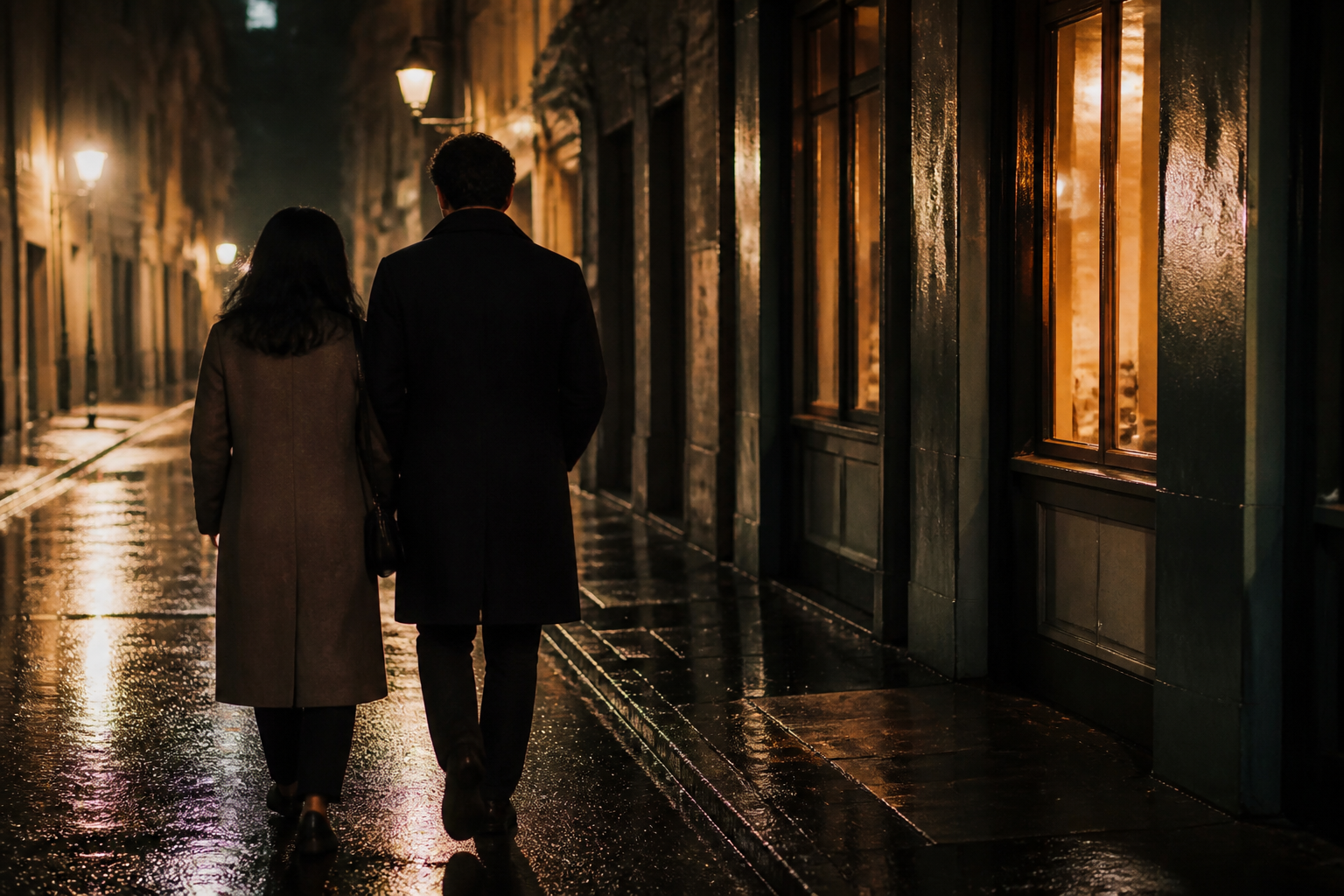
They stepped outside together.
The city watched them from a thousand lenses.
But Elisa did not watch Oscar.
She walked beside him, uncertain of what he would say next.
For the first time, uncertainty felt less like danger than possibility.
She had known almost everything about him before they met.
Now, finally, she might begin to know him.
Return to Transit